The Trust Multiplier: How the Best Leaders Scale Impact Without Burning Out
The Executive Summary
Scaling your impact isn't about working harder. It's about building trust-based systems that multiply leadership across your organization. This post covers why trust is the foundation of scalable leadership, how to turn delegation and prioritization into trust practices, what it takes to build leaders (not followers), and how to extend your influence beyond your direct team. You'll also get a self-diagnostic to pinpoint your biggest leadership bottleneck.
"If you want to do a few small things right, do them yourself. If you want to do great things and make a big impact, learn to delegate."
John Maxwell
Leadership is not about doing it all; it's about enabling others to succeed and amplifying your team's collective impact. But here's what most leadership advice gets wrong: it treats delegation, prioritization, and talent development as separate skills to master. They're not. They are all expressions of a single underlying capability, the ability to build and sustain trust.
Scaling as a leader requires letting go. And letting go only works when trust is in place, trust in your people, their trust in you, and the organizational trust that holds it all together.
The Real Bottleneck to Scale
Every senior leader hits a ceiling. Not a competence ceiling, but a capacity ceiling. The strategies that got you here (deep involvement, hands-on problem-solving, being the smartest person in the room) become the very things that hold your organization back.
The uncomfortable truth: you are the bottleneck.
The path forward isn't about time management hacks or better prioritization apps. It's about fundamentally shifting from being the person who does the work to the person who designs the system in which great work happens. And the operating system that makes this possible is trust.
A meta-analysis of 112 studies covering 7,700 teams found that trust was a stronger predictor of team performance than incentives or leadership style alone (De Jong et al., 2016). Google's landmark Project Aristotle reached the same conclusion: the single most important factor behind high-performing teams was psychological safety, a climate of trust where people felt safe to speak up, take risks, and own outcomes.
Before you can scale your leadership, you have to scale trust.
Why Trust Is the Foundation of Scalable Leadership
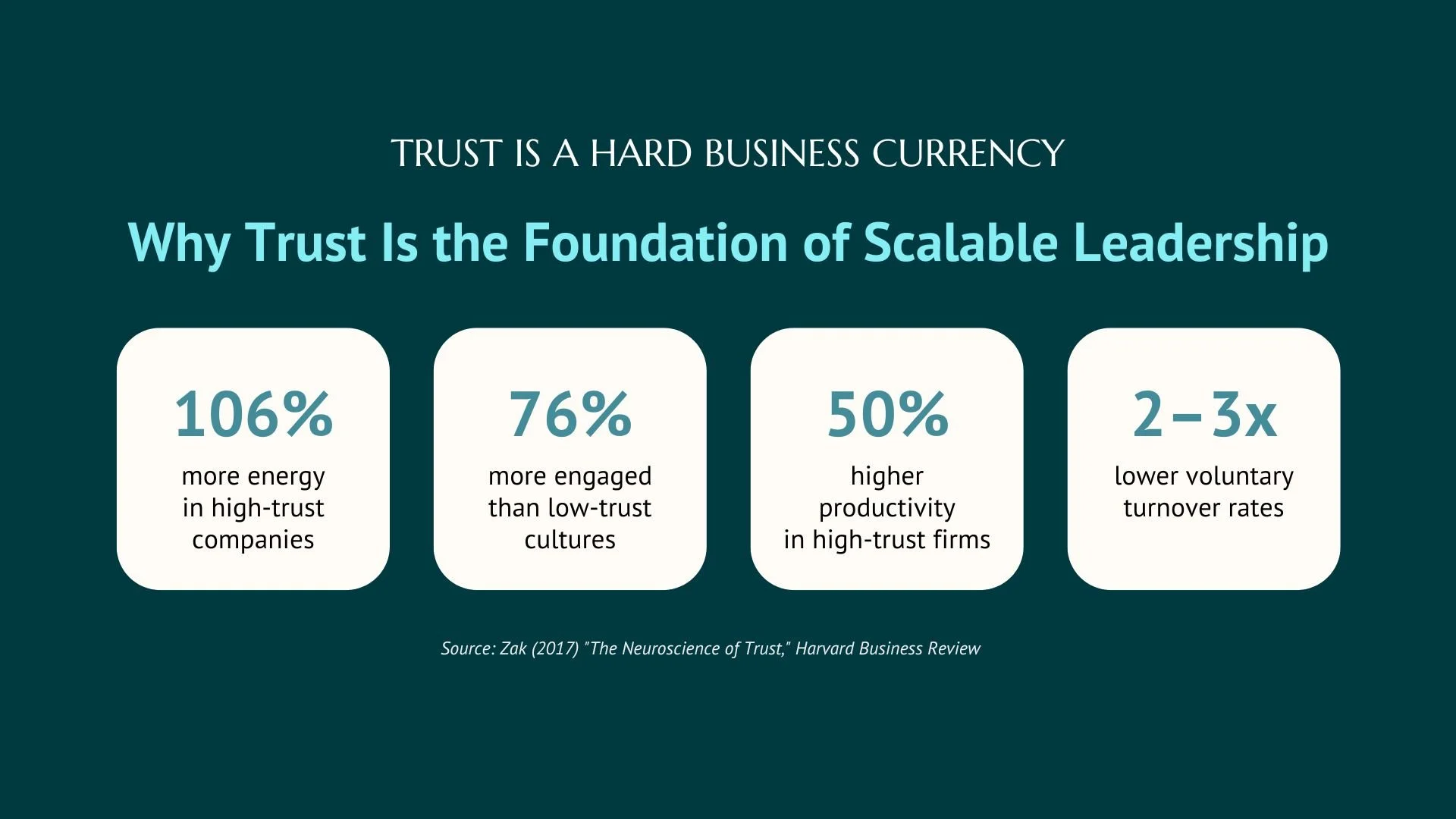
Trust isn't a "soft" virtue. It's a hard business currency and perhaps the strongest predictor of organizational performance we have.
For leaders trying to scale, these numbers tell a clear story: trust is the multiplier. Without it, every delegation becomes a bottleneck, every handoff becomes a risk, and every new initiative requires your personal involvement to move forward. With it, your organization accelerates.
The Trust Equation
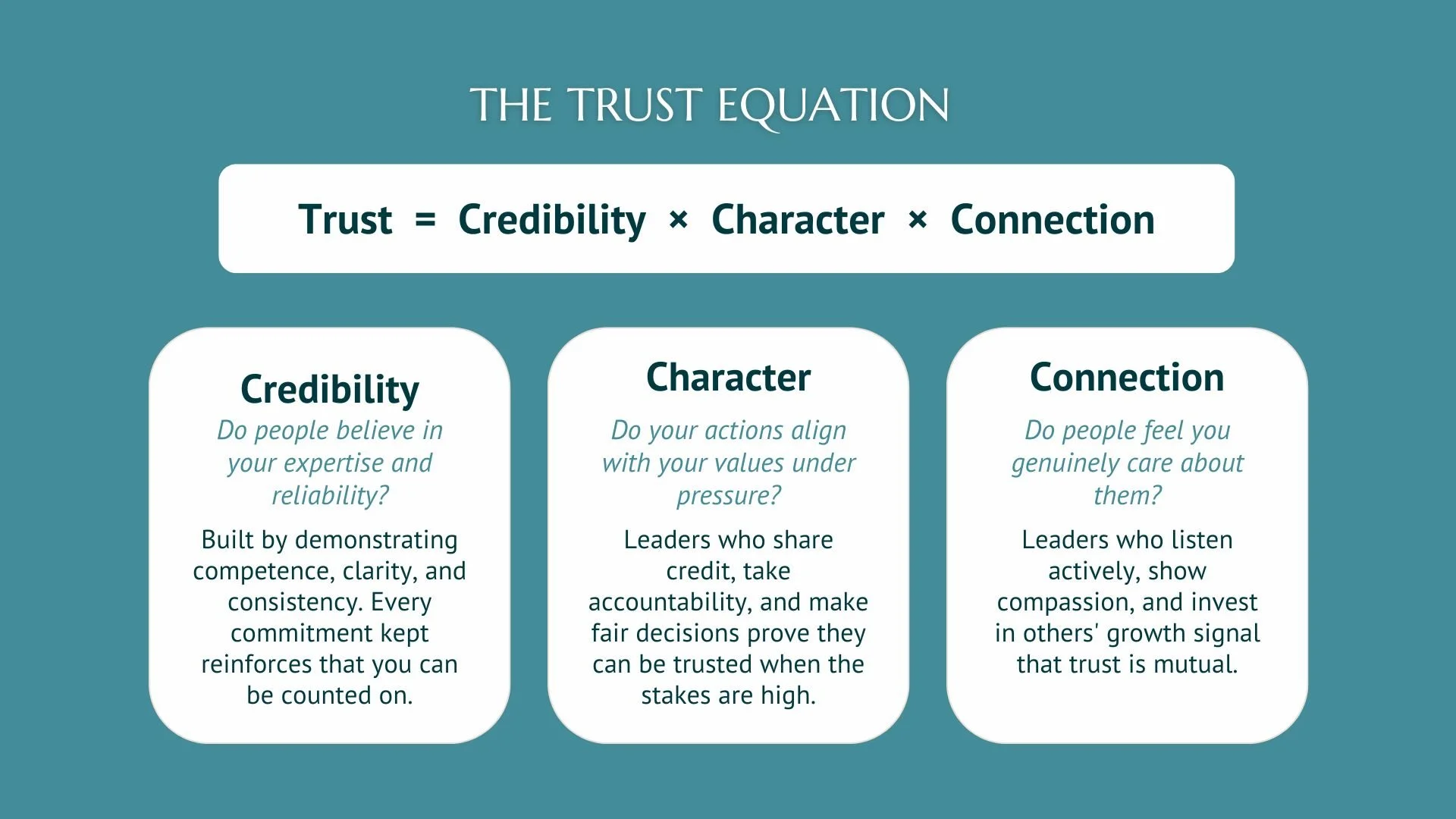
These three factors multiply together. If any one is missing, overall trust collapses. A brilliant leader who lacks character will be distrusted. A principled leader who never connects will feel distant. And a charismatic leader who isn't credible will quickly lose reliability.
This model aligns with Mayer, Davis, and Schoorman's (1995) foundational research identifying ability, integrity, and benevolence as the core dimensions of trustworthiness.
The critical insight for scaling: You cannot delegate effectively to people who don't trust you, and you cannot empower people you don't trust. Building all three dimensions is the prerequisite, not the byproduct, of scaling your leadership.
Delegation as a Trust Practice
Most leadership advice treats delegation as a task-management technique: identify tasks, assign them, and set deadlines. But at the executive level, delegation is fundamentally a trust practice, one that requires you to extend trust before it's been fully earned, and to create conditions where that trust is validated.
Consider Satya Nadella's transformation of Microsoft. He didn't just delegate tasks; he restructured trust. He dismantled the stack-ranking system that had pitted leaders against each other and replaced it with a growth-mindset culture where leaders at every level were empowered to innovate, fail, and learn. The result: a company that grew from $300 billion to over $3 trillion in market cap.
Nadella's approach addressed all three trust dimensions simultaneously: credibility through transparency about challenges and vision; character by modeling vulnerability and openly discussing his own learning; and connection by investing deeply in understanding what employees and customers needed.
Strategy 1: Executive-Level Delegation: Beyond Task Assignment
Delegate decisions, not just tasks.
The highest-leverage delegation is giving others the authority to make decisions you used to make. This requires clarity on decision rights, guardrails (not micromanagement), and a willingness to accept that others may choose differently than you would, and that's okay.
Delegate to strengths.
As Sheryl Sandberg emphasized in Lean In, recognizing and deploying unique talents is key to unlocking potential. When people work in their strengths, they need less oversight, trust becomes self-reinforcing. Gallup's research shows strengths-based management increases engagement by up to 73%.
Delegate with trust, not surveillance.
There's a difference between accountability and control. High-trust delegation means agreeing on outcomes, providing resources, and then getting out of the way. Trust that's felt, not just stated, is what unlocks discretionary effort.
Prioritization: Leading Through Strategic Restraint
"Deciding what not to do is as important as deciding what to do."
Steve Jobs
When Jobs returned to Apple, he cut the product line from 350 to 10. That wasn't just prioritization, it was a trust signal to the entire organization: we believe in our people enough to focus them on fewer things and expect excellence.
For executives, prioritization isn't personal productivity. Its organizational focus is creating clarity that cascades through every level.
Strategy 2: A Prioritization Framework for Senior Leaders
Strategic Value Filter
For every initiative, ask: Does this directly advance our top 2–3 strategic priorities? If not, it's a candidate for elimination or delegation, regardless of how interesting or urgent it feels.
Trust-Based Time Audit
Review your calendar weekly: Am I spending time on things that only I can do, or am I holding onto tasks because I haven't built the trust systems to let go? Leaders who do this honestly often find 40–60% of their time is spent on work others could own.
The "What Would Break?" Test
Before saying yes to anything, ask: If I don't do this, what actually breaks? Often the honest answer is "nothing", which means it's a candidate for delegation or elimination.
Building Leaders, Not Followers: Multiplying Your Impact
The ultimate test of scalable leadership isn't what happens when you're in the room; it's what happens when you're not.
Indra Nooyi, former CEO of PepsiCo, didn't just mentor emerging leaders; she created systems that developed leadership at scale: rotational programs, stretch assignments, and a culture where taking smart risks was rewarded. Her approach built a pipeline so strong that PepsiCo became known as a "CEO factory."
Strategy 3:Four Practices for Developing Leaders at Scale
Spot and stretch.
Identify team members with leadership potential and pair stretch assignments with support, not sink-or-swim. Trust grows when people feel challenged and backed.
Mentor through trust, not control.
Share your decision-making frameworks. The goal isn't leaders who think like you, it's leaders who think for themselves with the same rigor. As Edmondson's research shows, this requires environments where people can disagree, experiment, and fail without fear.
Build a feedback culture grounded in connection.
Trust-based feedback is direct, specific, and delivered with genuine care. It goes both ways: leaders who seek feedback from their teams model the vulnerability that makes trust possible. Zak's neuroscience research confirms it, when people feel trusted, oxytocin levels rise, driving deeper collaboration.
Recognize and promote trust behaviors.
What you celebrate, you reinforce. Recognize not just results but the behaviors that drive them: transparent communication, owning mistakes, developing others. When trust is visibly valued, it becomes organizational DNA.
Scaling Beyond Your Direct Team: Enterprise-Level Leadership
Managing your direct reports well is necessary but insufficient. The real challenge is scaling leadership through leaders you don't directly manage, across business units, geographies, and functions. This requires a shift from personal leadership to systems leadership.
Strategy 4: Design Trust Architecture
Your job as a senior leader is to create the structures, processes, and cultural norms that enable trust at scale:
Decision-making frameworks
Clarify who owns what, reducing ambiguity and political friction across the organization.
Communication rhythms
Keep information flowing transparently across silos. Opacity breeds distrust; cadence builds confidence.
Incentive structures
Reward collaboration over internal competition. Misaligned incentives are the fastest way to erode organizational trust.
Strategy 5: Lead Through Other Leaders
The most leveraged thing a senior leader can do is develop the leaders who develop others. Invest in your leadership team's ability to build trust within their own teams. Hold them accountable not just for results, but for how they lead.
Strategy 6: Influence Without Authority
At the enterprise level, much of your impact comes through influence, not control. Trust is the currency of influence. Leaders who have built credibility, demonstrated character, and invested in connection across the organization can mobilize resources and drive change far beyond their formal authority.
turnover, greater innovation output, and stronger profitability.
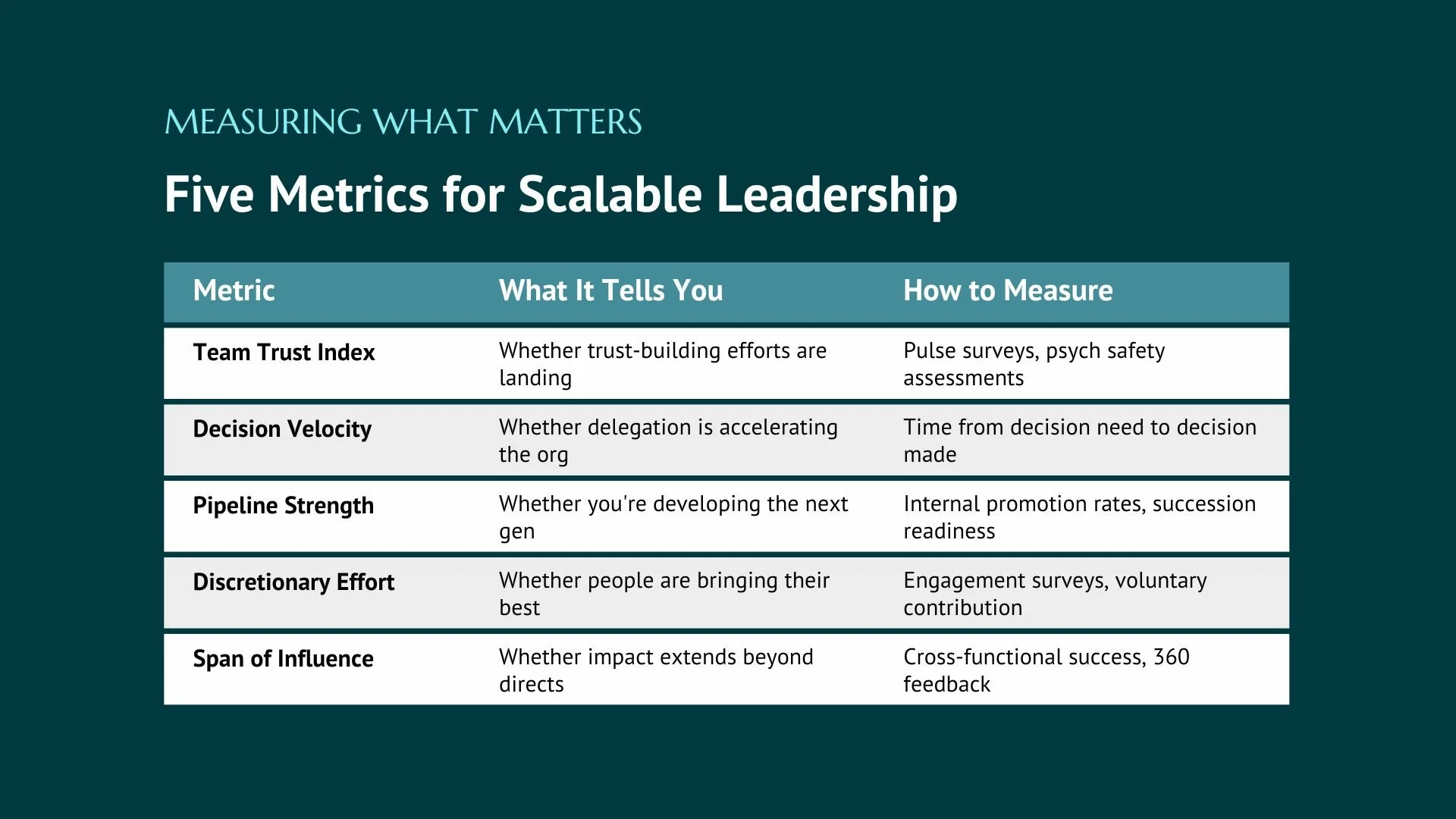
When these strategies work, you see it in the numbers: lower turnover, greater innovation output, and stronger profitability. But "it feels like things are working" isn't a leadership strategy. If you're going to scale trust, you need to measure it. Here are five metrics that tell you whether your leadership is actually multiplying, or just staying busy.
Overcoming Common Barriers
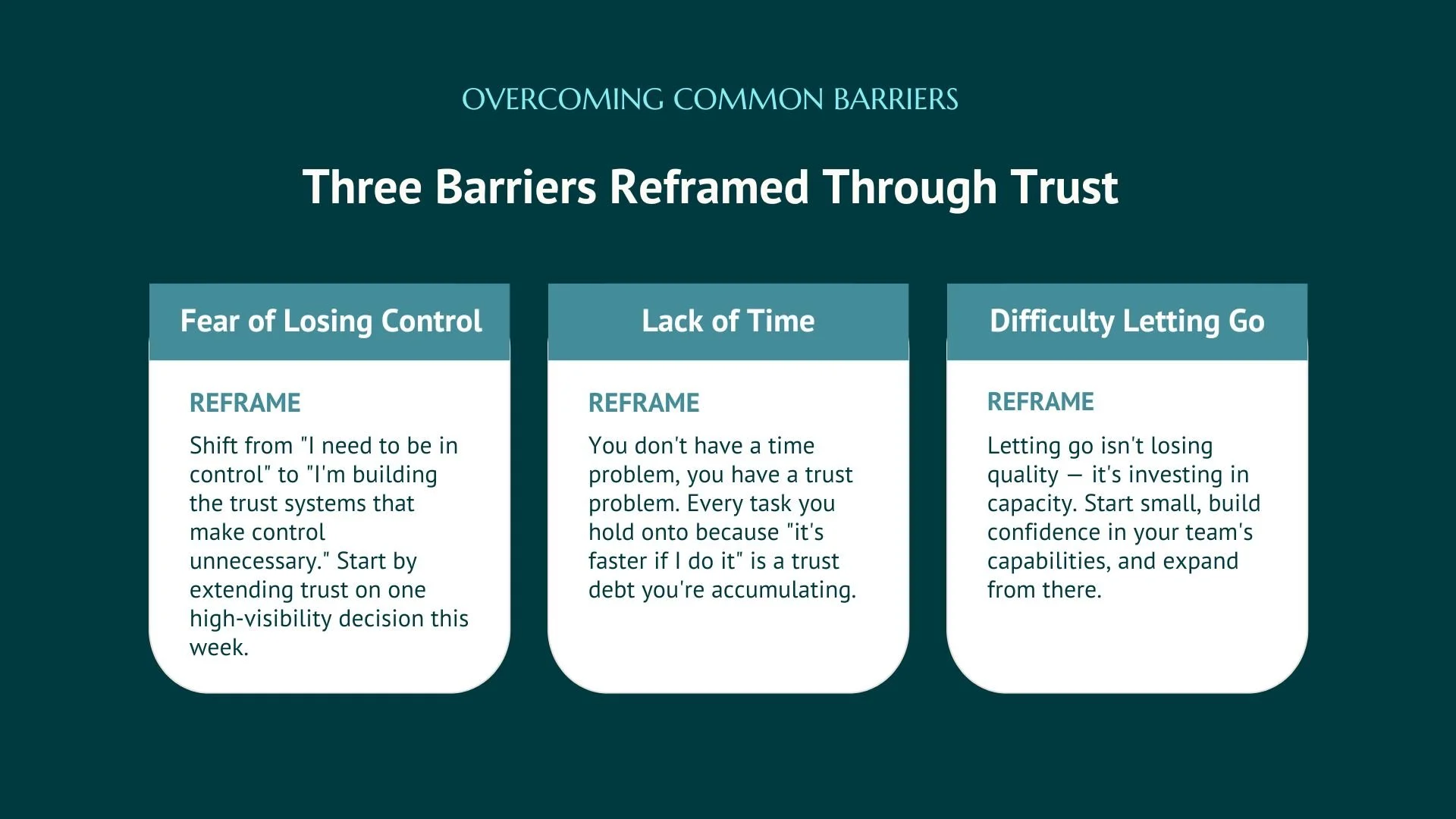
The biggest obstacle to scaling your leadership isn't your team's readiness. It's your own resistance. And that resistance usually sounds reasonable. "It's faster if I do it." "They're not ready yet." "I can't afford a mistake on this one."
But here's what the research tells us: leaders who hold on too tightly don't protect quality. They cap it. They create organizations that can never outperform one person's capacity.
Scaling requires you to confront the internal barriers that keep you operating as the ceiling instead of the foundation. The good news? Every one of these barriers becomes movable once you see it for what it really is: a trust gap you can close.
Self-Diagnostic: Where Is Your Leadership Bottleneck?
Frameworks are only useful if you know where to apply them. Before you build a plan to scale, you need an honest read on where your leadership is already multiplying and where it's stuck.
This diagnostic isn't about scoring well. It's about finding the one or two places where a shift in trust, whether in delegation, development, or letting go, would unlock the most capacity. Be honest with yourself. The number that makes you uncomfortable is probably the one that matters most.
Rate yourself honestly on each question (1 = rarely, 5 = almost always):
01 I delegate decisions (not just tasks) to my team regularly.
02 My direct reports could articulate our top 3 strategic priorities without prompting.
03 I spend 70%+ of my time on work that only I can do.
04 I have at least two people who could step into my role within 12 months.
05 My team takes smart risks without waiting for my approval.
06 I receive honest, critical feedback from my team at least monthly.
07 Leaders two levels below me make strong decisions without my involvement.
08 I invest time weekly in developing other leaders (not just managing them).
Answer Key:
32–40 Scalable leader. Focus on extending trust systems enterprise-wide.
24–31 Solid foundation.You're likely the bottleneck in 1–2 areas.
16–23 Stretched thin. Start with one high-impact delegation this week.
8–15Capacity ceiling hit. Address trust gaps in credibility, character, or connection first.
Your Leadership Legacy
"Value is measured in the total upside of a business relationship, not by how much you squeezed out in any one deal."
Mark Cuban
Scaling your leadership is ultimately about the legacy you create. Not the deals you closed or the projects you delivered, but the leaders you built, the trust you cultivated, and the organizational capacity you left behind.
The leaders who scale best understand that trust is not a byproduct of good leadership; it is good leadership. When you deliberately cultivate credibility, character, and connection, you unlock discretionary effort, the willingness of people to go above and beyond because they want to, not because they have to.
That discretionary effort, multiplied across an organization, is the ultimate competitive advantage. It's the one thing competitors can't easily replicate.
The question isn't whether you can scale your leadership.
It's whether you're willing to build the trust that makes it possible.