Much of my coaching is with experts: senior leaders and specialists who are very good at what they do. Many of them share a habit. They judge the value of their work by the effort they put into it, so they over-prepare, over-deliver and still leave unsure it was enough.
Most professionals will recognise some version of this. A presentation gains a fortieth slide the night before. An email is rewritten five times before it goes out. A meeting gets replayed on the drive home, and the parts that went well barely register while the one awkward moment plays again and again.
The case: when credibility becomes the measure
The case below is a composite of how this shows up in coaching. I will call her Dana. Dana is a senior director and the person colleagues call when a problem is hard. She was promoted for always knowing the answer, and she now leads a team of twelve. Credibility is how she measures herself. When she feels unsure, she reaches for more of it: more preparation, more content, another answer. She came to our session the day after leading a half-day planning session with her team, at the end of a hard week. She was pleased with the first half and unhappy with the second, and she wanted to work out what had gone wrong.
Me: What are you measuring the second half against?
Dana: I didn’t get through two sections of the plan. I was tired, and I didn’t give them as much as I wanted to.
Me: What did your team say?
Dana: They said it was useful. I think they were being polite.
Me: What would you need to see to believe them?
Dana: That I gave them enough. That it was worth their morning.
Me: How do you usually know you have given enough?
Dana: Honestly? When I’m exhausted.
We stayed with that answer for a while. Underneath it was a belief she had carried since early in her career: that she had to earn her place in the room every single time, and that being the one with the answer was the proof. The belief had served her well. It made her prepared, thorough and trusted. It also meant that under pressure, her energy went into looking credible. Listening, asking and leaving the team room to think were the first things to go. In the second half she was tired, so she talked more and asked less.
There is a reason credibility is the one people reach for. In the Trust Formula we use, trust is credibility times character times connection. Credibility is the part you can show in a single meeting. Character and connection build over time and are harder to see in the moment, so when a leader is anxious, credibility is the part they can prove right now.
What the data let us talk about
Her team had already told her the session was useful, and she had put it down to politeness. If I had told her she was credible, she would have put that down to politeness too. What made the conversation possible was data. Earlier in the year, Dana’s team, peers and senior leaders had completed the Leadership Trust Audit®, which rates a leader on credibility, character and connection, and she had rated herself on the same items.
Her team rated her credibility as her strongest score, and she rated it as her weakest. On connection it was the reverse: she rated herself well, and her team rated it as her lowest. Their written comments asked for the same thing in different words: more time to work problems through with her before she gave them the answer. Her extra effort was going to the part of trust that needed it least, and because the parts multiply, more credibility could not make up for the gap in connection.
Self-check: when you feel unsure in a meeting, what do you reach for first, another answer or another question?
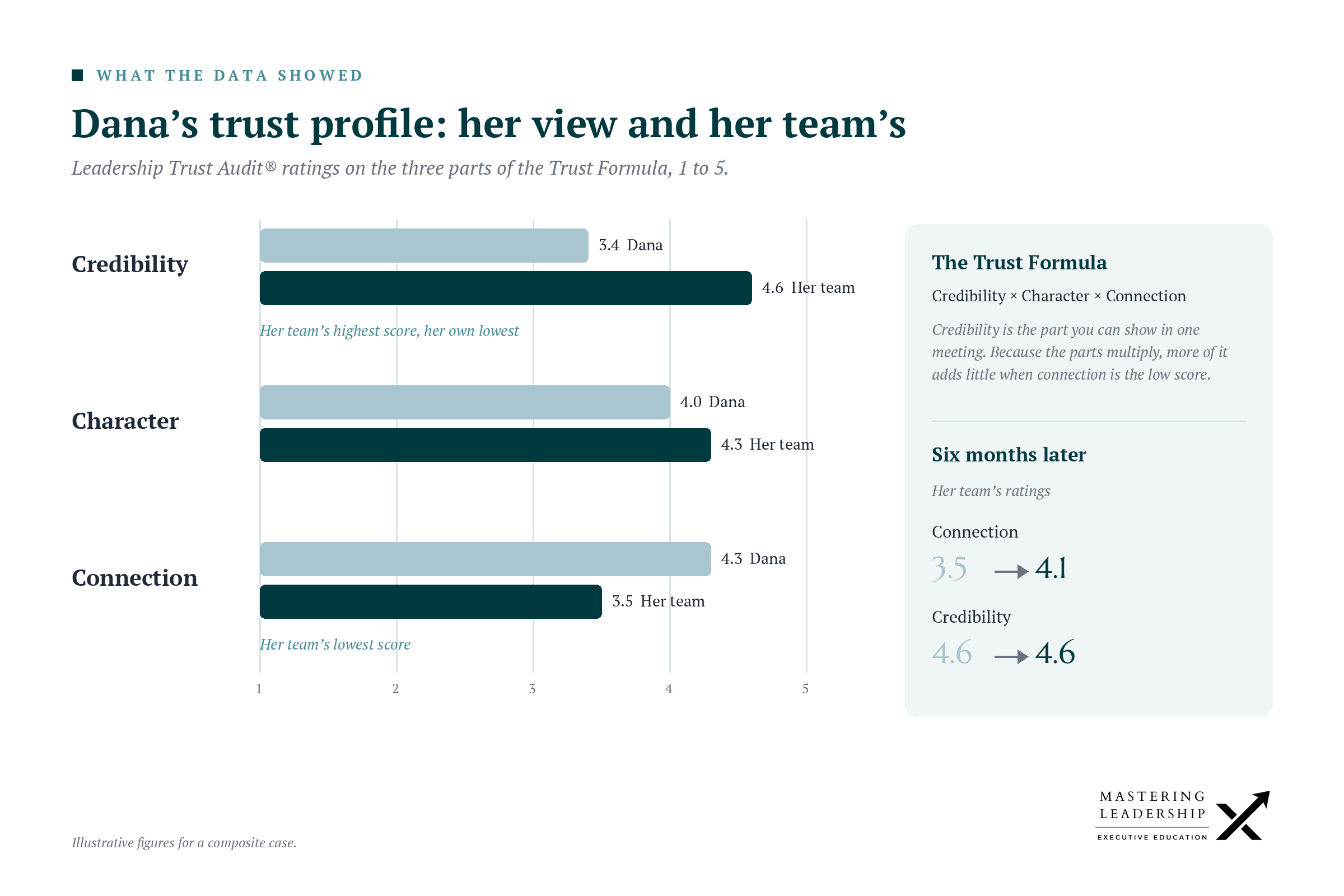
Then I asked what one person on her team would do differently next week because of the second half. She had an answer straight away. She had been measuring the session by what she gave. Her team was measuring it by what they could use. We agreed on one change: in each meeting, she would ask one question and wait before giving her own view. Over the next month she tracked what someone told her they would use after each meeting, and the list grew quickly. When her team rated her again six months later, her connection score had gone up, and her credibility score had not moved.
Self-check: what would one person on your team say they will use from your last meeting?
Why it is a problem
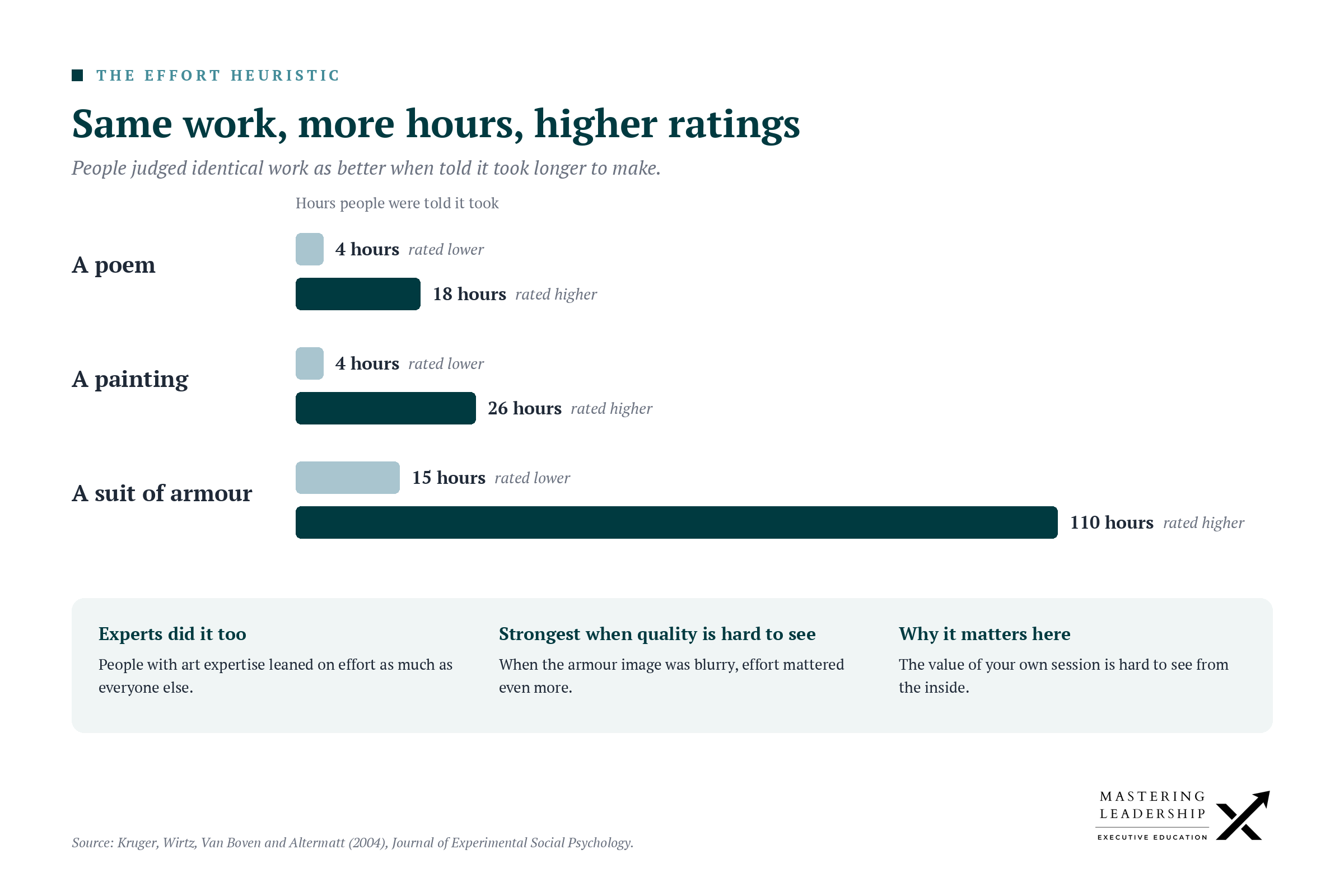
Psychologists call this the effort heuristic. In a 2004 study, Justin Kruger and his colleagues found that people rated a poem, a painting and a suit of armour more highly when they were told more time and effort had gone into making them. We use effort as a stand-in for quality, and we apply the same rule to our own work.
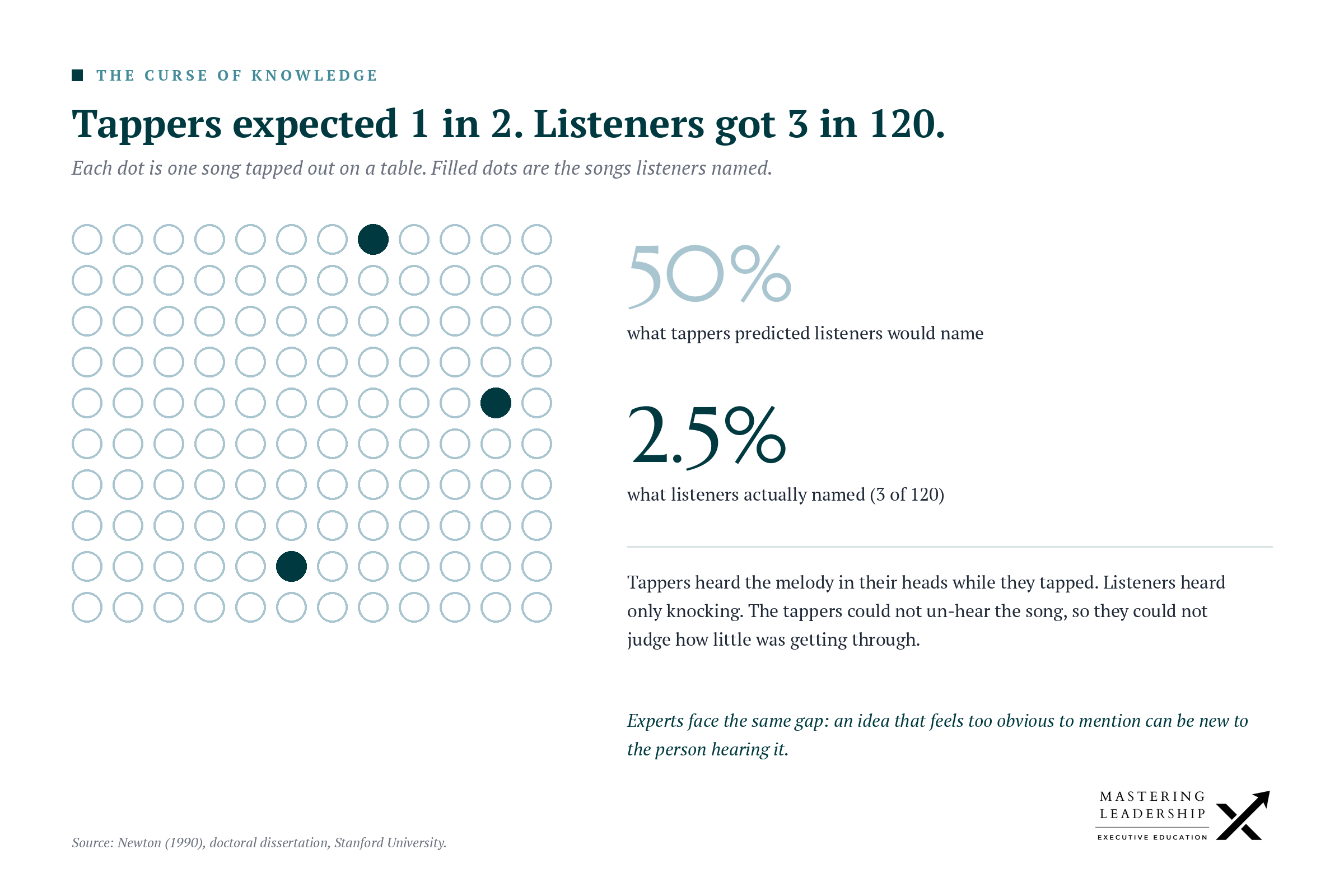
Expertise makes the rule less reliable. Economists call it the curse of knowledge: once we know something well, we lose track of what it was like not to know it. In Elizabeth Newton’s study at Stanford, people tapped out the rhythm of a well-known song and predicted that listeners would name about half of the songs. Listeners named 3 of 120, or 2.5 per cent. For an expert, the insight that takes one sentence feels too obvious to count, while for the person across the table it may be the most useful thing they hear that month.
We are also poor judges of how our contributions feel on the receiving end. In a 2018 study, Amit Kumar and Nicholas Epley asked people to write a letter of thanks to someone who mattered to them. The writers consistently underestimated how surprised and pleased the recipients would be, and overestimated how awkward it would feel. The same gap shows up after a session: the person delivering it reads it as less valuable than the people who received it.
The cost falls on the expert first. When self-worth rests on performance, it rises and falls with every result. Jennifer Crocker and her colleagues followed students applying to graduate school and found that those whose self-worth depended on academic success had larger drops in self-esteem on the days they were rejected. For an expert who measures by effort, every session becomes a small verdict.
It also affects the people the expert is trying to help, and the organization around them. A fuller session leaves them less room to think, so the session feels thinner, and the expert adds more again. In a team, this shows up as a bottleneck. When the most credible person in the room always supplies the answer, decisions wait for her and the team learns to bring problems to her instead of working them through. Dana’s planning session took roughly 48 hours of her team’s time. How much of that time they spent thinking is a better measure of the session than how much she covered. For the expert, the loop is also a path to exhaustion. In Give and Take, Adam Grant describes research showing that people who give without protecting their own time and energy are the most likely to burn out.
Self-check: in your last long meeting, how much of the time did your team spend thinking, and how much listening to you?
The mindset shift
Part of Dana’s shift was seeing the standard she was using. She judged the second half of her session against the first half, which was her best, and she did it at the end of a hard week. Her standard tracked her best performance, whatever the conditions. She would never have held someone on her team to that.
I see the same pattern from the other side of the table. When I review coaching transcripts for the moments where people said what they valued, the big moments rarely come up. People credit a phrase they used in a hard conversation, one distinction that changed how they saw their work, a script they finally used. Most of them mention it weeks later, at the start of the next session, and nobody mentions how much was covered.
For an expert like Dana, that is the shift. Much of what helps people most costs the expert a sentence. After years of study and practice, what feels easy to her can be exactly what someone a few stages behind needs.
The value of a session sits with the other person: in what they understand, decide and do afterwards. It is measured in their terms.
People also keep what they work out for themselves. In a 1978 study, Norman Slamecka and Peter Graf found that people remembered words they had generated far better than words they had simply read. An insight the other person reaches carries further than one handed to them, so holding back can help them more than adding another idea.
Self-check: what standard did you hold your last hard day to, and would you hold someone on your team to it?
Tools to apply
Test the feeling against data. Treat “that wasn’t enough” as a hypothesis. Compare it with what others report: evaluations, follow-up results or a 360 assessment. Act on the evidence.
Name the outcome first. Before a session, write down the one thing the person should leave with, and judge the session against that. It gives you a measure that sits outside your own effort.
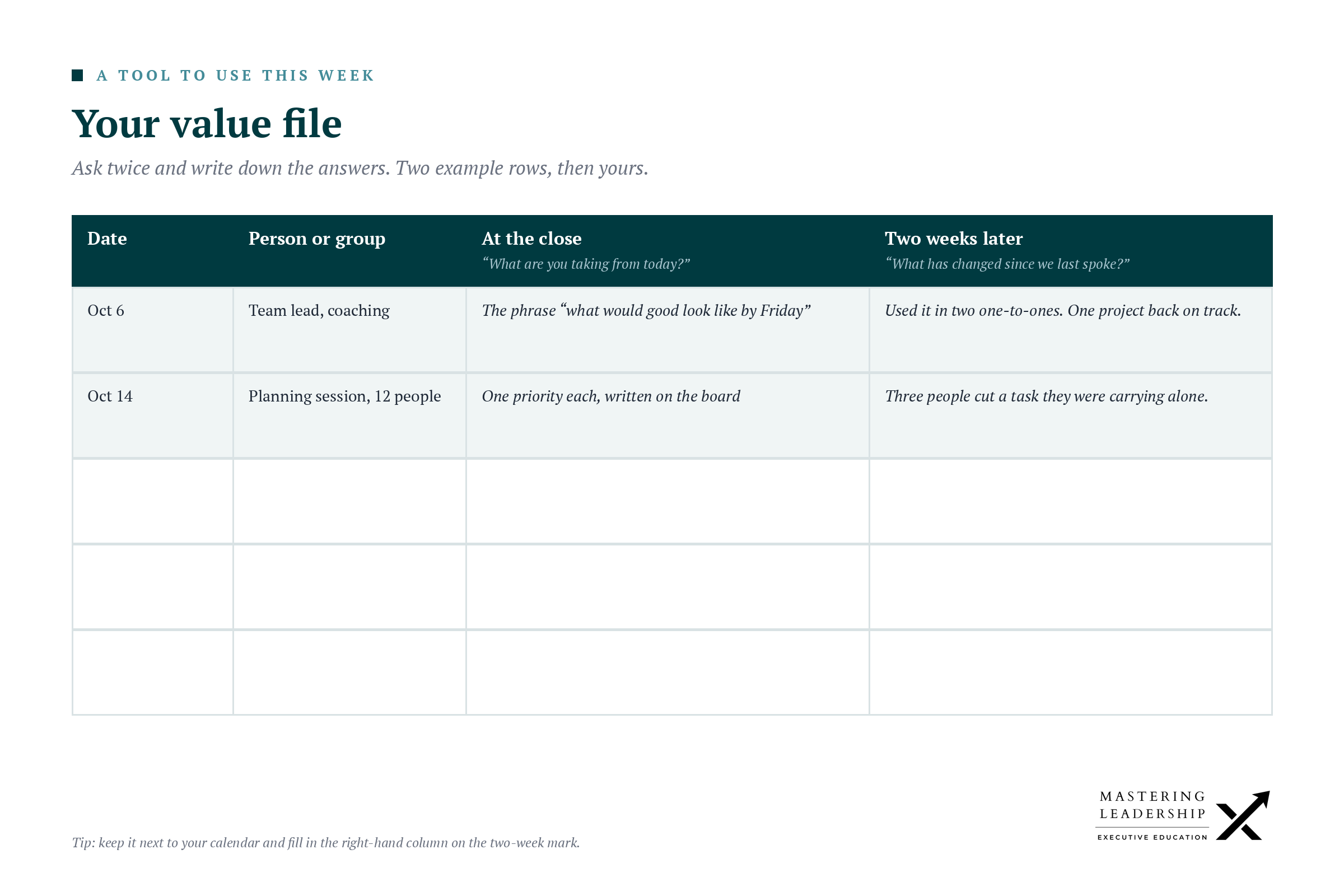
Ask twice. At the close: “What are you taking from today?” Two weeks later: “What has changed since we last spoke?” The first answer is the score for the session. The second is where most of the value shows up.
Give less, and leave room. Offer one idea, ask one question and wait. What the person works out for themselves is what they keep.
Keep a value file. Write down what people tell you they used. Left to memory, you will underestimate your impact, just as the letter writers did.
Review hard days in three parts. What worked, what you would change and what was outside your control. A hard week is a condition of the session, and it belongs in the third column.
What the data makes possible
We keep the data through the whole program: the baseline Leadership Trust Audit® ratings, the written comments, what leaders tell us they used after each session, and a second measure at the end. That record is what makes the harder conversations possible. Dana could set aside her team’s kind words and her coach’s reassurance. Ratings from her whole team, set beside her own, were harder to set aside. With the numbers in front of us, we could talk about where her effort was going, what it was costing her team and what to change first, and then check whether the change worked.
About MLX
Mastering Leadership Executive Education (MLX) is a Toronto-based leadership development firm. Science-led and trust-centred, we design and deliver executive programs, workshops, and coaching for organizations across banking, government, policing, and the nonprofit and creative sectors. Our work is built around the conversations that actually move organizations: trust, accountability, negotiation, feedback, and the difficult ones leaders avoid. Every program is grounded in peer-reviewed research and customized end to end: our in-house AI platforms, including the Leadership Trust Audit®, tailor the diagnostics, content, and coaching support to your people and your context. Then it is practiced on your real situations, not hypotheticals, which is why it still holds on Monday.
If your most credible leaders are measuring their value by effort, that is exactly the work we do. Contact us and we’d love to start a conversation about how we can help.
References
Camerer, C., Loewenstein, G., & Weber, M. (1989). The curse of knowledge in economic settings: An experimental analysis. Journal of Political Economy, 97(5), 1232 to 1254.
Crocker, J., Sommers, S. R., & Luhtanen, R. K. (2002). Hopes dashed and dreams fulfilled: Contingencies of self-worth and graduate school admissions. Personality and Social Psychology Bulletin, 28(9), 1275 to 1286.
Grant, A. (2013). Give and Take: Why Helping Others Drives Our Success. Viking.
Kruger, J., Wirtz, D., Van Boven, L., & Altermatt, T. W. (2004). The effort heuristic. Journal of Experimental Social Psychology, 40(1), 91 to 98.
Kumar, A., & Epley, N. (2018). Undervaluing gratitude: Expressers misunderstand the consequences of showing appreciation. Psychological Science, 29(9), 1423 to 1435.
Newton, E. L. (1990). The rocky road from actions to intentions (Doctoral dissertation). Stanford University.
Slamecka, N. J., & Graf, P. (1978). The generation effect: Delineation of a phenomenon. Journal of Experimental Psychology: Human Learning and Memory, 4(6), 592 to 604.