The Problem You Are Solving Is Probably Not the Problem
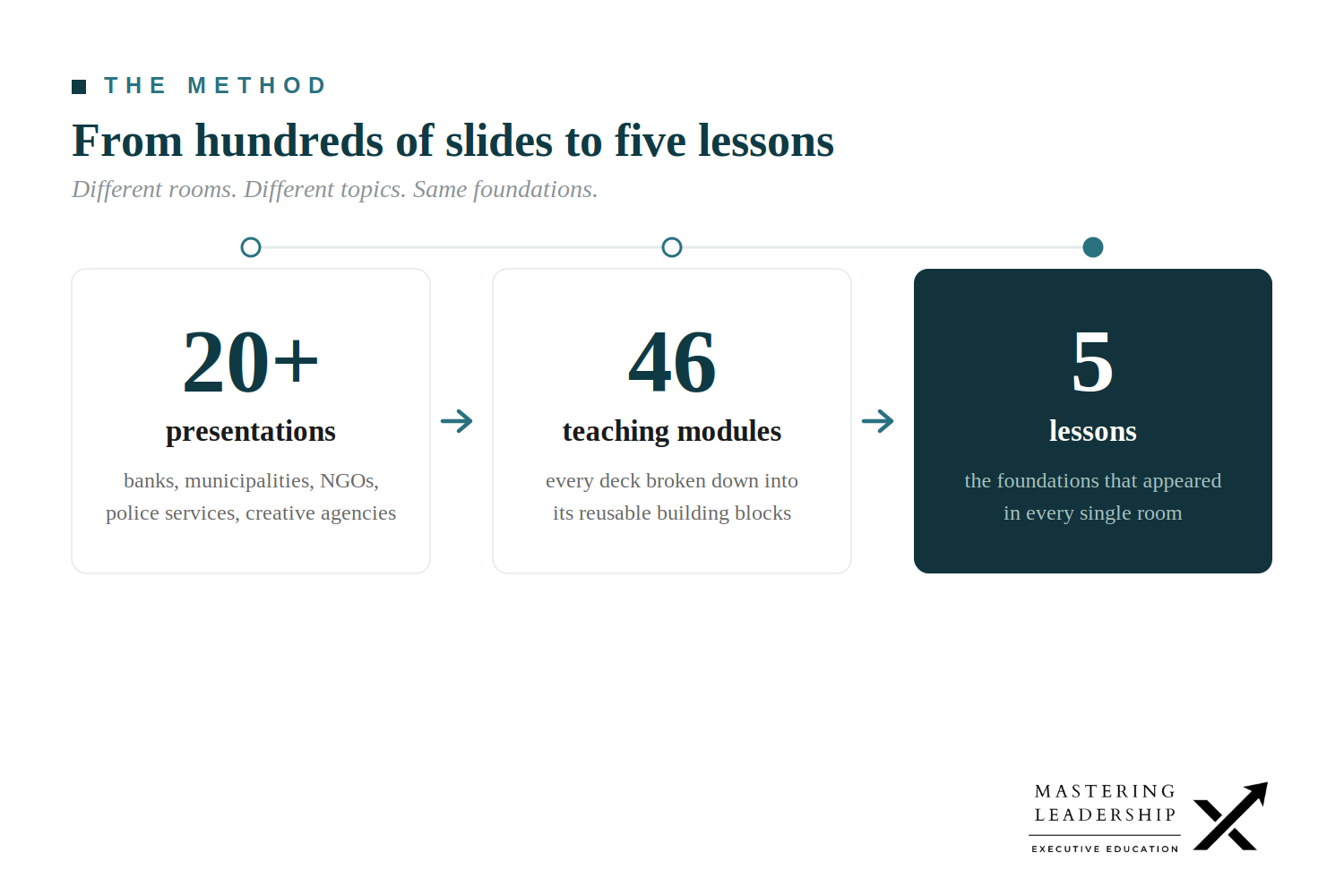
I audited 20+ of my own leadership presentations, delivered everywhere from banks and municipalities to NGOs, police services, and creative agencies.
On paper, the topics had little in common: trust and negotiation, feedback and coaching, difficult conversations and performance conversations, storytelling and change.
Underneath, every single room was circling the same five lessons.
I did not go looking for this. The audit started as an operational project. I was standardizing my teaching library, breaking years of client programs down into modules so my team and I could design future workshops faster and more consistently. Housekeeping, essentially. But when you lay hundreds of slides side by side, stripped of their client logos and industry examples, something becomes impossible to ignore. The topics were different. The rooms were different. The problems were not.
This piece walks through the five lessons, the research underneath each one, and a self-check you can run against your own leadership this week. Because here is my working theory after seeing the pattern this many times: the problem a leader thinks they are solving is usually one layer above the problem that is actually running the show.
Lesson one: a results problem is usually a trust problem
The request that comes into my inbox is almost never about trust. It is about a stalled negotiation, feedback that does not land, a change initiative that keeps meeting quiet resistance. Leaders arrive wanting better technique. And technique matters. But when we trace the stall back to its source, we land in the same place again and again: the relationship carrying the work cannot hold the weight being placed on it.
The research has been telling us this for decades. Mayer, Davis, and Schoorman's foundational model (1995) shows that trust rests on perceived ability, benevolence, and integrity, and that when any of those wobble, cooperation degrades long before anyone names it out loud. Maister, Green, and Galford (2000) put it in an equation practitioners can use: credibility, reliability, and intimacy build trust, while self-orientation divides it. A zero anywhere in the numerator zeroes the whole thing, no matter how elegant your strategy deck is.
In practice, this means the diagnostic question is not "what is wrong with our approach?" but "what is the state of the relationships this approach depends on?" I have watched technically excellent plans die in rooms where that question was never asked.
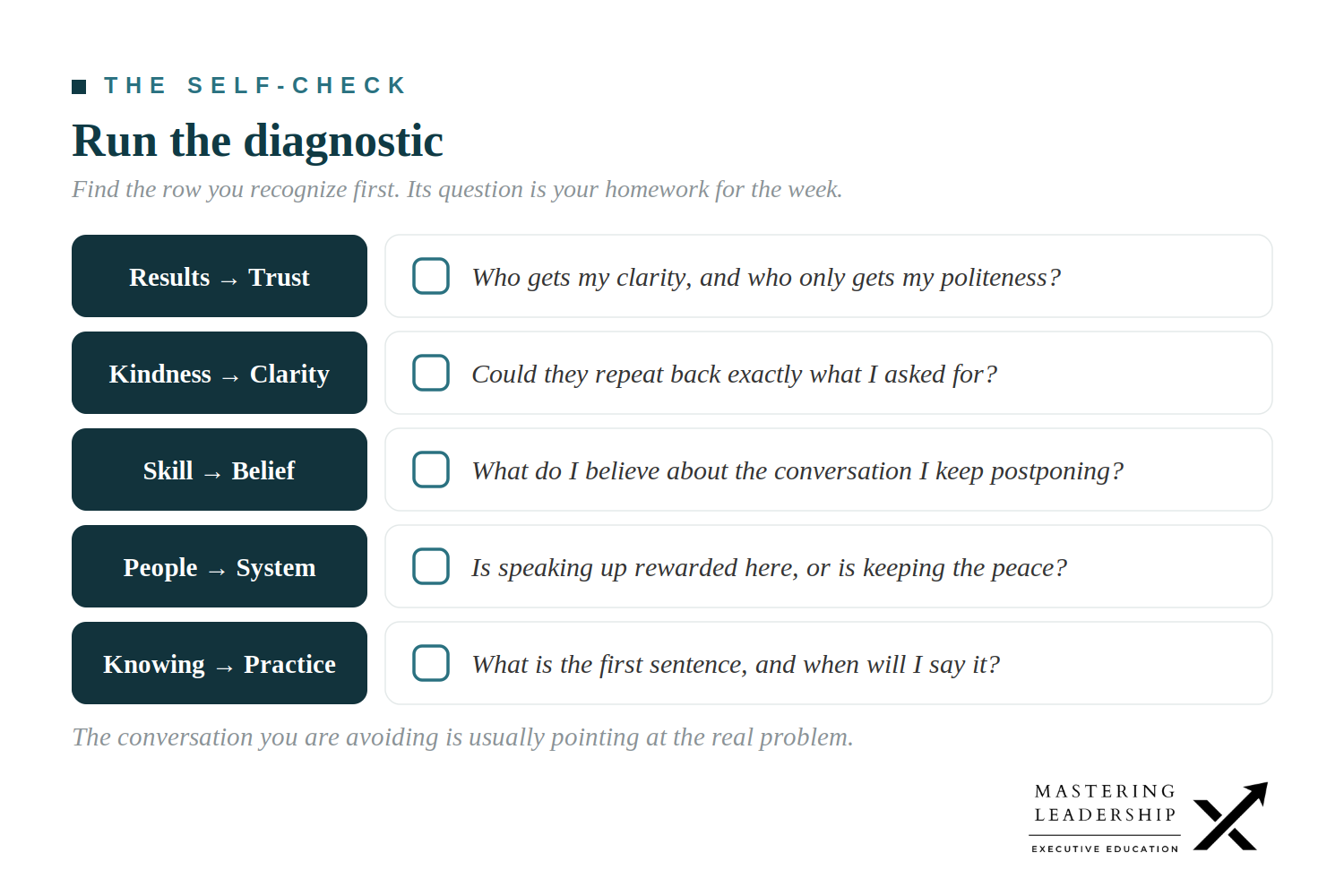
Self-check: who on my team gets my clarity, and who only gets my politeness?
Lesson two: a kindness problem is usually a clarity problem
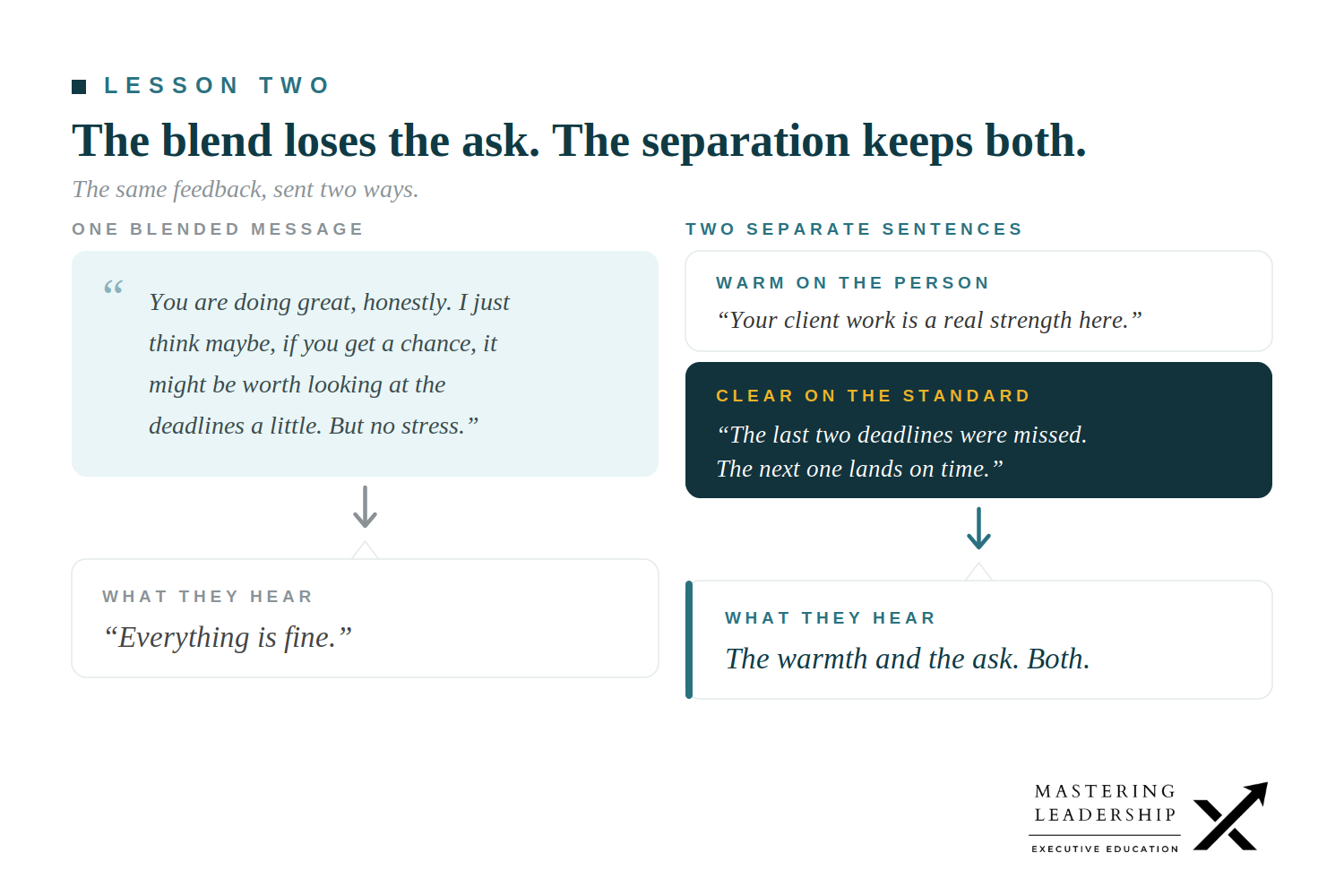
This is the lesson that draws the most nervous laughter in workshops, because everyone recognizes themselves in it. A leader has something difficult to say. They care about the person, so they soften the message. The person hears the warmth and misses the ask entirely. A month later, the leader is having the same conversation again, this time with frustration leaking through, and the relationship they were trying to protect is worse off than if they had been clear the first time.
The mistake is treating warmth and clarity as a dial, where more of one means less of the other. They are not a dial. They are two separate moves, and the damage comes from blending them, not from either one. Warm on the person. Clear on the standard. In that order, and as two distinct sentences, not one diluted compromise.
Brené Brown's phrase "clear is kind, unclear is unkind" has become shorthand for this, and the shorthand is earned. Unclear feedback is not a kindness extended to the other person. It is a comfort we purchase for ourselves and bill to them, because they are the one who loses the chance to grow, and they are the one blindsided when the accumulated frustration finally arrives all at once.
Self-check: in my last difficult conversation, could the other person repeat back exactly what I asked for?
Lesson three: a skill problem is usually a belief problem
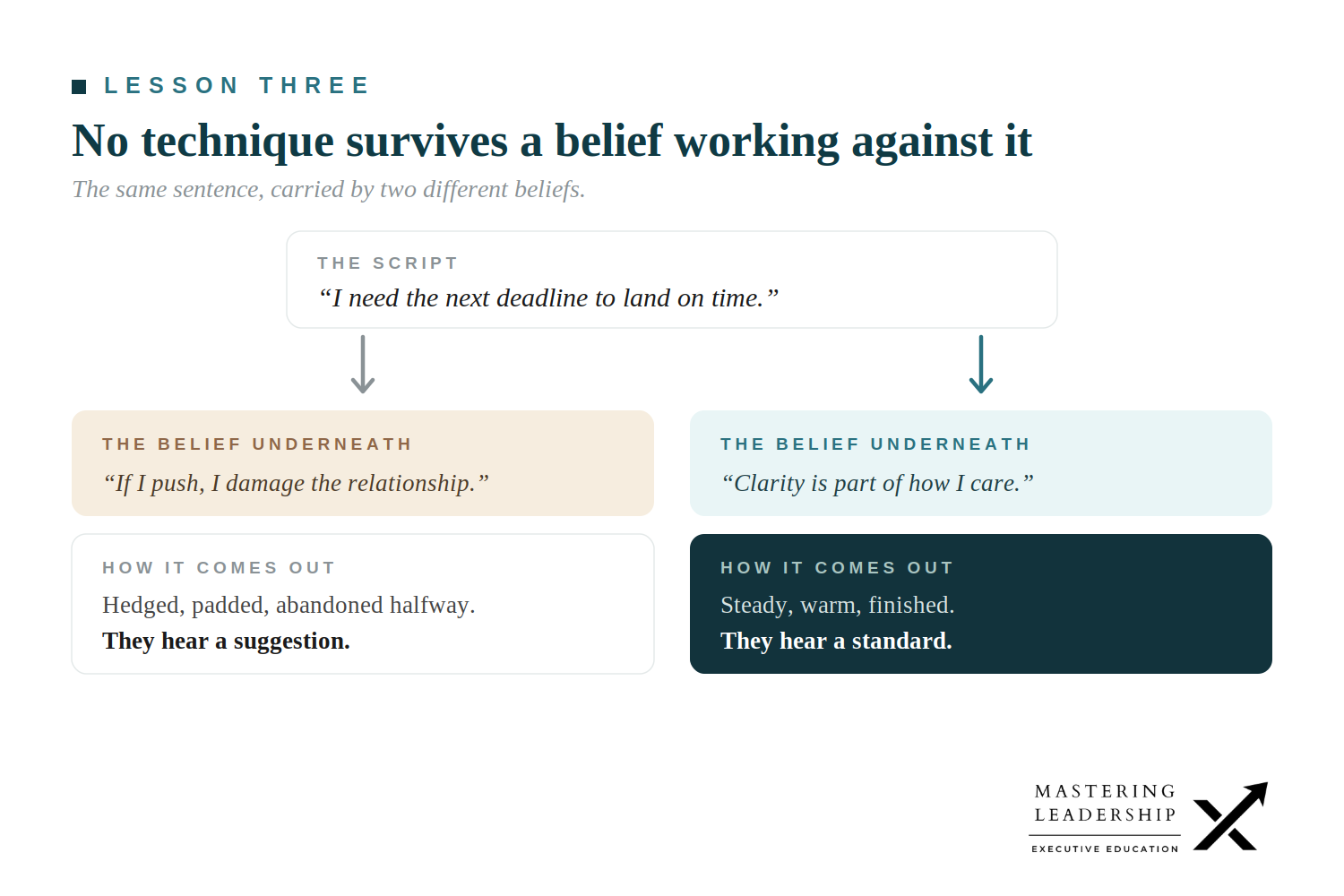
Across every negotiation program I have delivered, in banking, in media, in professional services, the pattern holds: the breakthrough moment is almost never learning the script. It is naming the belief that made the script feel impossible.
"If I push back, I will damage the relationship." "They already know our value." "They have more power than we do." "If I say no, I lose the deal." These beliefs sit underneath the behaviour, and no technique survives a belief working against it. You can hand someone the best-researched language for anchoring or boundary-setting, and if they privately believe the relationship cannot survive directness, their delivery will betray them in the first ten seconds.
This is consistent with what we know about self-efficacy (Bandura, 1977): people do not act on their capabilities, they act on their beliefs about their capabilities. It also shows up in the behavioural research on skilled negotiators (Rackham and Carlisle, 1978), where the differences between expert and average negotiators were observable behaviours, asking more questions, testing understanding, avoiding defend-attack spirals, that anyone could technically perform. What separates those who perform them under pressure is rarely knowledge. It is what they believe will happen if they do.
So before you send yourself or your team to another skills workshop, do the quieter work first. Name the belief. Ask where the evidence for it actually comes from. Then practice the skill with the reframe in hand.
Self-check: what do I believe about the conversation I keep postponing?
Lesson four: a people problem is usually a system problem
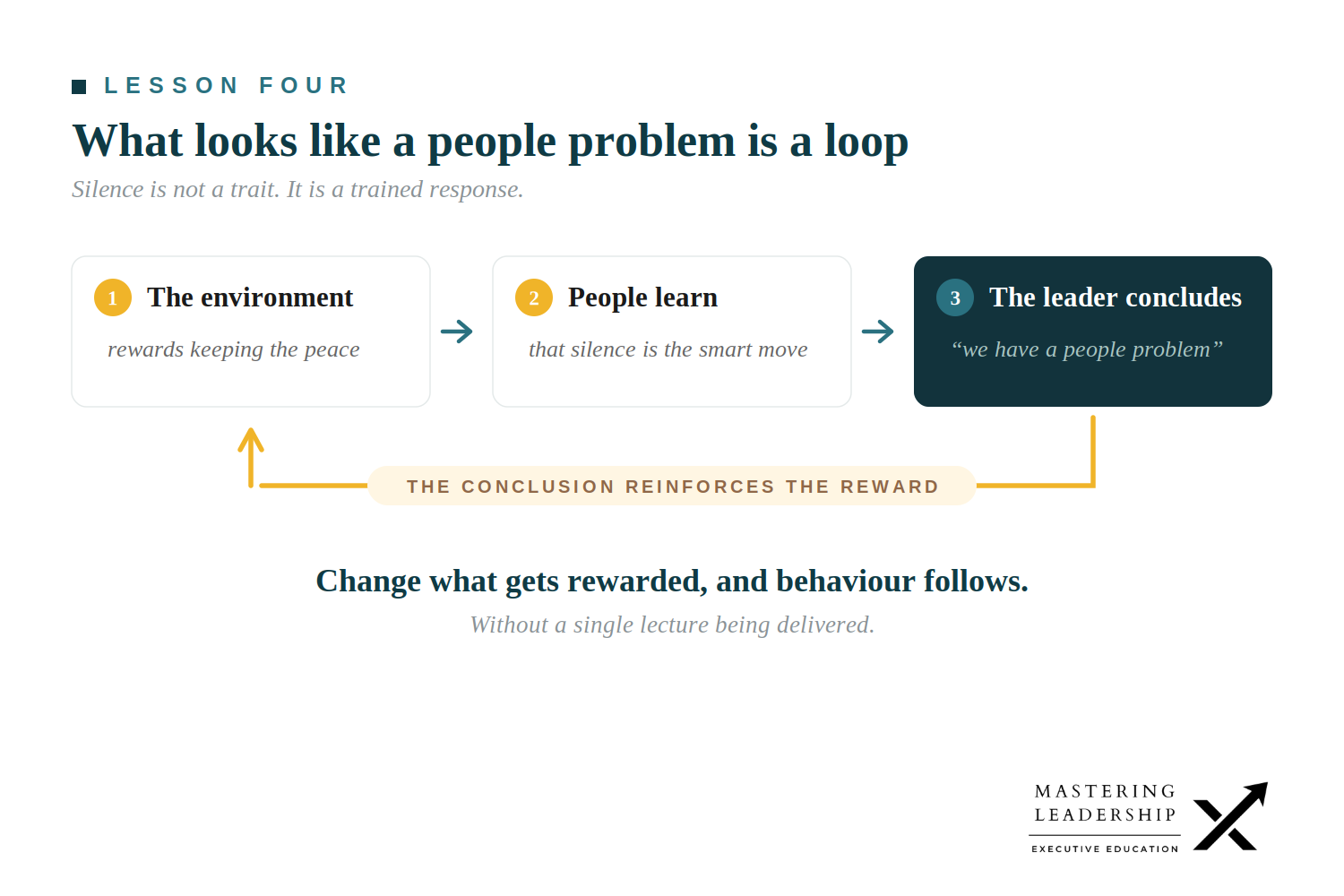
When a team goes quiet, when commitments slip and nobody names it, when resistance appears that no one can quite explain, the instinctive question is "what is wrong with these people?" It is almost always the wrong question. The better one: what does this environment reward?
Silence is rarely a character flaw. In a system where speaking up has ever been punished, staying quiet is not weakness, it is intelligence. David Rock's SCARF model (2008) maps how leaders unintentionally trigger threat across status, certainty, autonomy, relatedness, and fairness, and how each trigger produces predictable withdrawal. Amy Edmondson's psychological safety research (1999) shows the same thing from the team side: candour follows safety, not courage campaigns. And the change literature is unambiguous that resistance intensifies when people feel control being removed, which is why repeating the business case louder so reliably fails.
The leaders I work with find this lesson simultaneously humbling and liberating. Humbling, because the system they are asking about is usually one they built or inherited and kept. Liberating, because systems can be redesigned, and behaviour follows what gets rewarded without a single lecture being delivered.
Self-check: what does my team actually get rewarded for, speaking up or keeping the peace?
Lesson five: a knowing problem is almost never the problem
Here is something uncomfortable about my own industry: most leadership development fails at the exact moment it matters, which is the Monday after the workshop. The session was great. People nodded. Nothing changed.
The transfer of training research explains why (Baldwin and Ford, 1988, and decades of work since): insight alone transfers poorly. What transfers is rehearsal on the learner's own real material, with feedback, with stakes, with a named next step. This is why, in every program I design, the module participants remember a year later is never the framework. It is the moment they ran their own actual conversation out loud, with a colleague pushing back, and discovered where their language softened under pressure.
Your team almost certainly knows what good looks like. Knowing was never the constraint. The constraint is that the real conversation has not been rehearsed, scheduled, or spoken aloud even once. The fix costs nothing: pick the conversation, write the first sentence, say it out loud today, and put a date on the rest.
Self-check: what is the first sentence of the conversation I have been avoiding, and when will I say it?
The pattern under all five
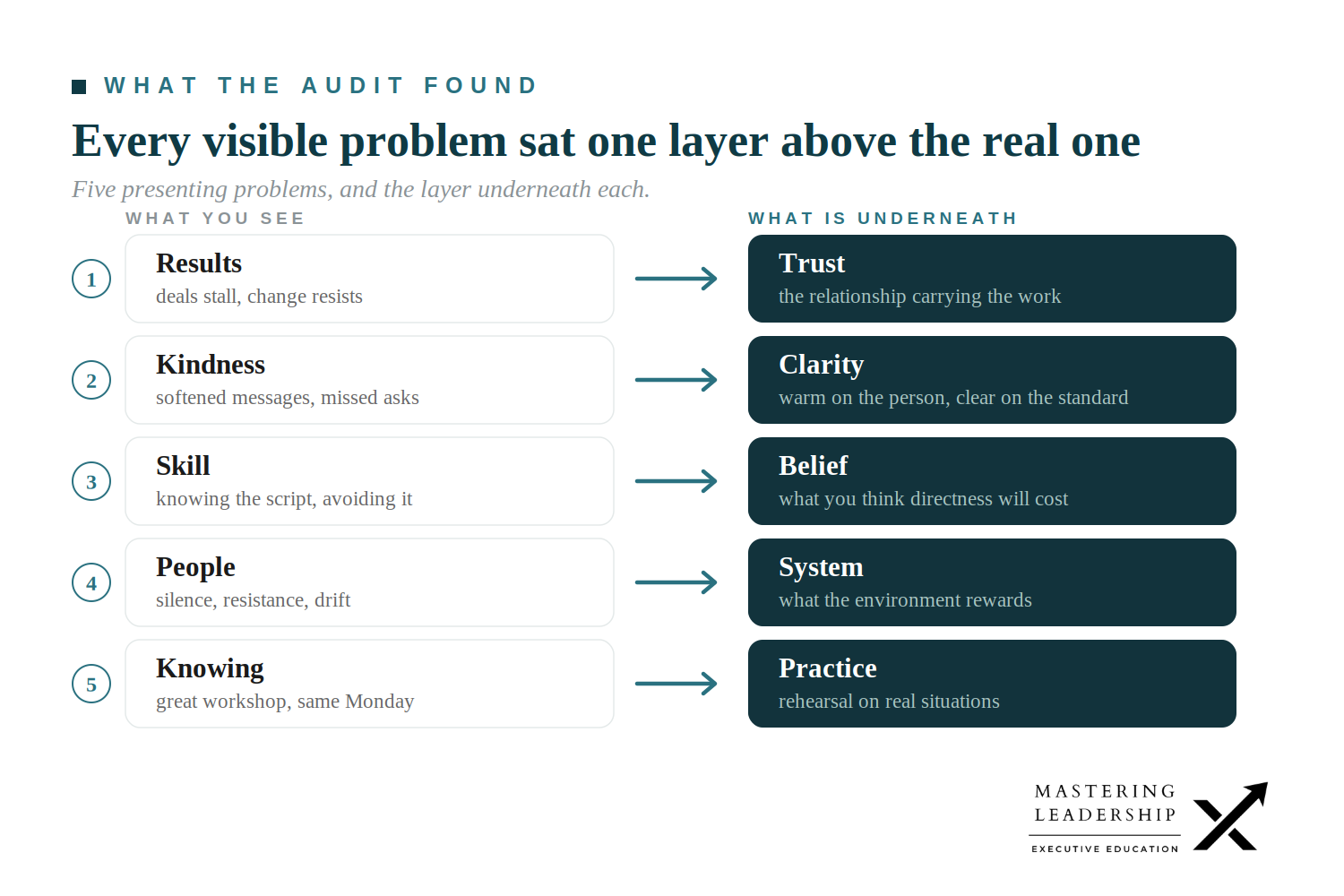
Look at the five lessons together and the same shape appears. Results point to trust. Kindness points to clarity. Skill points to belief. People point to systems. Knowing points to practice. In every pair, the visible problem sits one layer above the real one, and leaders spend their energy on the visible layer because it is the one that shows up in dashboards and complaints.
Which brings me to the sentence I landed on after hundreds of slides, and the one I would put on the wall if I could only keep one:
The conversation you are avoiding is usually pointing at the real problem.
Not because avoidance is a moral failure. Because avoidance is information. The conversation you keep postponing is postponed for a reason, and that reason, a thin relationship, a belief about what directness costs, a system that punishes candour, is the actual work. Name the conversation and you have located the layer underneath it.
So here is the practice I will leave you with, the same one I now run on my own work. Name the conversation you have been putting off. Just name it, to yourself, this week. Then ask which of the five lessons it points to. You will likely find you have been solving the wrong problem with real diligence, which is the most common and most fixable mistake in leadership I know.
About MLX
Mastering Leadership Executive Education (MLX) is a Toronto-based leadership development firm. Science-led and trust-centred, we design and deliver executive programs, workshops, and coaching for organizations across banking, government, policing, and the nonprofit and creative sectors. Our work is built around the conversations that actually move organizations: trust, accountability, negotiation, feedback, and the difficult ones leaders avoid. Every program is grounded in peer-reviewed research and customized end to end: our in-house AI platforms, including the Leadership Trust Audit, tailor the diagnostics, content, and coaching support to your people and your context. Then it is practiced on your real situations, not hypotheticals, which is why it still holds on Monday.
If one of these five lessons is live inside your organization right now, that is exactly the work we do. Contact us and we’d love to start a conversation about how we can help.
References
Maister, D. H., Green, C. H., & Galford, R. M. (2000). The Trusted Advisor. Free Press.
Mayer, R. C., Davis, J. H., & Schoorman, F. D. (1995). An integrative model of organizational trust. Academy of Management Review, 20(3), 709 to 734.
Rackham, N., & Carlisle, J. (1978). The effective negotiator. Journal of European Industrial Training, 2(6), 6 to 11.