Accountability Is the Proof of Kindness
What if the kindest thing you can do for someone on your team is the very thing you have been avoiding? We tend to treat accountability as the cold part of the job, the thing you reach for when the warm part has failed. Care is the relationship, the encouragement, the grace. Accountability is what you do, reluctantly, once someone has let you down. I want to argue the reverse. Accountability is not what is left when kindness runs out. It is one of the truest forms of kindness you have.
In most companies this sounds like a paradox, and it is lived like one. The leaders who care most about their people are very often the ones who cannot hold those people to a standard, precisely because holding the line feels like a betrayal of the warmth. So they soften the message, they wait for a better moment, they quietly do the work themselves, and they call it kindness. It is not kindness. It is avoidance wearing kindness as a costume, and the person it protects is almost always the leader, not the person they are failing to be honest with.
I want to take that apart. I will start with what avoidance actually costs a business, because the price is higher and stranger than it looks. Then I will go to the individual level, to what it feels like from the inside to be the leader who cannot say the hard thing. Then to the reframe that changes everything, that the standard is the gift, not the threat to the relationship. And I will finish with a definition of accountability worth keeping, and a handful of questions to sit with.
What avoidance actually costs
Start with a small one, because small is where this lives. A senior leader at a fast-growing company did not want to attend an important industry event on behalf of a client. She did not want to go, so she said she would rather not, and no one held her to her role. The team then spent days unable to decide who would go in her place. By the time they sorted it out, the tickets were gone. They missed the event, the client was upset, and the relationship took a real hit. Months later, the leader still does not connect any of it to her own avoidance. One soft I would rather not, never named, became lost opportunity, a damaged relationship, and reputational risk.
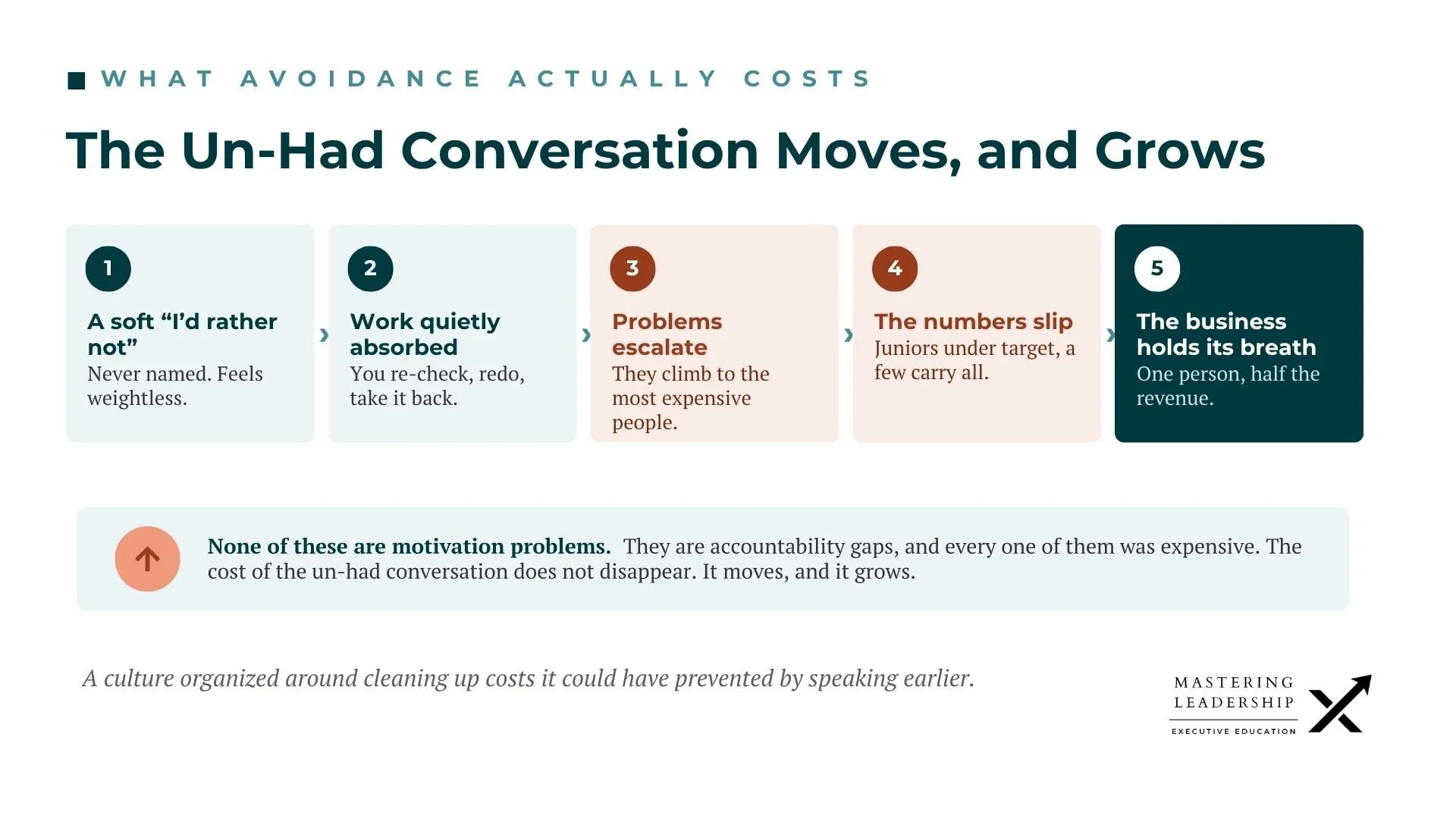
That is the shape of it every time. The cost of the un-had conversation does not disappear. It moves, and it grows. A clear task handed to a senior person sits untouched for three weeks while two other people quietly start doing it, until the leader who delegated it simply does it herself. A junior manager flails for months while the person meant to be managing her has, in that leader's own honest words, no idea, because no rhythm of checking in was ever built. Problems that should be solved between peers travel all the way up the chain instead, landing on the most expensive people in the building, because no one in the middle was ever given the standard, or the trust, to hold them.
And it shows up, eventually, in the only place leadership ultimately reads, the results. At one company the junior managers were billing a fraction of their targets while two or three strong performers carried everyone, a situation the leadership knew was unsustainable and could not fix without finally holding people to their numbers. Another company had a single person generating close to half of all revenue and was scrambling to spread that load, because a company that depends on one person is a company holding its breath. None of these are motivation problems. They are accountability gaps, and every one of them was expensive.
There is a phrase I heard from a leader at a high-stakes, heavily regulated organization that I have not been able to forget. They were, she said, very good at firefighting, very good at investigating what had gone wrong, but only because by the time they acted, the event had already happened. That is what an accountability gap is at scale. It is a whole culture organized around cleaning up costs it could have prevented by speaking earlier. A leader's avoidance does not stay the leader's. It becomes the ceiling on what everyone below is willing to raise.
How it shows up in you
Now turn it around and look at the person doing the avoiding, because it is rarely a careless person. It is usually the most caring one in the room.
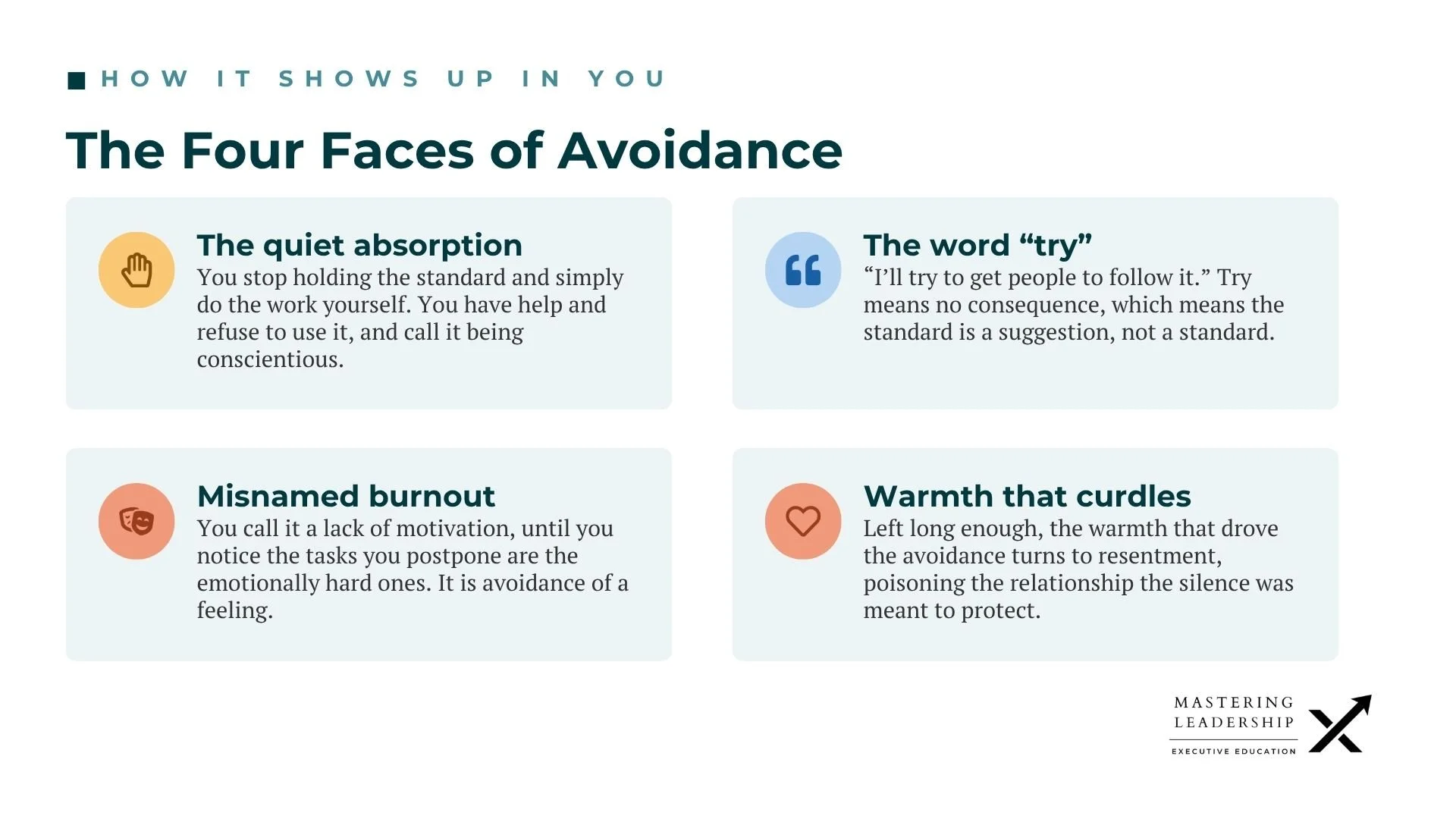
The most common form is the quietest. You stop holding someone to a standard and you simply absorb the work yourself. A detail-oriented manager is given an assistant to lighten her load, does not quite trust the lists the assistant builds, and ends up re-checking and redoing every one of them, until, as she put it, she has just mentally taken it back. She has help and refuses to use it, because holding someone to a standard turned out to be harder than silently doing it alone. Her standards stay high. Her team stays small. And she calls it being conscientious.
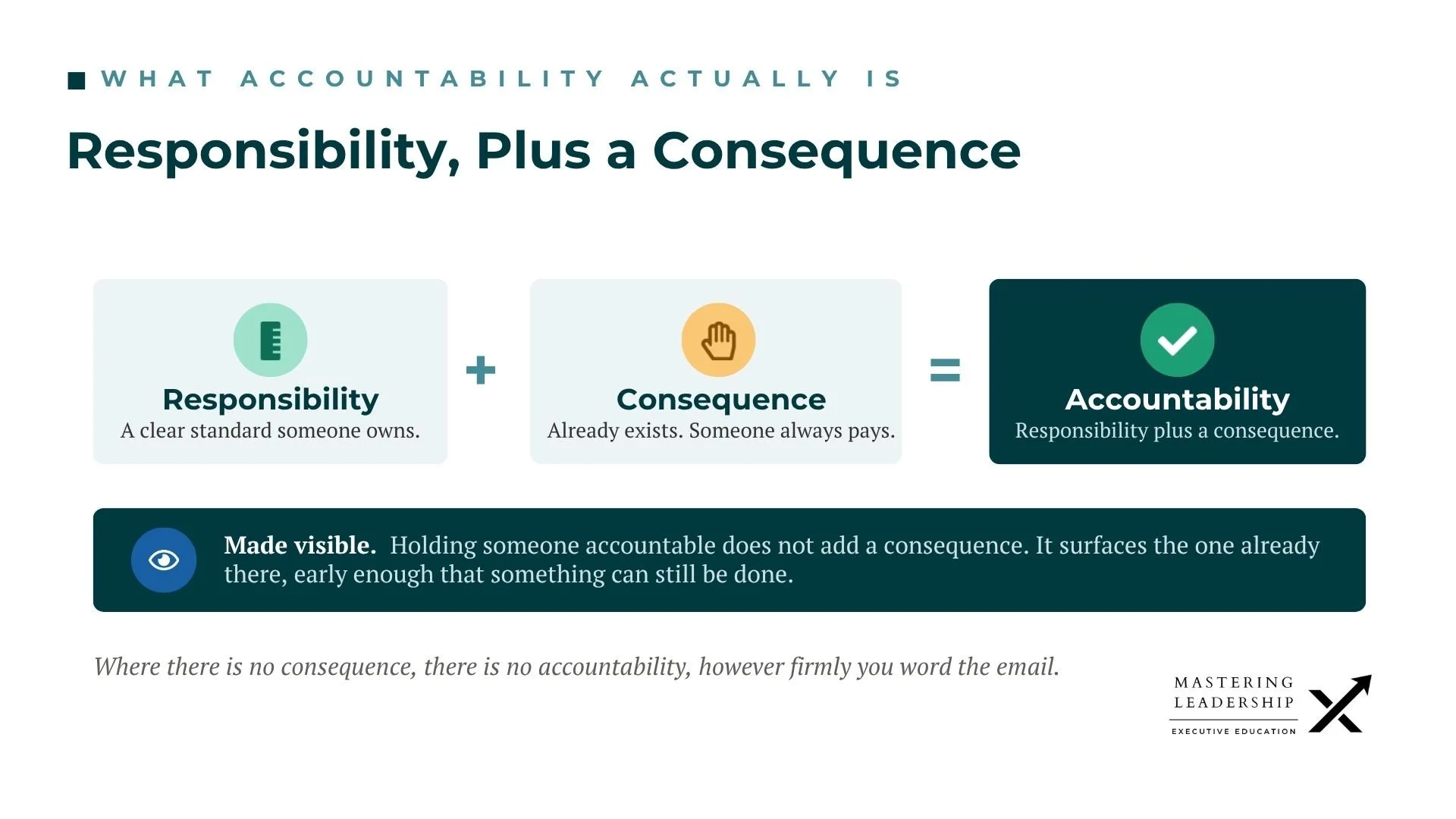
Another form hides in a single word. A leader rolling out a new way of working says she will try to get people to follow it. Try is the tell. Try quietly means there is no consequence if they do not, which means the new standard is not a standard at all, it is a suggestion, and the leader will keep paying for the gap herself. Accountability, at its core, is responsibility plus a consequence. Where there is no consequence, there is no accountability, however firmly you word the email.
Often the avoidance does not even know its own name. A leader calls her stuckness burnout, or a lack of motivation, until you notice that the specific tasks she keeps postponing are the emotionally hard ones, the conversation that ends something, the consequence that has to be delivered. It is not a motivation problem. It is avoidance of a feeling. And it leaks into the language. Watch a leader smile while she describes the thing that is upsetting her, and hedge every honest sentence, I think I am frustrated, I think I have reached a point, each I think a small act of taking the weight out of the words so she does not have to face the reaction to them.
At its most intense, avoidance feels like something much bigger than work. One leader described ending an unproductive working relationship as feeling like breaking up with someone, and kept postponing it, even around the other person's personal milestones, to spare feelings that the delay was not actually sparing. The relationship had been built with the emotional weight of a friendship, which is exactly what made an ordinary professional decision feel unbearable. And yet, almost universally, the same people describe the other side of it the same way. There is such a build-up, one of them said, and then I finally do it, and afterward I think, that felt good, I should have done it months ago. The dread is in the waiting. It is almost never in the conversation.
Left long enough, the warmth that started all this avoidance curdles. I have put so much into trying to turn this around for you, one leader said, for you to pretend you are interested and then not do it, again and again. That is what unspoken accountability becomes in the end. Not peace. Resentment, quietly poisoning the very relationship the silence was meant to protect.
The reframe: the standard is the gift
Here is the move that changes everything, and it is the opposite of what most caring leaders believe. The standard is not the threat to the relationship. The standard is the gift.
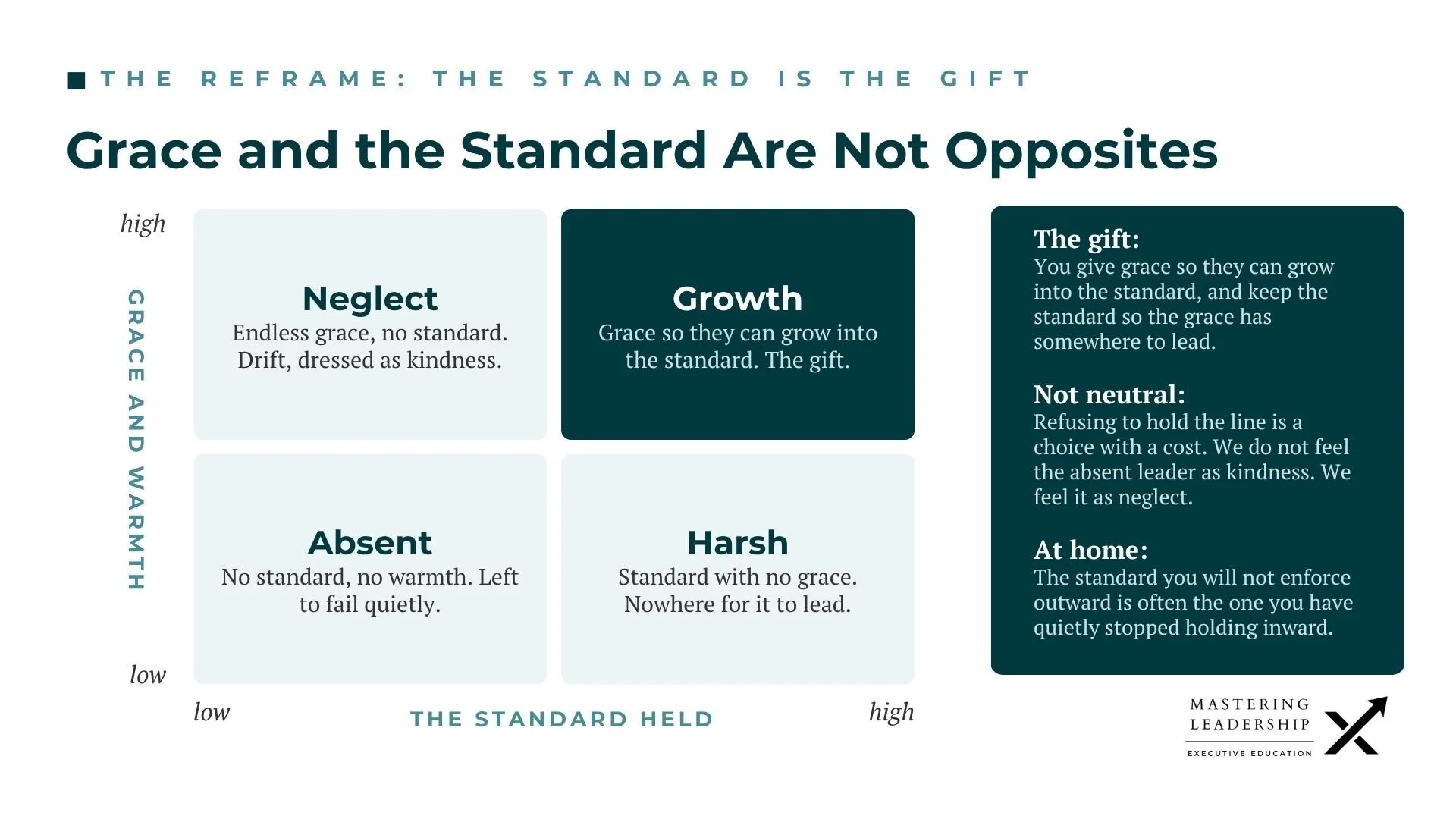
Think about what you actually do for someone you are invested in. You give them grace, room to grow, patience while they get there. But you hold the standard the whole time. Grace and the standard are not opposites you have to choose between. You give the grace so they can grow into the standard, and you keep the standard in place so the grace has somewhere to lead. A leader who offers endless grace and no standard has not given more kindness. She has given less, because she has removed the thing the grace was for.
The proof is in the leadership style everyone has suffered under and no one defends, the absent one. The leader who hovers and then vanishes, who holds no standard, gives no feedback, and leaves people to drift. We do not experience that as kindness, even though it asks nothing of anyone. We experience it as neglect, because that is what it is. Refusing to hold the line is not a neutral act. It is a choice with a cost, and the people who pay it are the ones being left to fail quietly.
This is why vague warmth is not feedback. You are amazing, we could not do this without you, however sincerely it is meant, teaches a person nothing they can use. I have watched leaders who only ever receive that kind of praise grow suspicious of it, because some part of them knows that if nothing specific is ever said, something true is probably being withheld. The specific, process-tied truth, here is exactly where this worked and here is exactly where it did not, is the respectful thing. It treats the other person as someone capable of growing, rather than someone too fragile to hear it.
Indirectness, then, is not a gentleness. It is a disservice. People who are anxious do not need softer signals, they need clearer ones, because predictability is what lets a nervous system settle, and predictability comes from you being direct. When you blur the message to protect someone's feelings, you do not spare them the anxiety. You hand them a fog and let them fill it with the worst thing they can imagine. And the discomfort you are working so hard to prevent is frequently the point. The negative feeling that comes with a real consequence is not damage to be avoided. It is often the doorway to the lesson. Protect someone from ever feeling the weight of a missed standard, and you have not protected them. You have quietly ensured they never learn the thing the weight would have taught.
There is one more turn of this, the most uncomfortable one. The thing you are tolerating in someone else is very often the thing you are tolerating in yourself. The leader who cannot hold a coasting team member to account is frequently the same leader who has been letting her own hard tasks slide. The standard you will not enforce outward is usually the standard you have quietly stopped holding inward. Which means accountability, the real kind, starts at home.
What accountability actually is
So let me define it plainly, because the word has been so thoroughly confused with control that it needs rescuing. Accountability is responsibility plus a consequence, made visible. The consequence is not something you invent in order to punish someone. It already exists. When a standard slips, someone always pays, the team that absorbs the slack, the client who gets less, the person who never builds the skill, the leader who can never step back. Holding someone accountable does not add a consequence. It makes the consequence that is already there visible, early enough that something can still be done about it.
Put one more way, accountability is keeping a promise visible so the standard holds and the person grows. It is not surveillance and it is not policing. At its best it is developmental. You catch things early, you help someone see what they could not, you let them find their own way once they have built the foundation to. And it has to be even, or it is nothing, because the moment one person's results buy them an exemption from the standard everyone else is held to, you have not been kind to your strongest performer. You have been unfair to everyone, and you have told the whole room that the rules are negotiable for the people you are most afraid to confront.
This is why I call accountability the proof of kindness. Anyone can offer the warmth, and on its own the warmth is cheap. The proof that you actually care about someone's growth is that you are willing to do the hard, unpaid, anxious work of telling them the truth and holding them to it, even when it would be far more comfortable to smile and let it slide. Avoidance protects you. Accountability costs you something and gives them something. That is what makes it the kind act, not the cold one.
Questions to sit with
If there is a conversation you have been carrying, sit with these before you have it, or before you avoid it one more time.
The conversation you have been postponing: if you do nothing for six months, what problem will you have then, and who is paying for it in the meantime?
When you say you will try to hold the line, does try secretly mean there is no consequence if they do not?
Are you holding the same standard for everyone, or has someone's results quietly bought them an exemption?
The thing you are tolerating in them, is it the same thing you have been tolerating in yourself?
When you step in and do it yourself, are you building their skill, or protecting yourself from the harder conversation?
Is your feedback specific enough to act on, or is it the vague warmth that sounds kind and teaches nothing?
Are you relating to this person as their leader, or only as their friend, and can those two be made to serve each other?
What would change today if you decided that the kindest thing available to you was to tell them the truth, early?
The kindest thing in the room
The leaders I work with who make this shift describe the same thing afterward, almost word for word. Not that the conversations became easy, but that the dread lifted, because they stopped carrying the slow weight of everything they were not saying. Their teams got sharper. Their strongest people stayed, because their strongest people could finally trust that the feedback they were getting was real. And the warmth they had been so afraid of losing did not vanish. It deepened, because it had finally become honest.
So the next time you find yourself softening, waiting, or quietly doing someone's work for them in the name of kindness, ask whether it is really kindness, or whether it is the more comfortable thing dressed up as the kind one. The kind thing is almost always the clear thing. And accountability is simply kindness that was brave enough to say the standard out loud.
Related reading
Proactive Leadership at Scale: From Why Not to How Yes — how senior teams shift from a fear-based culture to one that takes ownership.
Assertive Communication Using the DESO Script — the four-step structure for saying the hard thing clearly and kindly.
Decoding Conflict Resolution: The Fight, Fawn, Flight and Freeze Responses — what happens in the body when accountability lands as a threat, and how to keep it from doing so.
Work with MLX
At Mastering Leadership Executive Education, this is much of what my team and I do with leaders and their organizations: building the capacity to hold people to a standard without losing the relationship, and turning accountability from the cold part of the job into the clearest expression of care a leader has. We do it through workshops, one-to-one and team coaching, and longer culture work that makes honest, accountable conversation the norm rather than the exception. MLX is the firm I built, and the team I lead, to do exactly this. If this named a conversation you have been avoiding, let’s start a conversation.