Clear Is Kind: Why Your Hardest Conversations Are a Safety Problem, Not a Courage Problem
The hard part of a difficult conversation is not finding the courage to have it. That is the story we are told, and it sends us looking in exactly the wrong place. Courage is downstream of something quieter and far more physical, and until you understand that, you will keep mistaking a nervous system for a character flaw.
This article is about that mistake, and about the more useful way to see what is really happening when a hard conversation feels impossible. The argument is simple. The difficulty you feel beforehand is almost never a flaw in your character. It is a signal about your state, and about how safe the room is, and both of those are things you can change. Once you see the problem that way, it stops being a question of whether you are brave enough and becomes a set of moves you can actually make.
I will start in a real room, with a team of managers discovering what their avoidance had been costing them. From there I will lay out the reframe at the heart of this work, that skill in a hard conversation sits downstream of safety, not the other way around. We will look at why clarity and kindness are the same thing rather than opposites, why so much communication advice fails the moment things get tense, how to read the four states people move between under pressure, and the three moves that carry you through it. And we will finish where the stakes actually live, in the quiet, compounding cost of the conversations we keep not having.
The room: what avoidance actually looks like
I learned this most recently in a room full of people who are very good at their jobs. They were the managers at a fast-growing company, the kind of people whose work runs on relationships, with the clients, partners, and suppliers they depend on every day. Warmth was the currency. The closer and more trusting those relationships were, the better the work went, and the company had deliberately built a culture that prized that closeness.
Which is exactly where it gets hard. Because the closer you are to someone, the more a piece of honest feedback feels like a threat to the relationship you have worked to build. I asked the room a simple question. Name a conversation you have been avoiding. The silence that followed was not empty. It was full.
Then it opened. One manager described a client relationship she had let drift for months, a partner who kept missing what they had agreed while she nudged gently and nothing changed. Another talked about a supplier who was still technically delivering but had quietly stopped putting real care into the work, and the careful dance of not quite saying so. A third admitted that when a partner fell short, she would often just absorb it and fix it herself rather than name it. Underneath every example was the same structure. A standard quietly lowered. A small resentment accumulating. And a conviction that the honest conversation would be the unkind one.
The manager I keep thinking about put words to the cost. The conversation she needed to have was not a new problem. It was six months old. She had been paying for its absence the whole time, in her own frustration, in lost momentum, in a relationship that was being strained by the very avoidance meant to protect it.
Here is the part that is easy to miss, and it matters most. The most telling thing in that room was not any single confession. It was that the room had become safe enough, in under an hour, for those confessions to be possible at all. People who had been making small talk were now naming the exact thing they had been hiding from. That shift is not a coincidence, and it is not a difference between brave people and timid ones. It is the whole thesis of this work, demonstrating itself in real time. Candor is not a trait some people have and others lack. It is what a safe enough room produces.
The story we tell ourselves about hard conversations
When a difficult conversation looms, most of us experience it as a test of character. The internal question is moral and binary. Am I too nice, or am I a coward? Am I too much, or not enough? Will being direct make me the kind of person I do not want to be?
Framed that way, the conversation becomes impossible, because every option indicts you. Stay quiet and you are weak. Speak up and you are harsh. So you wait. You tell yourself you are being considerate, choosing your moment, protecting the relationship. And the cost keeps accruing somewhere you are not looking.
The single most useful move I make in this work is to take the conversation out of the domain of character entirely. The difficulty you feel is not evidence about who you are. It is information about something much more mechanical, and much more changeable.
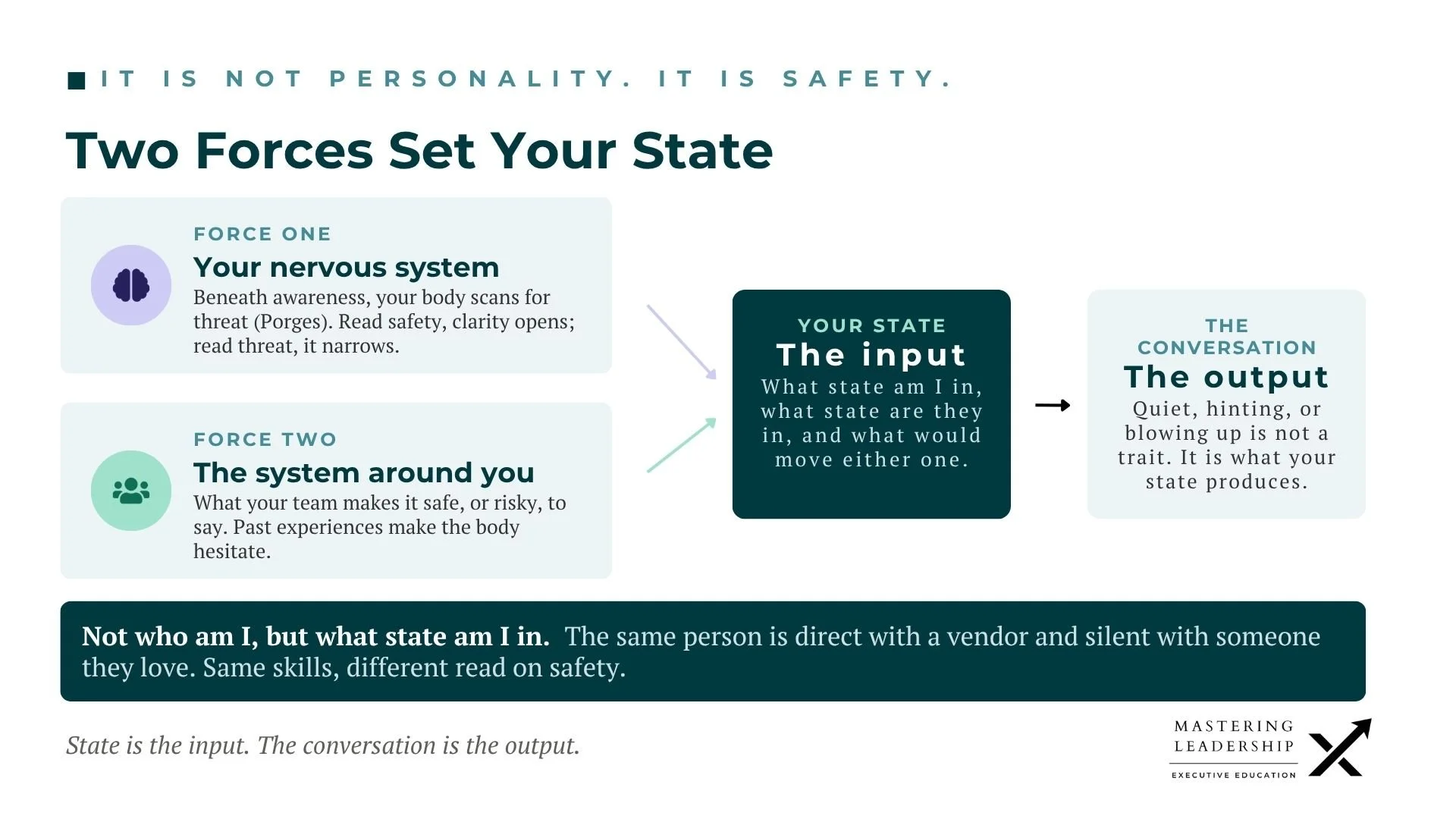
It is not personality. It is safety.
So if the difficulty is not a flaw in your character, what is it? Watch the same person across a single week and the question sharpens. The manager who cannot bring herself to raise a small issue with a client she adores will, an hour later, negotiate hard and clearly with a supplier she barely knows. Same skills, same spine, two completely different versions of her. Nothing about her character changed between those two conversations. The conditions did.
Whether you go quiet, hint, or blow up, then, has far less to do with who you are than with two forces acting on you in the moment.
Force one: your nervous system
Long before you decide anything consciously, your body is scanning the situation for threat. Stephen Porges calls this neuroception, the detection of safety or danger beneath awareness. When your system reads safety, you have access to the part of you that can be clear, curious, and warm at the same time. When it reads threat, that access narrows. Dan Siegel describes a window of tolerance, the band of arousal inside which you can still think straight. Push someone above it and they fight. Push them below it and they freeze. Neither state can hold a careful conversation, because the physiology will not allow it.
Force two: the system around you
The second force is what your team makes it safe, or risky, to say out loud. Amy Edmondson named this psychological safety, the shared belief that you can raise a hard thing without being punished for it. We absorb those norms quickly and obey them without noticing. If candor has cost you before, your body has filed that, and it will hesitate the next time on your behalf.
State is the input
This is the conversion the whole approach turns on. We take something you have been carrying as a verdict on your character and re-file it as a question of state. Not who am I, but what state am I in, what state are they in, and what would move either one. It is also why the same person can be perfectly direct with a brand or a vendor and go completely quiet with someone they love. Same skills, same person, different read on safety. The conversation is the output. State is the input.
The inversion: clear is kind
Kindness is not niceness
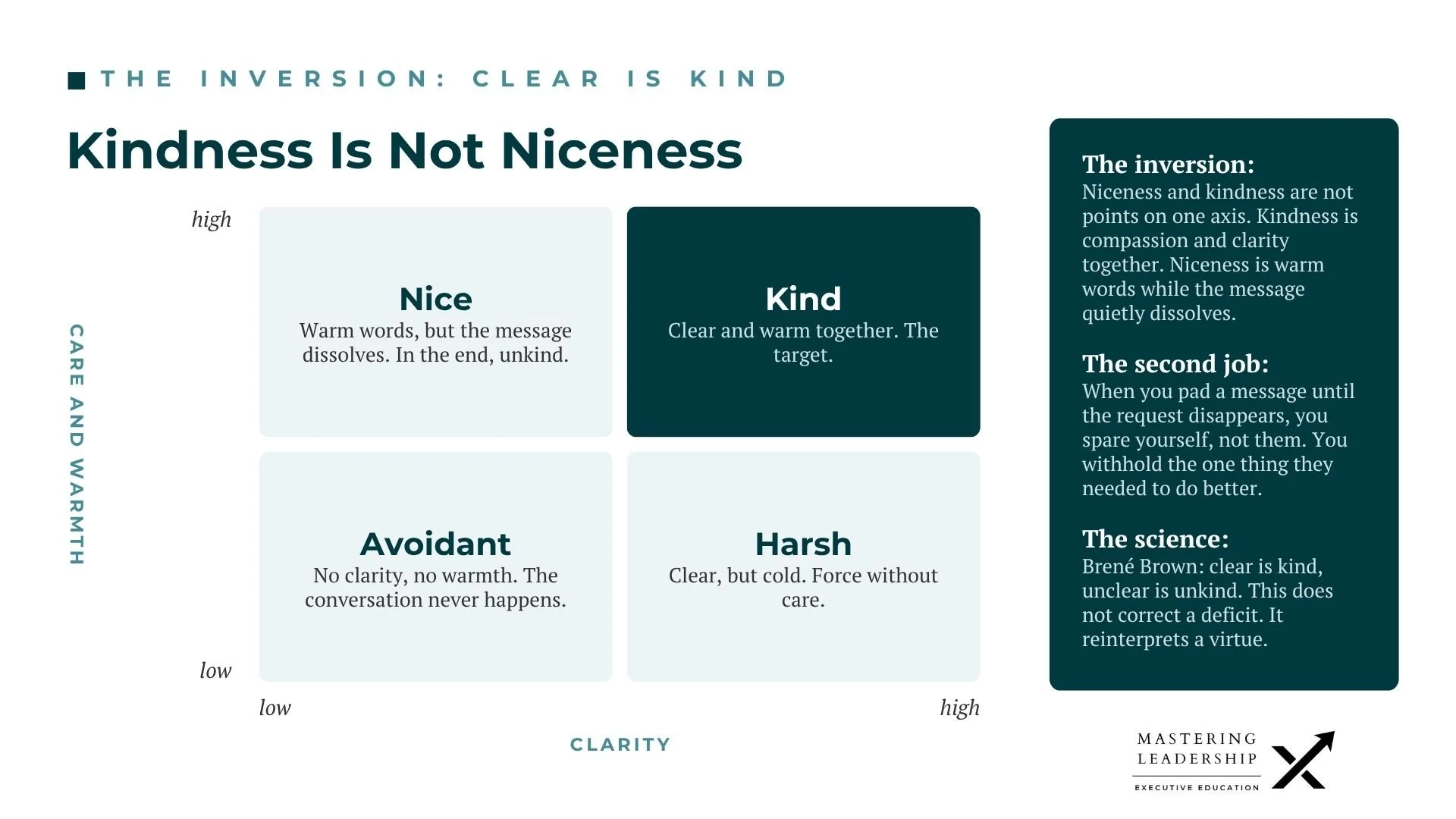
Brené Brown put the heart of it as plainly as it can be put. Clear is kind. Unclear is unkind. We confuse kindness with niceness, and they are not the same thing. Kindness is compassion and clarity together. You tell someone the honest thing, and you stay with them through it. Niceness is the words looking warm while the message quietly dissolves.
Your kindness was doing a second job
Most training treats avoidance as a skills gap. You lack the technique, or you lack the nerve. The reframe I work from is more unsettling, and more useful. You are not missing a skill. You are misreading a strength. The warmth you are proud of, the instinct to protect the relationship, the careful softening, has been doing a second job all along. It has been protecting you. When you pad a message until the other person cannot find the request inside it, you have not spared them anything. You have withheld the one thing they needed in order to do better, and you have done it for your own comfort, not theirs. That is why this reframe lands the way it does in a room. It does not correct a deficit. It reinterprets a virtue. You are not being told you are lacking. You are being shown that your kindness has not been as kind as you believed.
Why most advice fails
Three layers, three half-answers
There is a reason so much difficult-conversations advice collapses the moment things actually get tense. Most of it works on a single layer. Some of it teaches the ethic. Care personally and challenge directly. Be candid. True, and necessary, and it tells you why to have the conversation, not whether you are in any condition to have it. Some of it teaches the physiology. Regulate, breathe, find your window. Also true, and it leaves you sitting calmly with no idea what to say. Some of it teaches the read. Name the behavior, notice the dynamic, track who is doing what. Useful, and on its own, bloodless.
A real difficult conversation asks for all three at once. The ethic, so you know it is worth having. The physiology, so you know whether you and they can have it right now. And the read, so you can see what is actually happening between you, turn by turn, and adjust as you go. Pull any one out and the other two wobble.
The script is downstream of safety
This is why the script is not the skill. You cannot run a clean, four-step assertive script while your body is in fight or freeze. The words will not be available, and if you force them, they come out as aggression or as a mumble. The structure sits downstream of safety, not the other way around. So the real competence underneath every tool is the ability to read state, your own and the other person's, and to manage it until clear speech becomes possible. Put plainly, this is not really a communication problem. It is a regulation problem that produces communication problems.
Reading the dynamic
Four responses, not four types
When people watch themselves under pressure, they tend to land in one of four places. Randy Paterson maps them well. Passive, where you go quiet and give up your needs to make the threat pass. Passive-aggressive, where you cannot be direct so it leaks out sideways. Aggressive, where there is energy but no regulation, so you push to win. And assertive, the regulated response, clear and kind at once. If you want the deeper, body-level version of these states, I have written separately about the fight, fawn, flight and freeze defense responses.
The temptation is to read these as personality types. They are not. They are states, and which one you reach for depends on how much energy is in your system and how safe you have judged the moment to be. This is freeing, because a trait is who you are and a state is something you can move. You are not an avoidant person. You are a person who, in this specific dynamic, has not yet found enough safety to be direct. That is a problem you can solve.
The people most often told they are too much
There is a pattern worth naming directly, because for many people it is the whole story. The ones who hesitate most to be direct are very often the ones who have been punished for it. Many women learn early that their assertiveness gets relabeled. The same sentence that reads as confident from one person reads as aggressive, difficult, cold, or too much from them, and sometimes the label is cruder than that. So they adapt. They pad. They add the warmth back in so that the directness does not cost them. And then, often by the very same culture, they are told to be more direct.
Naming this as a learned, social pattern rather than a personal flaw matters, because it points you to the distinction that gives the power back. Assertive is not aggressive. Aggression uses force to make someone comply. If you are not doing that, you are not being aggressive, whatever label arrives at your door. You can be direct. You can even name your anger out loud, I am frustrated about this, I really want this in the deal, and still be entirely assertive. The moment you accept the label and shrink, the dynamic wins. The moment you trust your own read of what you were actually doing, you can hold steady through feedback that is, underneath, just a request for you to be smaller.
The three moves
When it is hot: regulate, do not reason
When the person in front of you is already activated, angry, defensive, or shut down, you cannot logic them back into a state where they can hear you. The stress chemistry takes time to clear, on the order of twenty to sixty minutes, and arguing better or faster usually makes it worse. So when it is hot, your first job is not to make your point. It is to lower the temperature. You find the truth in what they said and say it back first. You name what they are feeling. You ask a gentle, open question and you stay in it. You regulate someone back into their window. You do not reason them in. I have written about the neurobiology of de-escalation, from amygdala to oxytocin, if you want the science underneath this.
When it is calm: name it with structure
Once the moment is calm enough, structure carries you further than nerve does. The script I teach is DESO. Describe the facts, with no story about why. Express one honest concern without blame, the same move at the heart of a well-built I-statement. Specify the single clear thing you are asking for. Tie it to the Outcome they care about, and then confirm. A good structure is not a crutch. It is scaffolding that makes the assertive version possible for a body that would otherwise reach for the avoidant one. I have written about DESO in depth, with examples you can borrow.
Accountability is the proof of kindness
Accountability gets a bad name because it is so often confused with control, with hierarchy, with catching people out. In a warm, relationship-driven team it can feel like the thing that threatens the warmth. It is the opposite. Think about the best coach you ever had. The one who made you better was almost never the one who told you everything was fine. It was the one who told you the truth, specifically and early, because they were invested in your getting better. Vague encouragement feels nice and changes nothing. Specific, honest feedback is what raises performance, and it only works on a foundation of trust. Trust answers a single question. Do you have my back? Once someone knows you do, you no longer need the flowery niceties. You can be direct, and they can hear it as care, because it is. That is what accountability actually is. Not surveillance. It is keeping a promise visible so the standard holds and the person grows.
Avoidance obeys a conservation law
If there is one idea I would want a leader to carry out of all of this, it is this. Avoidance is never free. The only question is who pays, and when.
There is something almost thermodynamic about it. The cost of a hard conversation is conserved. You can defer it, you cannot delete it, and unlike most debts, this one compounds. The longer it sits, the more it costs to settle. The unspoken conversation does not disappear. It moves. It shows up as your own quiet resentment and your slowly dropping standards. It shows up in your team, who learn what is safe to raise by watching what you are willing to say, so your silence becomes their ceiling. It shows up in the people you manage, whose drift goes uncorrected until it has hardened. And it shows up with clients and partners as misalignment that surfaces late, when it is most expensive to repair.
I think of it like picking up a stick. Every behavior you pick up has another end, and the consequence is attached to it whether or not you have turned to look. Avoidance feels weightless precisely because the cost is at the far end, out of sight. It is still in your hand. You are still carrying it. You simply have not paid yet.
One question worth sitting with
So the next time a conversation tightens your chest and the old voice tells you that being clear would make you unkind, try treating it as a different kind of problem. Not am I brave enough, but am I safe and resourced enough to be clear, and have I made it safe enough for them to hear me. That is a problem with moves you can make. It is also why I no longer think of this as communication training. It is regulation and safety work that happens to produce better conversations. The conversation is the output. State is the input.
Here is the question I would leave you with. What is the one conversation you have been calling not a big deal, and who, exactly, is already paying for your silence?
If you are leading a team where the cost of the unspoken is starting to show, in the drift, the resentment, the standards that have quietly slipped, that is the work I do with leaders and their teams. Let us start a conversation. The clear kind.
Related reading
Assertive Communication Using the DESO Script — the four-step structure for naming the hard thing clearly and kindly, with worked examples.
Using I-Statements When Making Requests in Relationships — the Express move in depth: how to own your concern without blame.
How to Deescalate Conflict: From Amygdala to Oxytocin — the neuroscience of regulating someone back into their window before you name anything.
Decoding Conflict Resolution: The Engage, Fight, Fawn, Flight and Freeze Responses — the body-level version of the four responses, and how to co-regulate through them.
The conversations a team keeps avoiding are the ones quietly setting the ceiling on its performance. At Mastering Leadership Executive Education, we help leaders and their teams make those conversations possible, by building the safety underneath them, not just handing out scripts. Workshops, leadership coaching, and culture work that makes candor normal and accountability feel like care.
MLX is the firm I built to do this work. If this piece named a conversation you have been avoiding, let’s talk. The clear kind.