Psychological Safety at Work: Why You Never Have Enough Time
Why chronic busyness is often a symptom of low psychological safety, and what the science says is actually in your hands.
Marcus runs a unit inside a large public-sector organization. He is experienced, respected, and permanently underwater. When I asked his coaching group to audit their calendars from the previous week, one question only, how much did you control versus absorb, he answered first.
"I'm definitely an absorber. Things come in, I address them. The strategic work happens in the in-betweens."
"And the in-betweens," I asked, "fair to say you felt rushed? That you didn't have the capacity you wanted?" He laughed. He knew.
Around the virtual room, heads nodded. The majority of every calendar present was reaction. Planning, development, the actual leadership work, all of it squeezed into gaps that kept shrinking.
On the surface, this is a time management problem, and the standard prescriptions follow: prioritization frameworks, calendar blocking, delegation. But as the session went on, something more interesting surfaced. Marcus's time problem wasn't really about time. It was about safety.
(Marcus is a composite of leaders I coach, with details changed to protect confidentiality. The patterns are real and, I suspect, familiar.)
Organizational silence: the cost of yes is paid in silence
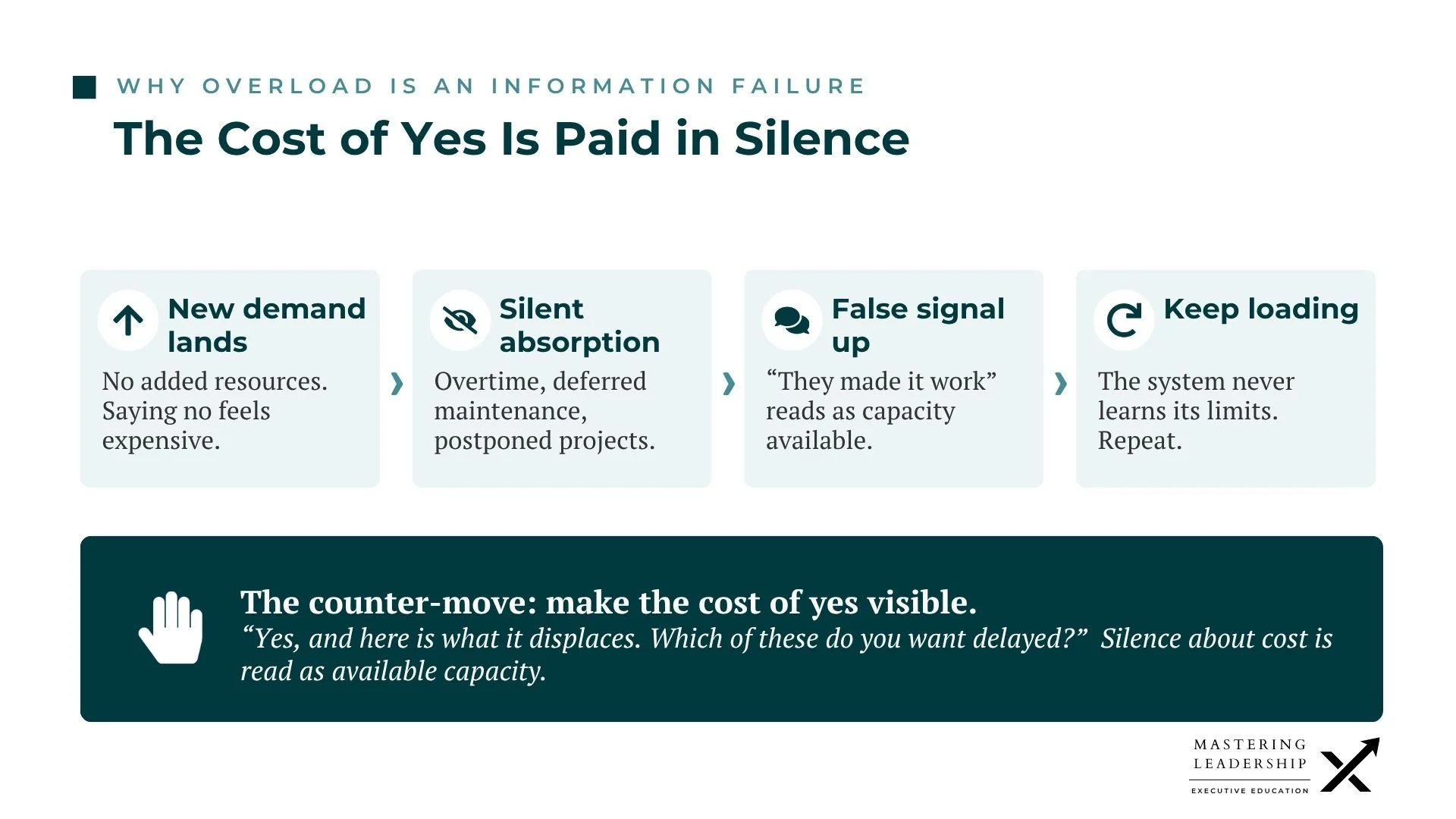
Earlier that year, a major initiative had landed on Marcus's unit with no additional resources. They made it work: extra hours, deferred maintenance, postponed projects that would, in his own words, come back to bite them later.
I told him what I would tell any client, quite frankly: if new demands keep coming in and nothing comes off the plate, that is a recipe for disaster. But here is what struck me more: at no point did anyone above him see a list of what that initiative displaced. The team just absorbed it.
Why? Because saying "yes, and here is what it costs" felt riskier than saying nothing. Research on organizational silence explains how universal this is. Work by Detert and Edmondson on what they call implicit voice theories shows that people carry unwritten rules about what is unsafe to say upward, rules they rarely examine: don't embarrass the boss, don't bring problems without solutions, don't challenge in front of others. The striking finding is that these internal rules persist even when the actual leader would welcome the input. People are often silenced less by their environment than by rules they have never tested.
The consequence is an information failure. When trade-offs go underground, the silence sends a false signal upward: capacity available, keep loading. Chronic overload isn't a planning failure. It's what happens when fear interrupts the feedback loop an organization needs to know its own limits.
"When a senior person calls a meeting, you show up"
Another leader in the session, newer to the organization, named what everyone had been dancing around: when someone senior calls a meeting, you attend. Whether your presence adds value is not part of the calculation.
Look at that through a safety lens. Declining a meeting is a micro-act of pushback. Where pushback feels unsafe, even that small act carries perceived career risk, so calendars fill with meetings nobody can question. Multiply that across an organization and you get thousands of hours consumed not by necessity but by deference.
Amy Edmondson, the researcher who put psychological safety on the map, found that in hierarchical, high-stakes environments, the person with the best information is rarely the person at the top. But that information only flows when people believe speaking up won't cost them. A calendar packed with unquestioned obligations is what it looks like when that belief is missing.
The micromanagement trap: the loop Marcus named in himself
Then Marcus said something that took unusual honesty. He admitted he takes on responsibilities to his own detriment, and that he micromanages, "because at least you're getting it done right."
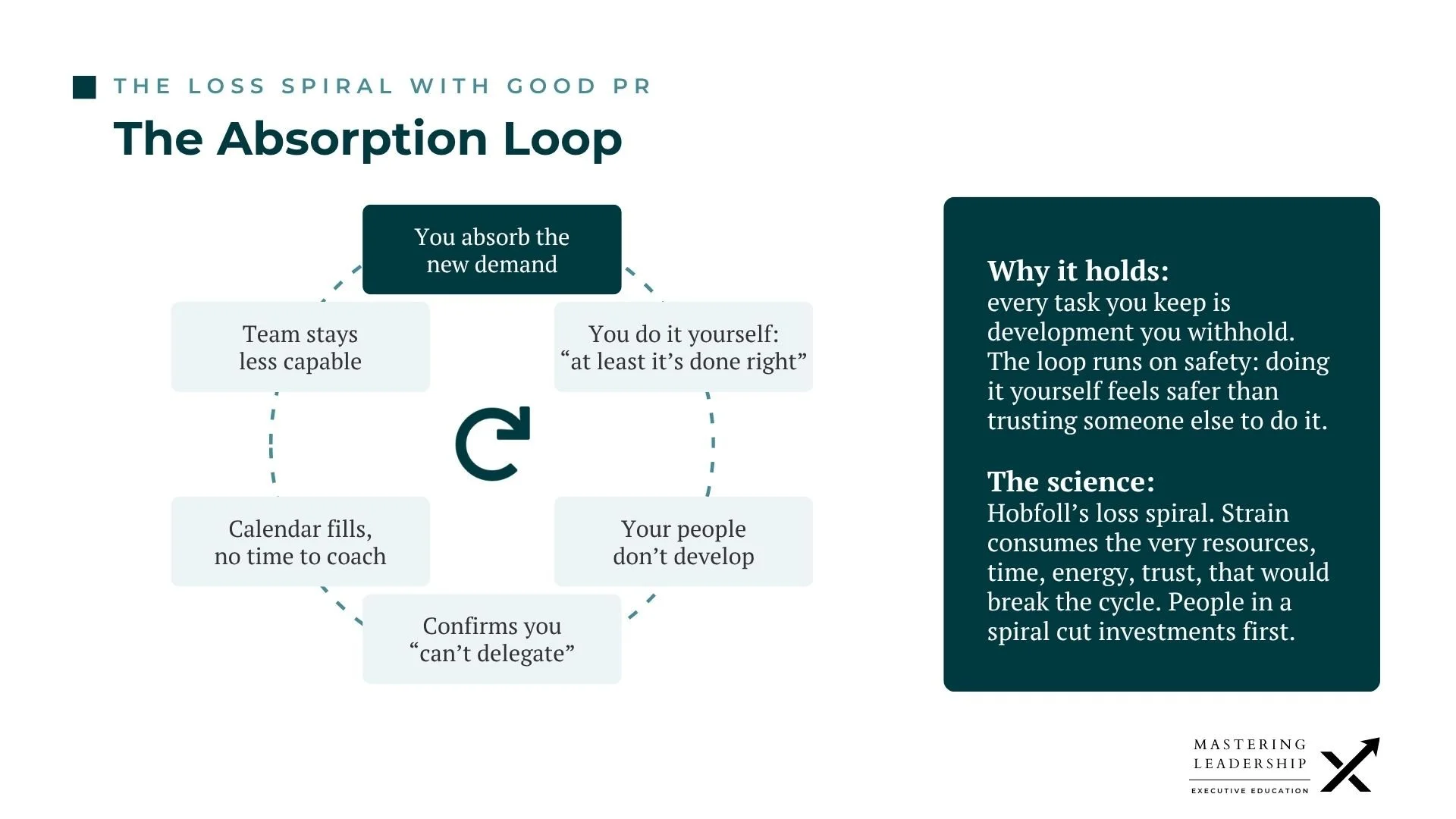
Notice the loop. Doing it yourself feels safer than trusting someone else to do it. But every task you keep is development you withhold. Your people stay less capable, which confirms your instinct that you can't hand things off, which keeps your calendar full, which leaves no time to coach them, which keeps them less capable.
I gave him back his own logic: when you ask me how to teach your team to manage their time, but your own calendar shows you have not mastered yours yet, how exactly are you going to teach them?
Stress researchers have a name for this shape. Hobfoll's Conservation of Resources theory shows that strain operates in loss spirals: when demands consume your resources faster than they're replenished, you have progressively less capacity to invest in the very things that would break the cycle. Delegation, relationship-building, and recovery are investments, and people in a loss spiral cut investments first.
None of this makes Marcus flawed. The research treats his position as a known occupational hazard. Karasek's demand-control model identifies high demands combined with low control as the most damaging work condition there is, and the famous Whitehall studies found low job control predicted heart disease better than many traditional risk factors. Permanent firefighting with no say over what lands on your plate is more than frustrating. It shows up in the body.
Toxic work culture or personal habit? Is it you, or is it the culture?
Before reaching for solutions, Marcus needed a diagnosis, because two very different conditions look identical from inside a packed calendar. Misdiagnose in one direction and you resilience-train yourself through a problem only the system can fix, which is how capable people burn out blaming themselves. Misdiagnose in the other and you write off agency you actually have, which is how capable people go passive in fixable situations.
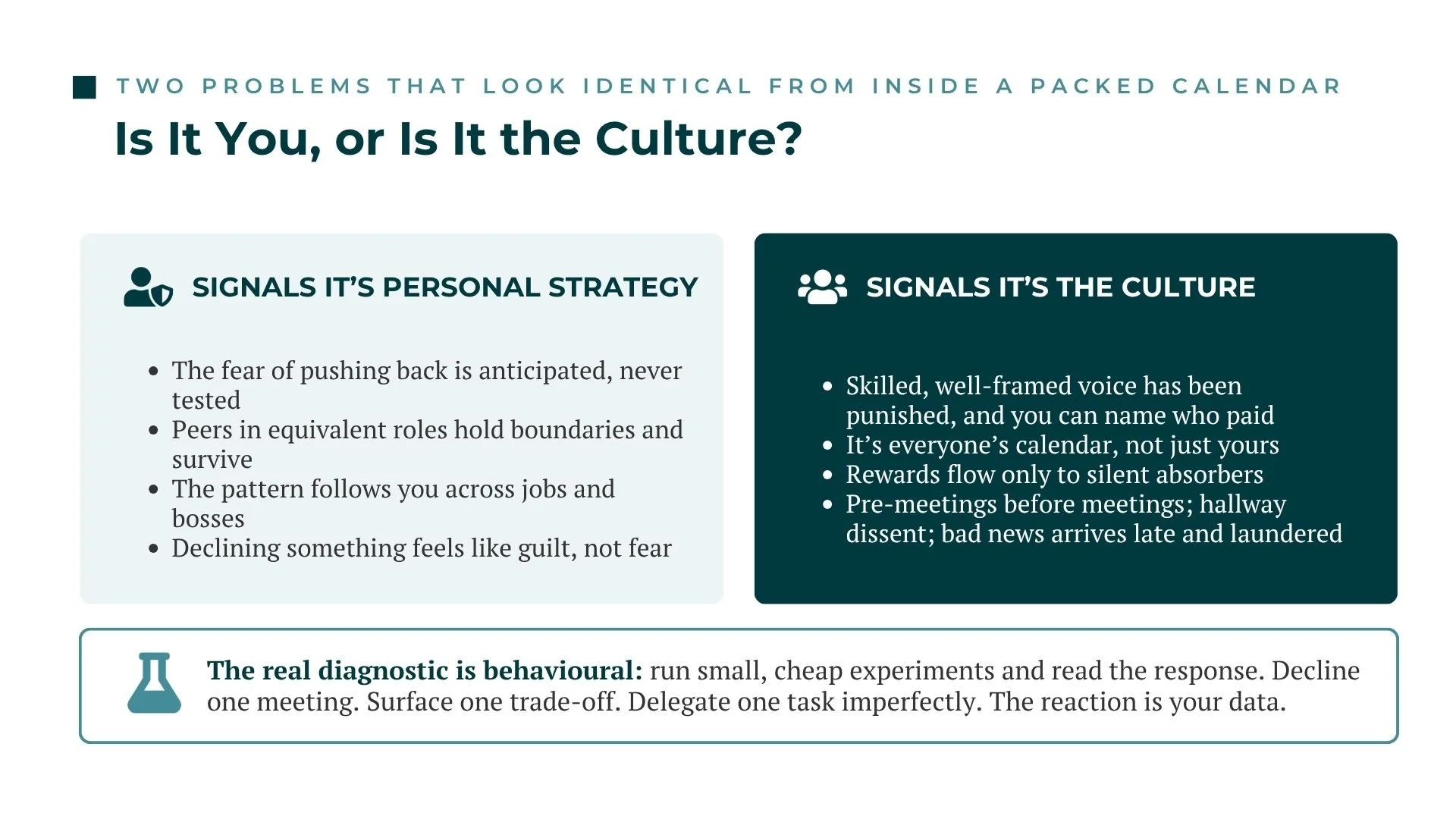
Some signals point to personal strategy: the fear of pushing back is anticipated rather than ever tested. Peers in equivalent roles hold boundaries and survive. The pattern follows you across jobs and bosses. What you feel when you imagine declining something is closer to guilt than fear.
Other signals point to culture: voice has actually been tested, by you or others, and punished, and you can name the people who paid. The pattern is universal, it's everyone's calendar, not just yours. The informal rewards flow exclusively to silent absorbers. And the meeting culture has tells: pre-meetings to decide what's safe to say in meetings, unanimous agreement in the room followed by dissent in the hallway, bad news that always arrives late and laundered.
But armchair signals only get you so far, because the voice research shows our beliefs about what's dangerous are unreliable narrators. The real diagnostic is behavioural, and in sessions I run it as a barrage of questions. Did you really have to go to all those meetings? The urgency someone put on that task, was it real or perceived? Was it their issue or yours? When someone crashed your blocked-off strategic time, did you ask to reschedule, or did you just accept it?
Then we convert the questions into experiments: run small, cheap probes and read the system's response. Decline one low-stakes meeting with a one-line reason. Surface one trade-off, well framed, to your manager. Delegate one task imperfectly and let the imperfection stand.
The reaction is your data. If the system responds neutrally or positively, your constraint was substantially internal. That is good news, because internal constraints are the fastest to change. If skilled, modest probes get punished, you've learned something important about your environment at a far lower price than years of silent absorption would have cost.
One honest complication: it's usually both. Most personal strategies were rational adaptations to a previous environment, a past boss, an early-career lesson, that now run on autopilot in a present that may no longer require them. The habits are yours; their origin was systemic. Which is exactly why they deserve testing rather than either loyalty or shame.
By the end of the session, Marcus had picked his experiment: one standing meeting he would hand to his second-in-command, imperfections and all, and one trade-off he would put in writing the next time a demand landed.
What you can control at work: five evidence-based levers
The encouraging part of the research is that the most reliable levers don't require the organization to change first.
Craft the job you have. Studies on job crafting (Wrzesniewski and Dutton) show that even people in highly constrained roles reduce strain by reshaping their work within their discretion: adjusting how tasks get done, changing who they interact with, and reframing what the work means. One leader in Marcus's session, whose role is reactive by design, reframed his question from "how do I find strategic time" to "what do I leave behind after every interaction that outlasts my presence." Same job, different exposure.
Use skillful voice, not just brave voice. Research on issue selling shows that the managers who successfully move concerns upward don't push harder, they package smarter: framing the issue in terms the level above already cares about, pairing it with data, choosing the timing, recruiting allies first. "Yes, and here is what it displaces, which of these do you want delayed?" works best as a prepared move, not a spontaneous complaint.
Build lateral support. Across the entire job-demands literature, social support is the most reliable buffer against strain, and peer support often outperforms supervisor support in high-pressure work. If you hold a role where "there's no one to share this with," look sideways before looking up. One caution from the research: pure venting with a sympathetic partner, what psychologists call co-rumination, can amplify distress. Protective support pairs validation with perspective, ideally including someone outside the organization who can reality-test what the inside view distorts.
Bank small wins. For people facing systems too large to change, the evidence supports shrinking the target: one declined meeting, one surfaced trade-off, one protected block. Small wins rebuild the sense of control that strain erodes, and they create witnessed precedent. Nobody pushes back on a priority until they've seen someone do it and survive. Every small win recalibrates what the people watching believe is permitted. And I will say, owning your calendar is not only about output. It is about being able to execute the way you want and to feel good while doing it.
Keep exit on the table, honestly. If voice has been honestly tried and the environment punishes it, staying carries documented health costs, and a transfer, role change, or departure is a legitimate strategy, not a failure.
Resilience at work: staying whole while you do it
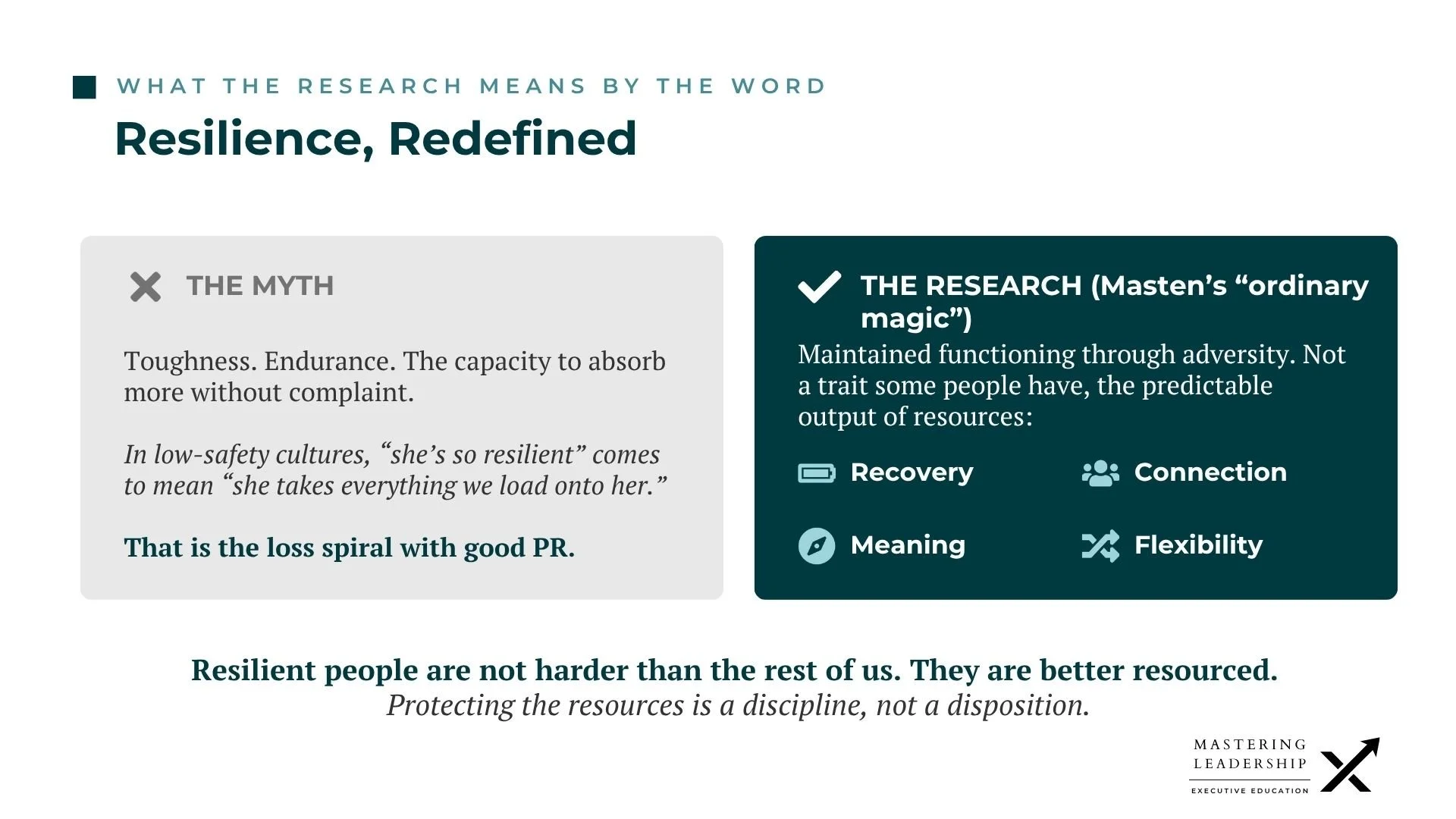
A caveat before the word "resilience" enters the room, because the word has been abused. The literature is consistent: personal coping moderates the damage of a bad system but cannot offset chronic high demands with low control. Organizations that prescribe yoga for a workload problem are treating the thermometer instead of the fever.
But the research definition of resilience is more useful than the pop version. Resilience scientists like Ann Masten define it not as toughness but as maintained functioning through adversity, and the core finding, what Masten calls "ordinary magic," is that it's not a trait some people have. It is the predictable output of resources: recovery, connection, meaning, flexibility. Low-safety cultures quietly redefine resilience as silent absorption: "she's so resilient" comes to mean "she takes everything without complaint." By the research definition, that isn't resilience. It's the loss spiral with good PR.
Protecting the resources, then, is the discipline. Three moves with strong evidence:
Break the rumination channel. Work stress reaches your health largely through rumination, the replaying and anticipating that happens off the clock. A deliberate transition ritual between work and home, and a contained 15-minute "worry appointment" on paper, improve the psychological detachment that protects you.
Reappraise from a distance. Ethan Kross's research on self-distancing shows that talking to yourself in the third person, or from a future vantage point, reliably reduces rumination and reactivity. The most protective reframe in a difficult culture is also the truest one: the system's reaction to you is data about the system, not a verdict on you.
Diversify your identity. Self-complexity research finds that people whose sense of self rests on multiple domains, parent, friend, athlete, craftsperson, are buffered against stress in any one of them. When work is your whole identity, a toxic workplace has access to your whole self. Investing in non-work identities is structural protection: it shrinks the surface area the culture can damage.
None of this fixes a culture. All of it determines what condition you're in while you run the experiments and decide, with a clear head rather than a depleted one, whether this is a system to change or a system to leave. Burnout makes that decision for you, and it usually decides badly. Protection keeps the decision yours.
Someone goes first
At the close of the session, I asked the group to name their experiments out loud. There was a pause, the kind that tells you the request costs something. Then Marcus went first.
That's the whole mechanism, really. We treat busyness as a badge and time management as a personal skill, but in many organizations chronic time scarcity is a symptom, and the disease is an environment where saying no, naming costs, and making mistakes all feel unsafe. You cannot calendar-block your way out of a trust problem.
What changes it is not a framework. It's a leader making the cost of yes visible, in front of people who are watching to see if it's survivable. It works because someone goes first.
When the culture is the work
Some of what this article describes, an individual can do alone. The rest takes organizational will, and quite frankly, not every organization is ready. For the ones that are, this is the work MLX does.
We partner with leadership teams to transform culture deliberately, not by poster campaign but through three connected moves: trust-centred training that gives leaders the language and tactics, data-driven executive conversations that surface what polished reporting hides, and coaching programs that turn insight into practiced behaviour. And because culture work without measurement is just hope, we anchor every engagement in metrics: we baseline how trust actually behaves in your organization using the Leadership Trust Audit, target the habits and conversations that move it, and re-measure to confirm trust is strengthening rather than just being discussed. In this work, what you do with the information is the most important part.
If your organization is too good at coping, and ready to stop, let's talk.
Dr. Tatiana Astray is the founder of Mastering Leadership Executive Education (MLX), a Toronto-based firm specializing in science-led, trust-centred leadership development, executive coaching, and negotiation training.
References
Bakker, A. B., & Demerouti, E. (2007). The job demands-resources model: State of the art. Journal of Managerial Psychology, 22(3), 309-328. https://doi.org/10.1108/02683940710733115
Boren, J.P. (2014). The relationships between co-rumination, social support, stress, and burnout among working adults. Management Communication Quarterly, 28(1), 3-25. https://doi.org/10.1177/0893318913509283
Detert, J. R., & Edmondson, A. C. (2011). Implicit voice theories: Taken-for-granted rules of self-censorship at work. Academy of Management Journal, 54(3), 461-488. https://doi.org/10.5465/amj.2011.61967925
Dutton, J. E., & Ashford, S. J. (1993). Selling issues to top management. Academy of Management Review, 18(3), 397-428. https://doi.org/10.5465/amr.1993.9309035145
Edmndson, A. C. (1999). Psychological safety and learning behavior in work teams. Administrative Science Quarterly, 44(2), 350-383. https://doi.org/10.2307/2666999
Edmondson, A. C. (2019). The fearless organization: Creating psychological safety in the workplace for learning, innovation, and growth. Wiley.
Hirschman, A. O. (1970). Exit, voice, and loyalty: Responses to decline in firms, organizations, and states. Harvard University Press.
Hobfoll, S. E. (1989). Conservation of resources: A new attempt at conceptualizing stress. American Psychologist, 44(3), 513-524. https://doi.org/10.1037/0003-066X.44.3.513
Karasek, R. A. (1979). Job demands, job decision latitude, and mental strain: Implications for job redesign. Administrative Science Quarterly, 24(2), 285-308. https://doi.org/10.2307/2392498
Kross, E., Bruehlman-Senecal, E., Park, J., Burson, A., Dougherty, A., Shablack, H., Bremner, R., Moser, J., & Ayduk, O. (2014). Self-talk as a regulatory mechanism: How you do it matters. Journal of Personality and Social Psychology, 106(2), 304-324. https://doi.org/10.1037/a0035173
Linville, P. W. (1987). Self-complexity as a cognitive buffer against stress-related illness and depression. Journal of Personality and Social Psychology, 52(4), 663-676. https://doi.org/10.1037/0022-3514.52.4.663
Marmot, M. G., Bosma, H., Hemingway, H., Brunner, E., & Stansfeld, S. (1997). Contribution of job control and other risk factors to social variations in coronary heart disease incidence. The Lancet, 350(9073), 235-239. https://doi.org/10.1016/S0140-6736(97)04244-X
Masten, A. S. (2001). Ordinary magic: Resilience processes in development. American Psychologist, 56(3), 227-238. https://doi.org/10.1037/0003-066X.56.3.227
Morrison, E. W., & Milliken, F. J. (2000). Organizational silence: A barrier to change and development in a pluralistic world. Academy of Management Review, 25(4), 706-725. https://doi.org/10.5465/amr.2000.3707697
Sonnentag, S., & Fritz, C. (2015). Recovery from job stress: The stressor-detachment model as an integrative framework. Journal of Organizational Behavior, 36(S1), S72-S103. https://doi.org/10.1002/job.1924
Weick, K. E. (1984). Small wins: Redefining the scale of social problems. American Psychologist, 39(1), 40-49. https://doi.org/10.1037/0003-066X.39.1.40
Wrzesniewski, A., & Dutton, J. E. (2001). Crafting a job: Revisioning employees as active crafters of their work. Academy of Management Review, 26(2), 179-201. https://doi.org/10.5465/amr.2001.4378011