Proactive Leadership Part 2: Why Silence Is Not Kindness
Silence is nice, but it is not kind.
In Part 1 of this series, Proactive Leadership at Scale: From "Why Not" to "How Yes", I wrote about what happens when the senior layer of a firm defaults to "why not" as the answer to every ambitious idea. That piece was about the question senior leaders ask when an opportunity hits the table.
This one is about the question they avoid when a person is not delivering on what was agreed.
What this piece covers, and why it matters. I will walk through six things. The pattern of the senior leader who knows the conversation she needs to have and has been deferring it for six quarters. The reframe that turns kindness inside out and asks who the silence is actually protecting. The two organisational signals silence sends to the team watching it, and how to tell which one you are running. A comparison of two leaders in different sectors who faced the same fork and chose differently. The three reckonings the senior leader has to face before the conversation becomes possible. And the two structures that make the conversation runnable when the silence has lasted too long.
This is the most expensive pattern I see in senior leaders. It costs the firm its best people, its standards, and its momentum, and it almost never shows up on a performance review. By the end you will have a diagnostic, a vocabulary, and a question to walk into your next quarter with.
Both pieces in this series are the same work. Proactive leadership reverses the default in both directions. It says yes to the idea that deserves a chance, and it says the hard thing to the leader who needs to hear it. Reactive leadership does the opposite. It says no to the idea, and nothing to the person. The best people on your bench notice both.
The leader who would not have the conversation
I want to start with one senior leader I have been working with, because her pattern is the most common one I see at the top of well-run firms. Read it as a description, not an indictment. Most senior leaders I sit across from can name a version of this leader, often themselves.
She runs a large business unit inside a Canadian financial services firm. Her numbers are strong. Her promotion track is on schedule. Two of her peers on the leadership team consider her one of the best operators in the building.
And she has had the same direct report underperforming in a critical role for two years.
She knows it. The team knows it. Her own leader knows it. The conversation has been on her quarterly list for six cycles. Every quarter, something more urgent arrives. Every quarter, the conversation gets pushed.
In the eighteen months before we started working together, she lost two of the strongest people on her bench to internal moves. Both exit conversations said the same thing in different words. One of them, almost verbatim: "I could not keep covering for someone who was not going to change, and watching her not say anything about it."
That last clause is the one that matters. The high performers did not leave because of the underperformer. They left because of the silence.
Takeaway: at the senior level, the best people leave because of what their leader is not saying, not because of what the underperformer is doing.
Kind to whom?
When we started, she described the silence as kindness. She did not want to embarrass him. He had been loyal to her during a hard restructuring two years earlier. The performance issue, she told me, was something she would address when the timing was better. What broke the frame open was a single question.
I asked her, kind to whom?
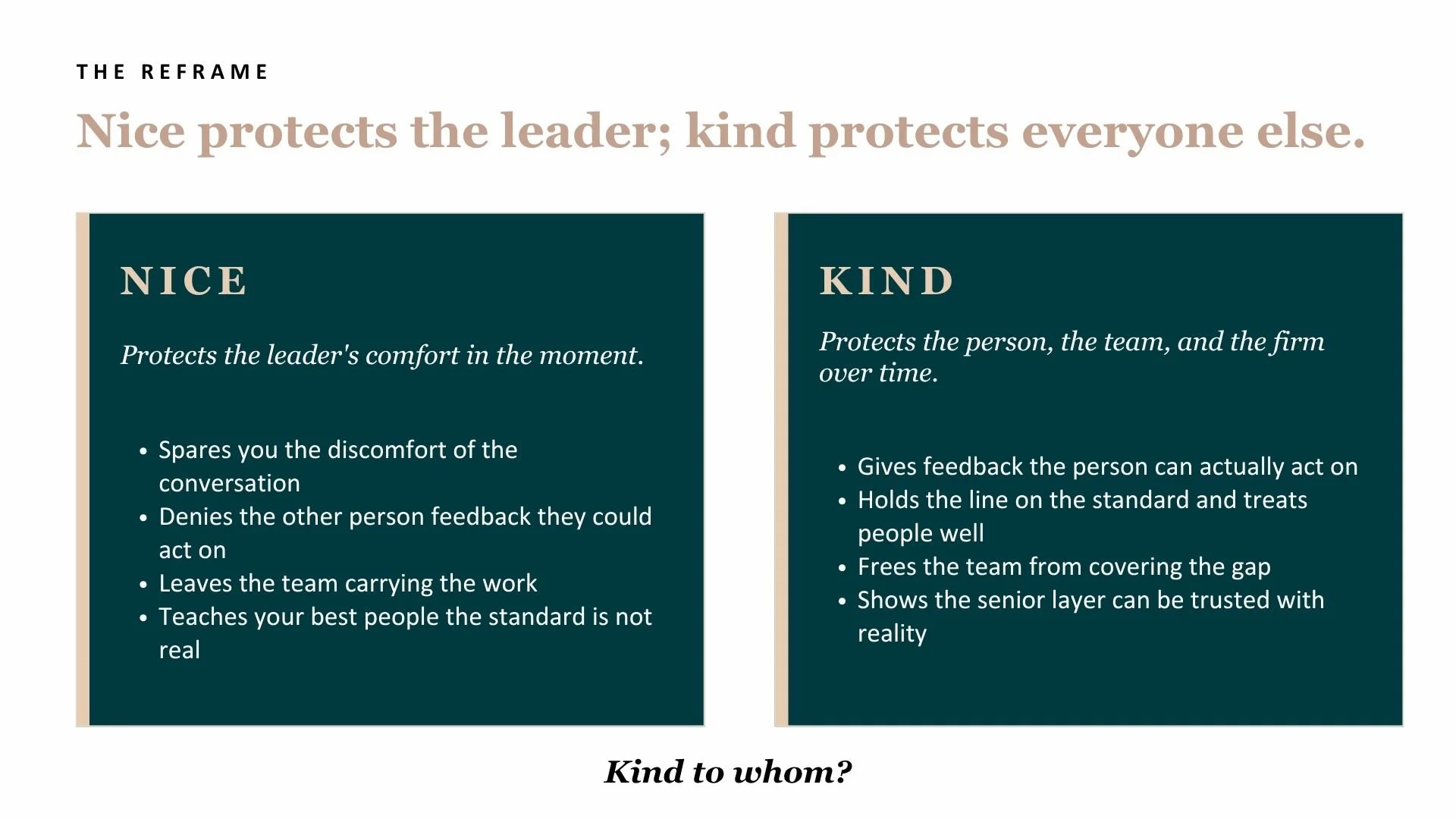
The silence she had been calling kindness was, on a daily basis, kind only to her. It spared her the discomfort of the conversation. The person on the other side was being denied feedback he could act on, which is the only form of kindness that matters at the senior level. The team around him was carrying his work. The two high performers who left were watching her, and what they were learning was that the standard she said she held was not actually real.
Silence is nice. Nice protects the leader's comfort in the moment. Kind protects the person, the team, and the firm over time. They are not the same thing, and they are often opposites.
Takeaway: if the silence is kind, ask who it is kind to. If the answer is anyone other than the person you are not speaking to, the frame is doing different work than you thought it was.
What silence signals at the senior level
The reframe is personal. The next move is structural. What does the team actually read when a senior leader holds silence on a standard for two years?
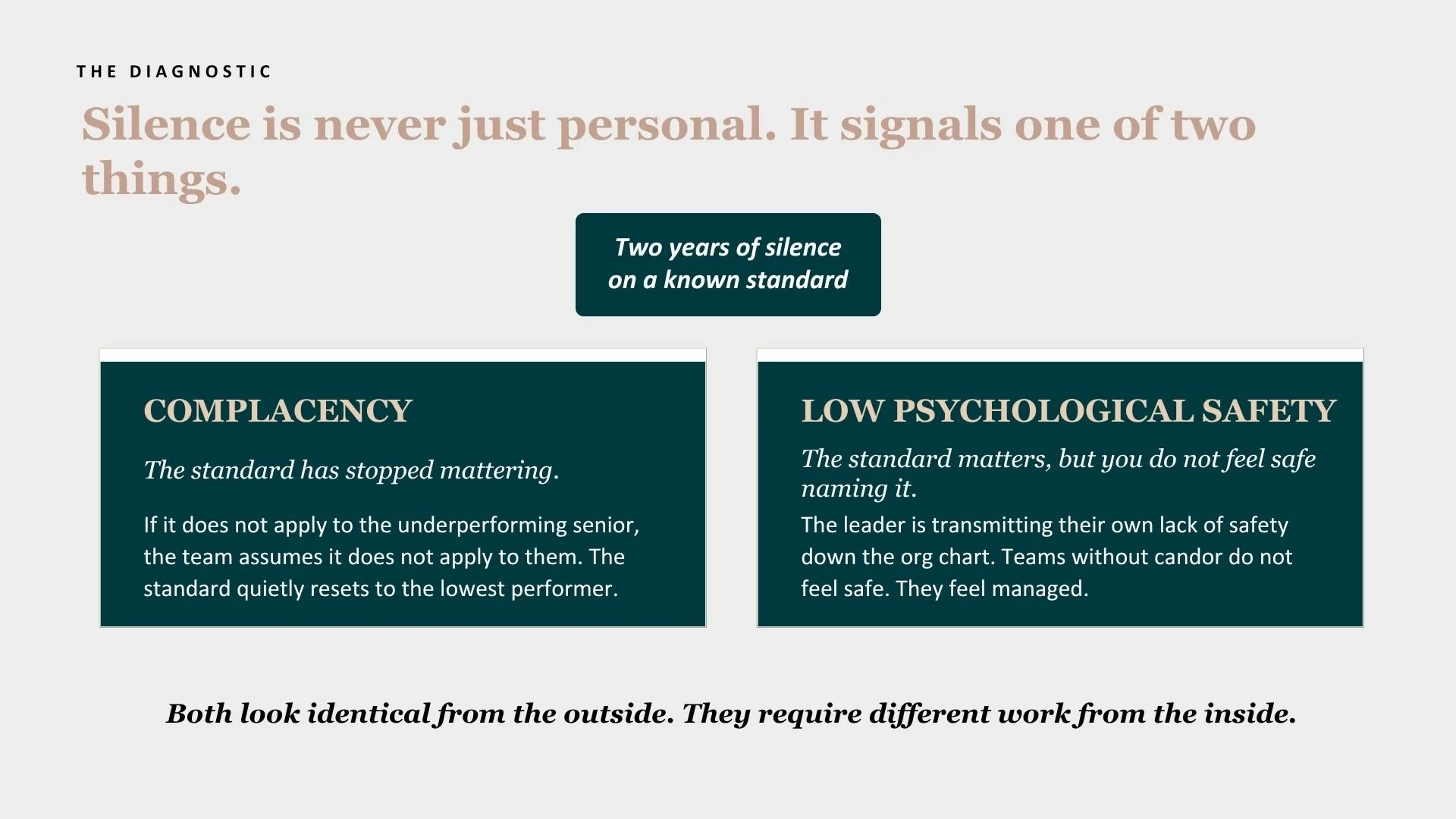
At the senior level, silence is never just personal. It signals one of two things to the team watching it.
The first is complacency. The leader has stopped caring about the standard enough to enforce it. The team reads this immediately, even if the leader has not yet read it in themselves. If the standard does not apply to the underperforming senior leader, the team's working assumption is that it does not really apply to them either. The standard quietly resets to whatever the lowest performer is delivering.
The second is low psychological safety. The leader cares about the standard but does not feel safe enough to name it. Amy Edmondson's research on psychological safety is often misread as the case for being nicer (Edmondson, 1999, 2018). Her teams hold the line on the standard and treat the person well at the same time. Most senior leaders do one or the other. Teams without candor do not feel safe. They feel managed. The senior leader who avoids the conversation is, almost always, transmitting their own lack of safety down the org chart.
Either way, the team is paying for it. And the high performers, who are the most calibrated readers of both signals, are the first to act on what they see.
Takeaway: before you have the conversation, diagnose which signal you have been sending. Complacency and absence of safety look identical from the outside, and they require different work from the inside.
Two leaders, two outcomes
The leader I described above is still mid-decision. To show what each path produces, here are two senior leaders I have worked with in different firms, who faced the same fork and chose differently. The comparison is the closest thing I have to a controlled experiment.
The first ran a business unit inside an investment management firm. The underperformer was a long-tenured senior who had been loyal to her during a restructuring two years earlier. Her reasoning was the one I hear most often. The person had history. Moving him would be disruptive. The market was tight and a clean replacement was unlikely. She told herself she would revisit in two quarters. Six months in, two of her strongest performers had taken roles elsewhere. By month nine, the team had missed the year's largest opportunity because the underperformer was the chair of the working group and could not move the file. By month twelve, when she finally ran the conversation, it was no longer just about him. It was about her. The team had spent a year drawing their own conclusions about whether she would hold a line. The conversation she ran at month twelve was four times harder than the one she could have run at month one, because the silence itself had become part of what she had to address.
The second ran a function inside a global professional services firm. Her situation was different in one specific way. The underperformer was someone she had hired herself, eighteen months earlier. The unhad conversation was not just about him. It was about whether she could admit a hiring decision had not worked. She did not have more courage than the first leader. What she had was a sharper read of what the silence was already costing. She ran the conversation in month three. She named what she was seeing. She named what support was on the table. She named the date by which the standard had to move. The progress did not come. The change followed in month five. Two things happened in the six months after. The team's two strongest performers, who had been quietly looking, stopped looking. And the people one layer down started bringing harder problems to her, because she had demonstrated that the senior layer could be trusted to address reality.
Same pattern. Different industries, different reasons for the hesitation, different timing. The shared variable was not courage. It was whether the leader had let herself see what the silence was costing.
Takeaway: the difference between the two outcomes is not courage. It is whether the leader named the cost of silence in specifics she could not ignore.
The three reckonings underneath the work
The diagnostic is intellectual. The reckonings are the part that actually shifts behaviour. Three things the senior leader has to face honestly before the conversation becomes possible.
The audience is not the person. It is the team. When you prepare for the conversation, you prepare as if there are two people in the room. There are usually twenty. The high performers are calibrating their assumptions about what you actually hold a line on, and they are doing it whether you ever have the conversation or not. The conversation you think is interpersonal is, almost always, the most visible structural decision you will make that quarter.
Hope is not a plan. If the behaviour has been the same for two quarters, the probability that the next quarter is different without an intervention is low. Hope as a strategy is the leader's preference not to act, dressed as patience.
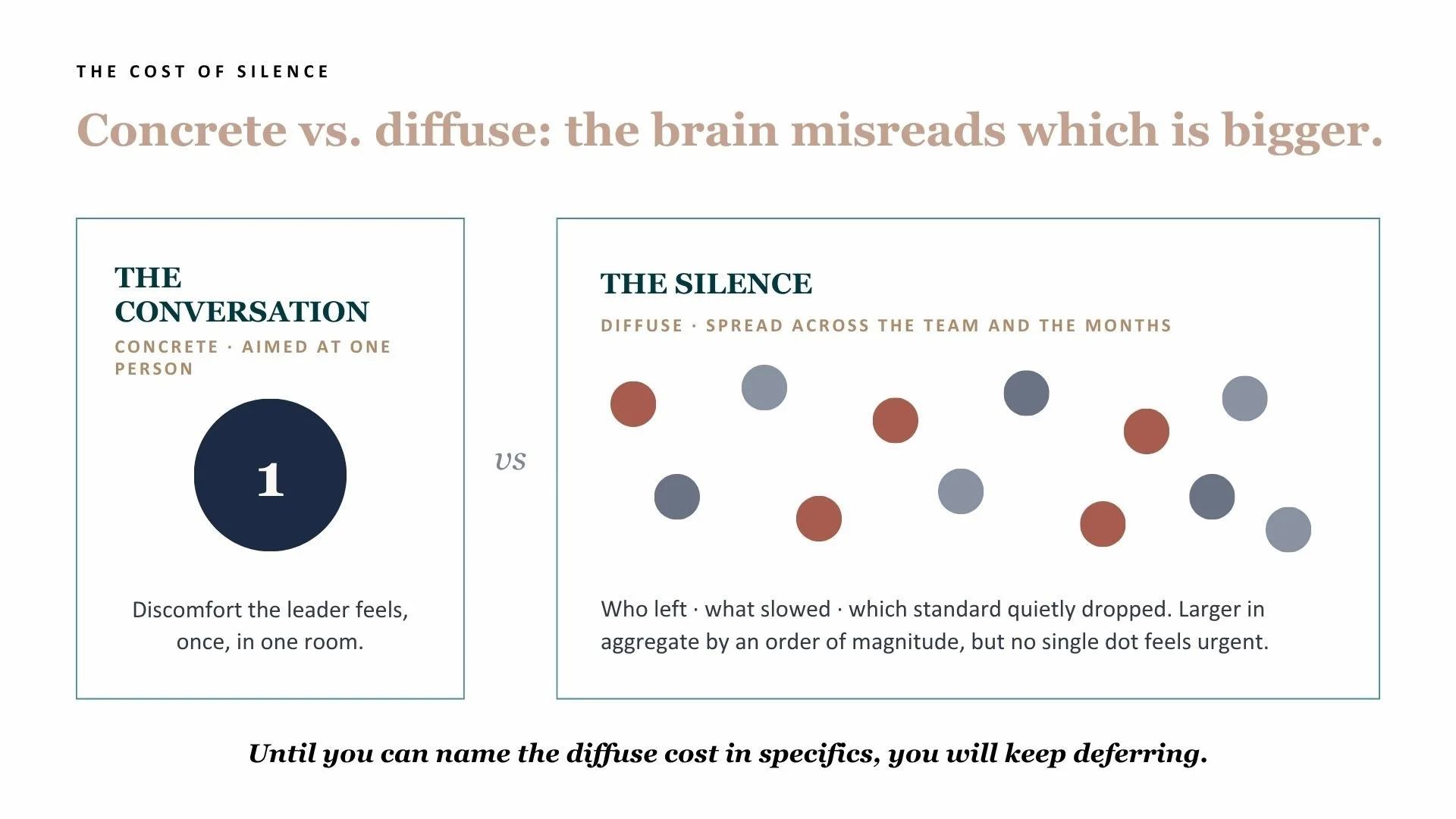
The cost of silence is real. It is just diffuse. The cost of the conversation is concrete, named, and aimed at one person. The cost of the silence is distributed across the team and the months. The senior leader's brain processes the concrete cost as larger even when the diffuse cost is, in aggregate, an order of magnitude greater. Until you can name the diffuse cost in specifics (who left, what slowed, what standard quietly dropped), you will keep deferring.
Takeaway: courage is not the prerequisite. Clarity about who is watching, honesty about hope as a strategy, and specificity about the diffuse cost are.
The tools that make the conversation runnable
The reckonings prepare the leader. The tools structure the conversation. Two specific structures I work with senior leaders to use when the silence has lasted too long and improvisation will not survive the room.
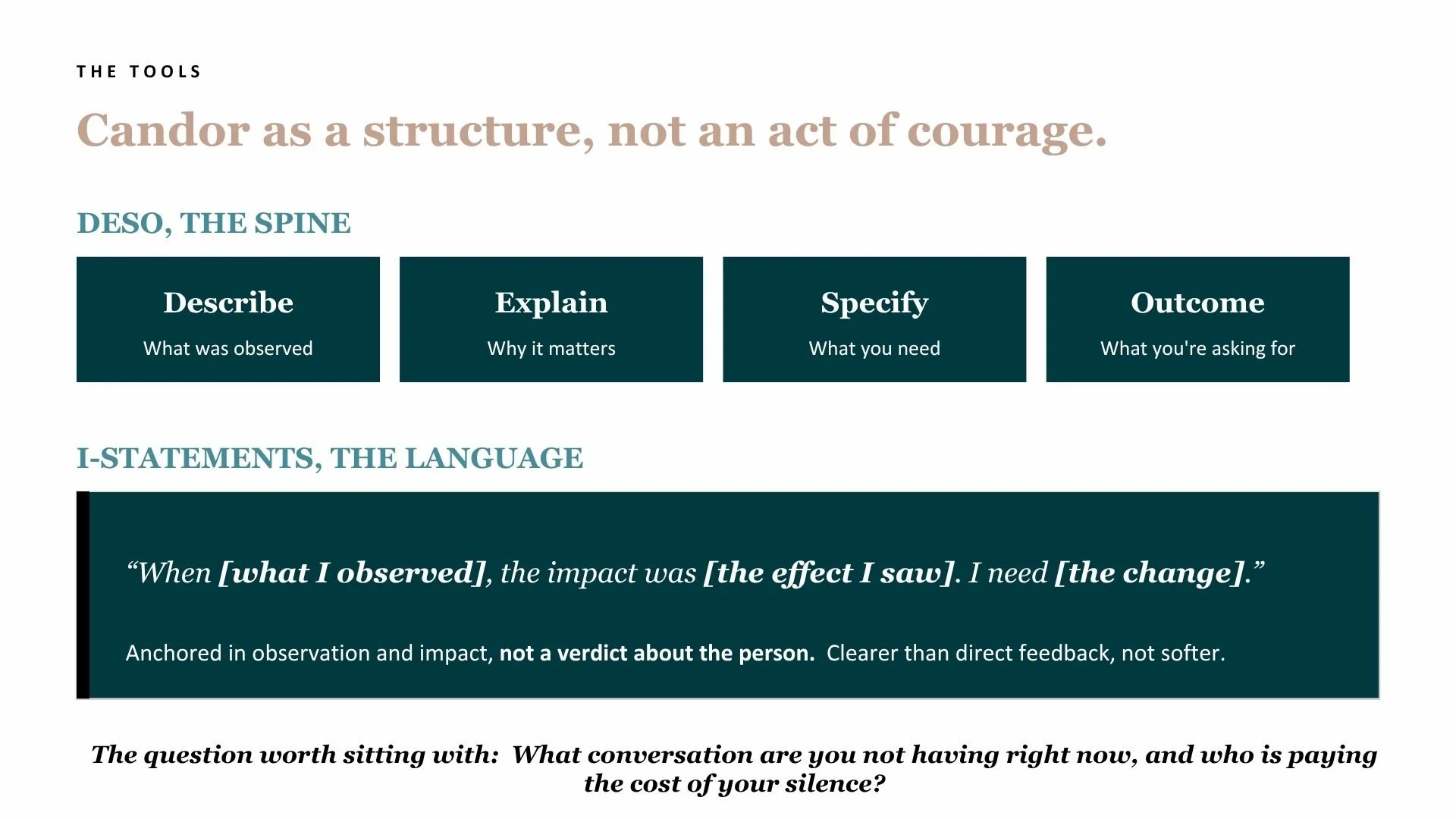
The first is the DESO script. Describe, Explain, Specify, Outcome. It separates what was observed from what the leader needs, and it ends with the outcome the leader is asking for. It is the structure I reach for when the conversation has been deferred long enough that the leader needs a spine to walk into the room with.
The second is I-statements. I-statements are not softer than direct feedback. They are clearer. They anchor the conversation in what the leader has observed and what the impact has been, rather than in a verdict about the other person.
Both tools do the same underlying work. They make it possible to be direct without delivering a verdict, and clear without being unkind. They are not a script the leader hides behind. They are a structure that lets the leader speak honestly when the silence has been the easier option for too long.
Takeaway: the conversation does not have to be improvised. DESO gives you the spine. I-statements give you the language. Both turn candor into a practice rather than an act of personal courage every time.
The question worth sitting with
Part 1 defined proactive leadership as root-cause, system-level, and run on strategic time. The conversation a senior leader is avoiding is all three. It is the root cause of the team's drift in standard. It is the system-level signal the rest of the team is already reading. And the time being lost to managing the silence (the workaround meetings, the side-channel reassurances to the people carrying the load, the working groups quietly restructured to keep the underperformer off the critical file) is strategic time the leader will not get back.
The most proactive move available to a senior leader is, almost always, the conversation they have been treating as the least urgent.
So here is the question.
What conversation are you not having right now, and who on your team is paying the cost of your silence?
If you cannot name the conversation, ask the high performers on your bench. They can. If the high performers have already left, the standard has already reset. The room you walked into this morning is now the new ceiling.
The next move is yours.
The Leadership Trust Audit maps where the silence is actually living inside your senior layer, and what it is costing. Coaching is where the three reckonings happen. Structural design is what makes candor a default rather than an act of courage every time.
If you are working on the gap between the leader you intended to be and the conversations you have actually been having, let's start. The first call is thirty minutes.
References
Edmondson, A. C. (1999). Psychological safety and learning behavior in work teams. Administrative Science Quarterly, 44(2), 350-383. doi.org/10.2307/2666999
Edmondson, A. C. (2018). The fearless organization: Creating psychological safety in the workplace for learning, innovation, and growth. Hoboken, NJ: John Wiley & Sons.