I coach senior leaders, and the sentence I hear most often is some version of “I don’t have time.” The week is usually full. What is less clear, until we look at the data, is what the week is full of.
In the time audits I run with leaders, three things come up again and again. The highest-value work gets the smallest share of the week. The people around them, direct reports, a chief of staff, an assistant, carry less than they could. And the tools that could take repetitive work off their plate, including AI, are barely used.
What it looks like
The case below is a composite of how this shows up in coaching. I will call him Marcus. Marcus is a senior vice president at a large financial institution, responsible for a division of several hundred people and six directors. He rose through the organization as the person who could fix anything: the best analyst, then the best manager, then the leader everyone escalated to. He is respected, decisive and fully booked. He came to coaching with one request: help me find time to think.
Me: Where did last week go?
Marcus: Meetings, mostly. And email at night.
Me: How much of it went to the strategy you were hired to deliver?
Marcus: Not enough. Maybe a day.
Me: Would you track one week, hour by hour, so we can see it?
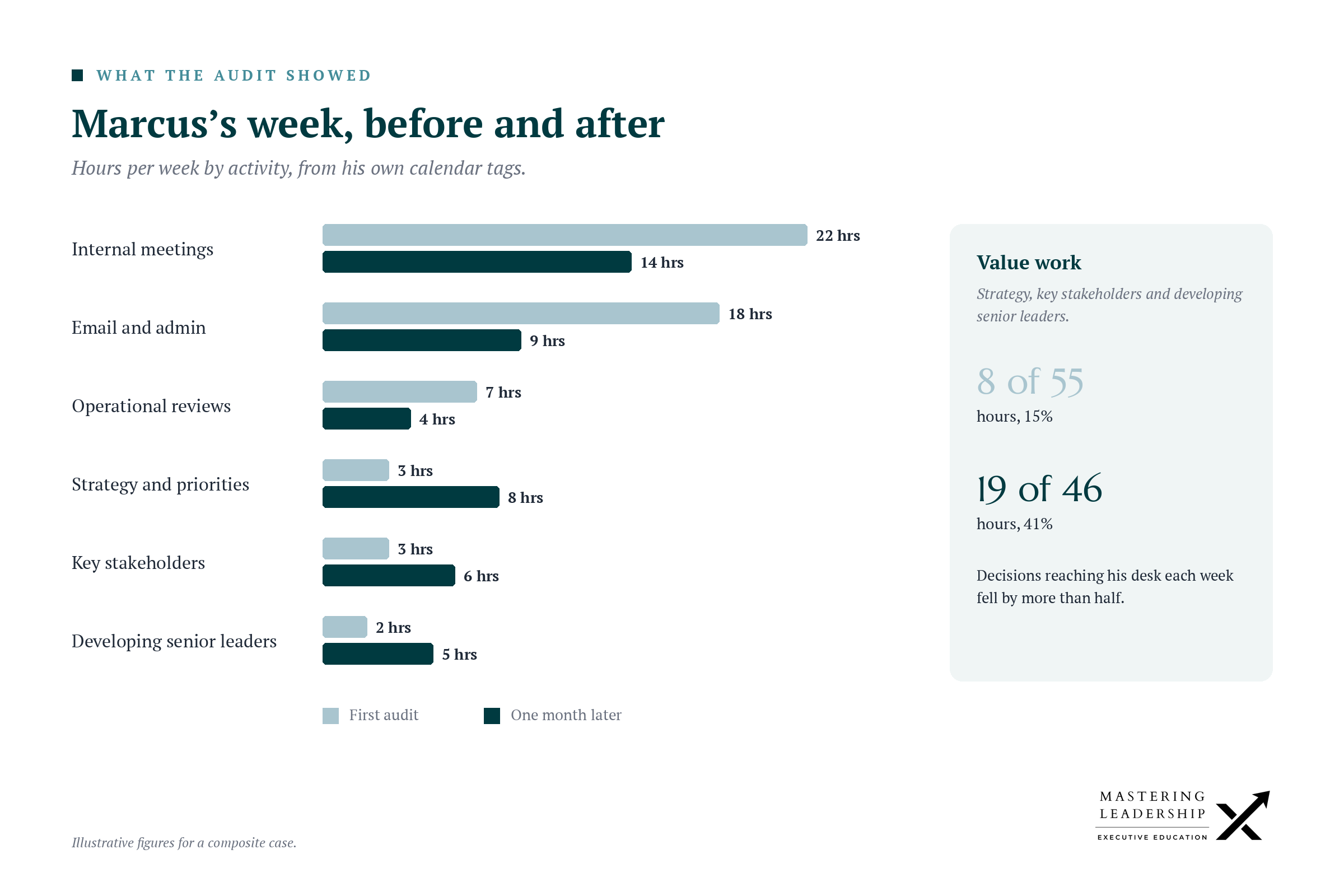
He tagged every block in his calendar for the next week, including the evenings in his inbox. The total was 55 hours. Twenty-two went to internal meetings, eighteen to email and administration and seven to operational reviews and escalations. Strategy and priorities got three hours. His most important stakeholder relationships got three. Developing his senior leaders got two. The day he thought he spent on strategy was closer to three hours.
Self-check: if you tracked last week by the hour, how many hours went to the work only you can do?
Three more things came out of the audit. His directors brought him decisions they were capable of making, and he made them, because it was faster than explaining what good looked like. His chief of staff was managing his calendar when she could have been driving his priorities. And he used AI only to tidy emails he had already written.
Me: Why do those decisions come to you?
Marcus: They’re not ready. If I hand it off, I’ll spend longer fixing it.
Me: When did they last get the chance to get ready?
Marcus: They haven’t. I’ve never had the time to build that.
Me: So the time you don’t have is the time it would take to build them.
Marcus: Put like that, yes.
Me: What happens for you when a director brings you a decision you know they could make?
Marcus: Honestly? Relief. I know how to fix it, and it gets done.
Me: And when you hand something off?
Marcus: I’m uneasy until I see it. If it goes wrong, it’s my name on it.
Me: What would it say about you if a decision went wrong and you hadn’t touched it?
Marcus: That I’m not on top of my business.
We stayed with that answer for a while. Underneath it was a belief he had carried since his first promotion: a good leader is on top of every detail, and being on top means being involved. The belief had served him well. It made him the person everyone trusted with a problem. At his level, it kept him in work two layers below his role, and it kept his directors waiting for permission.
It also explained the loop he was in. Marcus did not trust his team with the work, so he kept it, so they never built the capability, so he still could not trust them. Every week he stayed in the loop, it got harder to step out of, and he kept choosing the wrong work for a sensible-sounding reason.
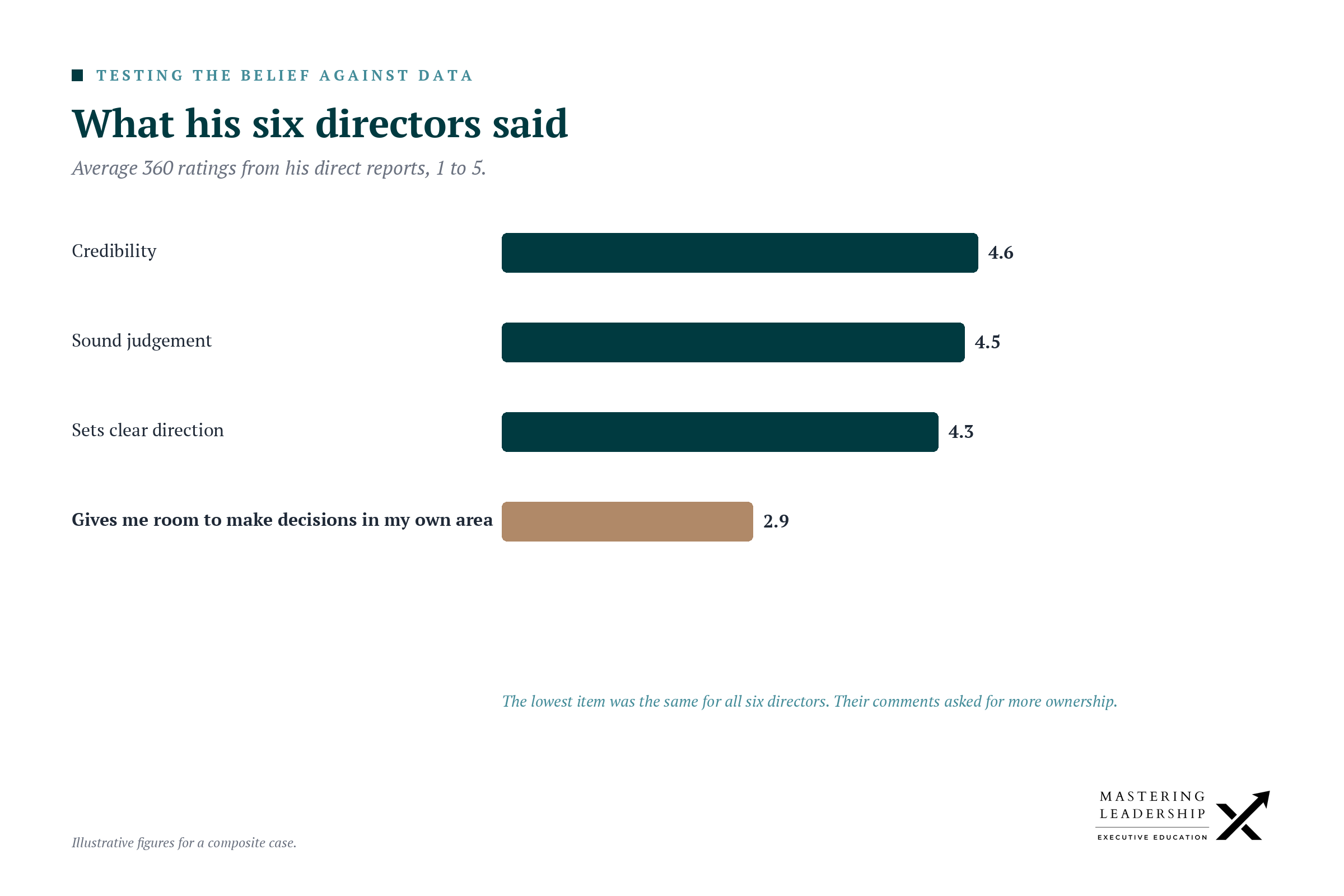
So we tested the belief against data. His six directors had recently rated his leadership in a 360 assessment. They rated his credibility and judgement among his strongest scores. The lowest item, across all six, was “gives me room to make decisions in my own area.” Their written comments said the same thing in different words: they wanted more ownership, and they believed they were ready for it. The people Marcus was protecting the work from were asking for it.
Self-check: which decision reached your desk this week that someone on your team could have made?
Over the next month, Marcus treated building his team as part of the strategy. He wrote down the decisions his directors could make without him, the ones they would recommend for his approval and the few he would keep. He asked each director to bring a recommendation with every problem. For the first month he held a fifteen-minute review each week with each of them on the decisions they had made, then stepped back. One director made a call he would have made differently, and it worked. He asked his chief of staff to triage his inbox and own the follow-up on his top three priorities, and he gave an AI assistant one recurring job, a one-page summary of the week’s pre-reads. He dropped three recurring meetings and moved strategy to the first two hours of three mornings a week.
When he tracked a week again, strategy and stakeholder work had gone from six hours to fourteen, and the decisions reaching his desk each week had fallen by more than half. His directors noticed first. Two of them told him it was the most energizing month they had had in the role.
Why it is a problem
Our sense of where time goes is unreliable. For decades, time-use researchers have found that people’s estimates of their working hours run well above what their time diaries show, and the gap grows as the hours get longer. When a week feels full, it is hard to see what is in it.
Urgency also pulls attention away from value. In a series of experiments, Meng Zhu, Yang Yang and Christopher Hsee found that people chose tasks with a deadline over tasks with a larger payoff, even when the important task was clearly better for them. They called it the mere urgency effect. An inbox and a full meeting calendar are a steady supply of small, urgent tasks. The McKinsey Global Institute estimated that knowledge workers spend about 28 per cent of their week managing email, and Sophie Leroy’s research on attention residue shows that each switch between tasks leaves part of our attention behind, so the next task gets less of us.
The deepest cause is often trust. Leaders keep work because they do not trust their team’s capacity to do it well. Because they keep it, the team never builds the capacity, and the trust never grows. The loop feeds itself, and it looks like diligence from the inside. Trust also works in the other direction. Sabrina Salamon and Sandra Robinson studied a retail chain and found that when employees felt trusted by management, they took more responsibility for results and their stores performed better. Being trusted is part of how people become trustworthy.
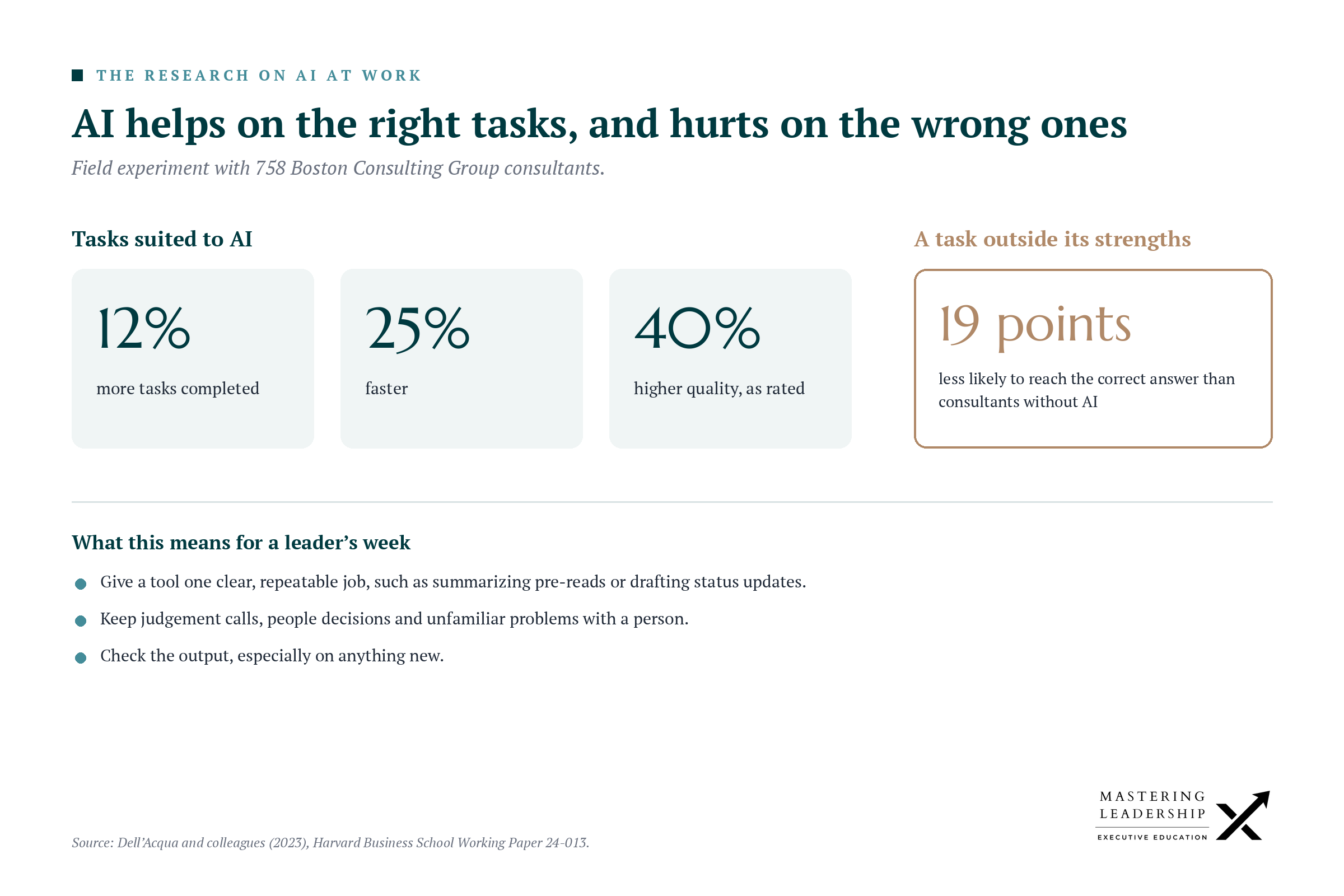
The tools are underused too. In a field experiment with Boston Consulting Group, Fabrizio Dell’Acqua and colleagues found that consultants using AI on tasks suited to it completed about 12 per cent more tasks, 25 per cent faster, with work rated about 40 per cent higher in quality. On a task outside the AI’s strengths, the consultants who used it were less accurate. The gains come from choosing the right tasks and checking the output.
Self-check: what is the most urgent item on your list today, and is it the most valuable?
The mindset shift
“I don’t have time” is a description of a full week. It says little about whether the week is going to the right work.
The more senior the role, the more this matters. A senior leader is paid for judgement, direction and relationships: setting priorities, making the calls nobody else can make, building the leaders below them and holding the relationships the organization depends on. Every hour spent on work someone else could do well is an hour taken from that work. It costs the team as well, because the decisions a leader holds on to are often the stretch the people below them need.
Building the team is part of the strategy. The hours it takes to build capacity are an investment, and they pay back every week afterwards. The practical question is how to make it easier to start, so that handing work over feels safe before the trust is fully there.
The principle I use with leaders is simple: protect the work only you can do, and build a system for everything else. Your people need clear decision rights, a written standard and room to own the work. Your tools need one clear job at a time. And you need a regular time audit, because without data the principle stays an intention.
Self-check: what would your team say you are holding on to?
Tools to apply
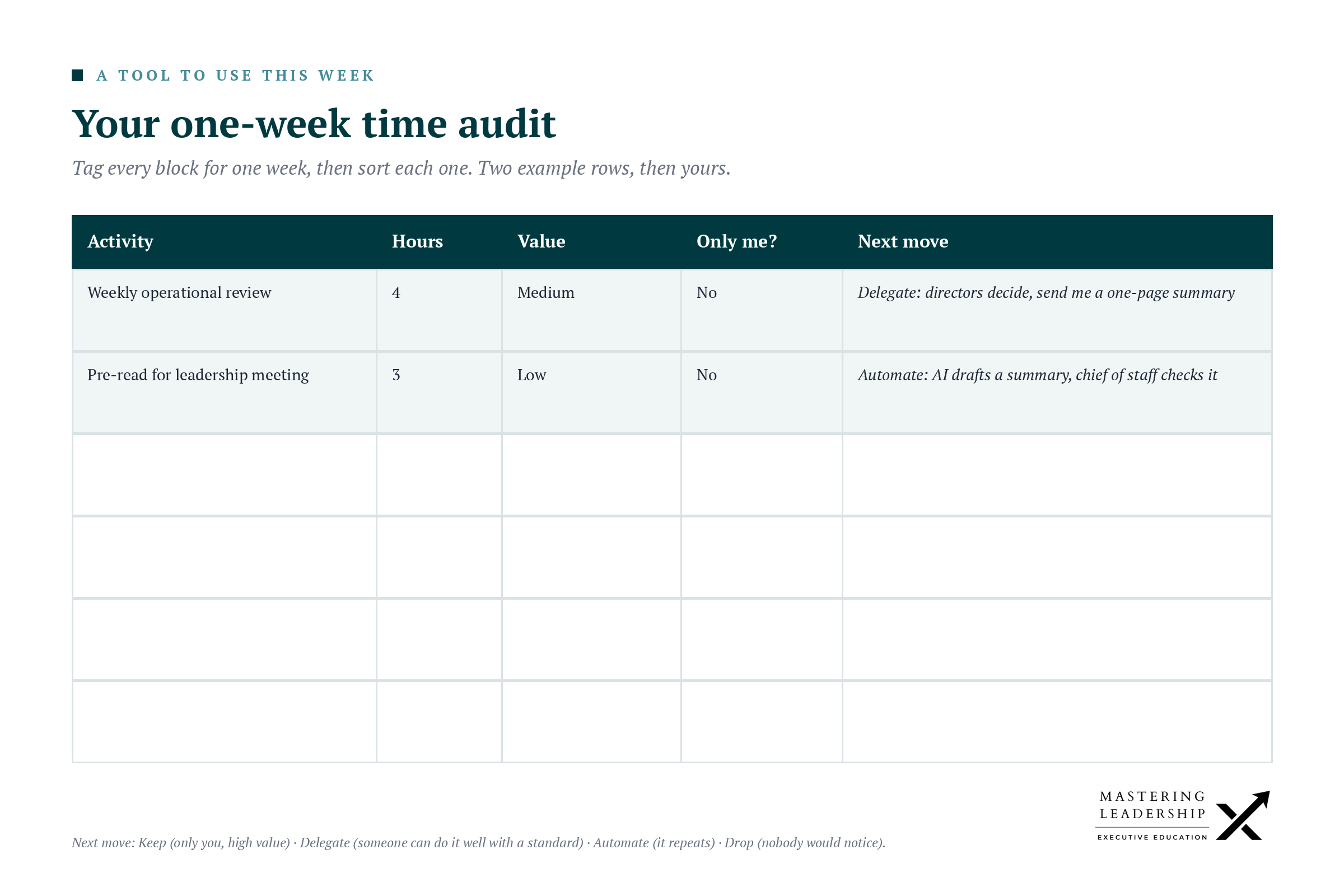
Run a one-week time audit. Tag every calendar block for a week, evenings in the inbox included. For each block, note how much value it created and whether anyone else could do it well with some support. Use the record, and leave your memory out of it.
Name and protect your value work. Choose the two or three activities that create the most value in your role, set a target share of the week for them, and schedule them first, before the inbox.
Write down who decides what. List the decisions your team can make without you, the ones they recommend and you approve, and the few you keep. Clear decision rights remove most of the traffic to your desk.
Build trust in stages. Hand work over in steps: they watch you, you do it together, they do it and you review, then they own it and tell you the result. Ask for a recommendation with every problem. Start with frequent, lower-risk work, and agree the guardrails, such as a spending limit or the situations that still come to you.
Make the handover easy. Give people what you carry in your head: a checklist of what excellent looks like, an example of work done well, or a short recording of you doing the task. AI can turn a recording or a rough note into clear steps, draft the routine pieces and summarize what you need to review.
Review briefly, then step back, and re-audit monthly. Hold a fifteen-minute weekly review of delegated work for the first month, then stretch it out. Each month, compare the hours in your value work with your target, and adjust.
What the data makes possible
At Mastering Leadership Executive Education, we start with data before advice. A sense that there is no time is a hypothesis, and a time audit tests it, in the same way our Leadership Trust Audit® tests how a leader is experienced by others. We look at where the hours go, which work creates value and what the team and tools could carry, and we design the development from there. Then we measure again.
Marcus found the time by testing a belief against data, building a team he could trust with the work, and choosing where his own hours went.
About MLX
Mastering Leadership Executive Education (MLX) is a Toronto-based leadership development firm. Science-led and trust-centred, we design and deliver executive programs, workshops, and coaching for organizations across banking, government, policing, and the nonprofit and creative sectors. Our work is built around the conversations that actually move organizations: trust, accountability, negotiation, feedback, and the difficult ones leaders avoid. Every program is grounded in peer-reviewed research and customized end to end: our in-house AI platforms, including the Leadership Trust Audit®, tailor the diagnostics, content, and coaching support to your people and your context. Then it is practiced on your real situations, not hypotheticals, which is why it still holds on Monday.
If your senior leaders have no time for the work only they can do, that is exactly the work we do. Contact us and we’d love to start a conversation about how we can help.
References
Dell’Acqua, F., McFowland, E., Mollick, E. R., Lifshitz-Assaf, H., Kellogg, K., Rajendran, S., Krayer, L., Candelon, F., & Lakhani, K. R. (2023). Navigating the jagged technological frontier: Field experimental evidence of the effects of AI on knowledge worker productivity and quality (Working Paper No. 24-013). Harvard Business School.
Leroy, S. (2009). Why is it so hard to do my work? The challenge of attention residue when switching between work tasks. Organizational Behavior and Human Decision Processes, 109(2), 168 to 181.
McKinsey Global Institute. (2012). The social economy: Unlocking value and productivity through social technologies.
Robinson, J. P., Martin, S., Glorieux, I., & Minnen, J. (2011). The overestimated workweek revisited. Monthly Labor Review, 134(6), 43 to 53.
Salamon, S. D., & Robinson, S. L. (2008). Experience of being trusted: Effects on responsibility norms and performance. Journal of Applied Psychology, 93(3), 593 to 601.
Zhu, M., Yang, Y., & Hsee, C. K. (2018). The mere urgency effect. Journal of Consumer Research, 45(3), 673 to 690.