Beyond The Invisible Playbook: Why Senior Women Cannot Stop Performing
Why does winning not feel like winning?
That is the question that keeps surfacing, in different words, from the senior women I work with. After the meeting, after the keynote, after the third glass of wine, the conversation circles back to the same thing.
I cannot sleep. I cannot stop replaying it. I closed the deal, and within an hour, I was second-guessing every word. My team thinks I have it together. I have not been a full human in months.
We have been calling this perfectionism for a long time. We have been calling it impostor syndrome. We have been telling women to let it go, to trust themselves, to stop being so hard on themselves.
None of that lands. Because none of it is naming what is actually happening.
The women I work with are not under-confident. They have evidence of their excellence. They have the title, the team, and the trust of the people who matter. The data does not match the feeling. Which means the standard prescriptions, the ones that target the feeling as if it were the problem, do not move the dial. The pattern is more durable than that. It is wired in.
This piece is about what is underneath that feeling. The cost of running the wrong playbook for too long. The exhaustion that does not respond to sleep. The replaying of emails for hours after they have been sent. The closed deal that does not feel closed. The body that has not had a deep breath in three years.
What perfectionism actually is
What looks like perfectionism in senior women is rarely perfectionism. It is hypervigilance.
The research on perfectionism distinguishes three types (Hewitt & Flett, 1991). Self-oriented perfectionism is the drive to meet your own standards. Other-oriented perfectionism is the drive to hold others to yours. The one that maps onto what senior women carry is the third: socially prescribed perfectionism. The belief that others demand perfection from you, and that failing to meet that demand will cost you.
The reason this distinction matters: socially prescribed perfectionism is not a personality trait. It is a learned response to an environment. And it is the only one of the three that consistently predicts depression, anxiety, and chronic stress (Curran & Hill, 2019). Self-oriented perfectionism can be exhausting. Socially prescribed perfectionism breaks you, because you are not the one setting the bar.
When socially prescribed perfectionism meets a workplace where women actually are evaluated more harshly than men, it stops being a personality trait. It becomes a survival posture.
Your brain has learned that staying perpetually on alert is the only way to stay safe. That is hypervigilance. It is the same mechanism trauma research has documented in people who lived through unpredictable, high-cost environments (van der Kolk, 2014). The mechanism does not care that the environment is now a board meeting instead of something earlier. It only knows that the cost of error has been high, and so the threat detector is set permanently to on.
This is why working harder does not solve it. The system you are trying to fix with effort is the one that is producing the exhaustion. You cannot outperform a survival response. You can only stop triggering it.
At the core, you are not anxious because you have a personality problem. You are anxious because your nervous system did the math correctly.
Why this maps onto women specifically
The math your nervous system has been doing is structural, not personal.
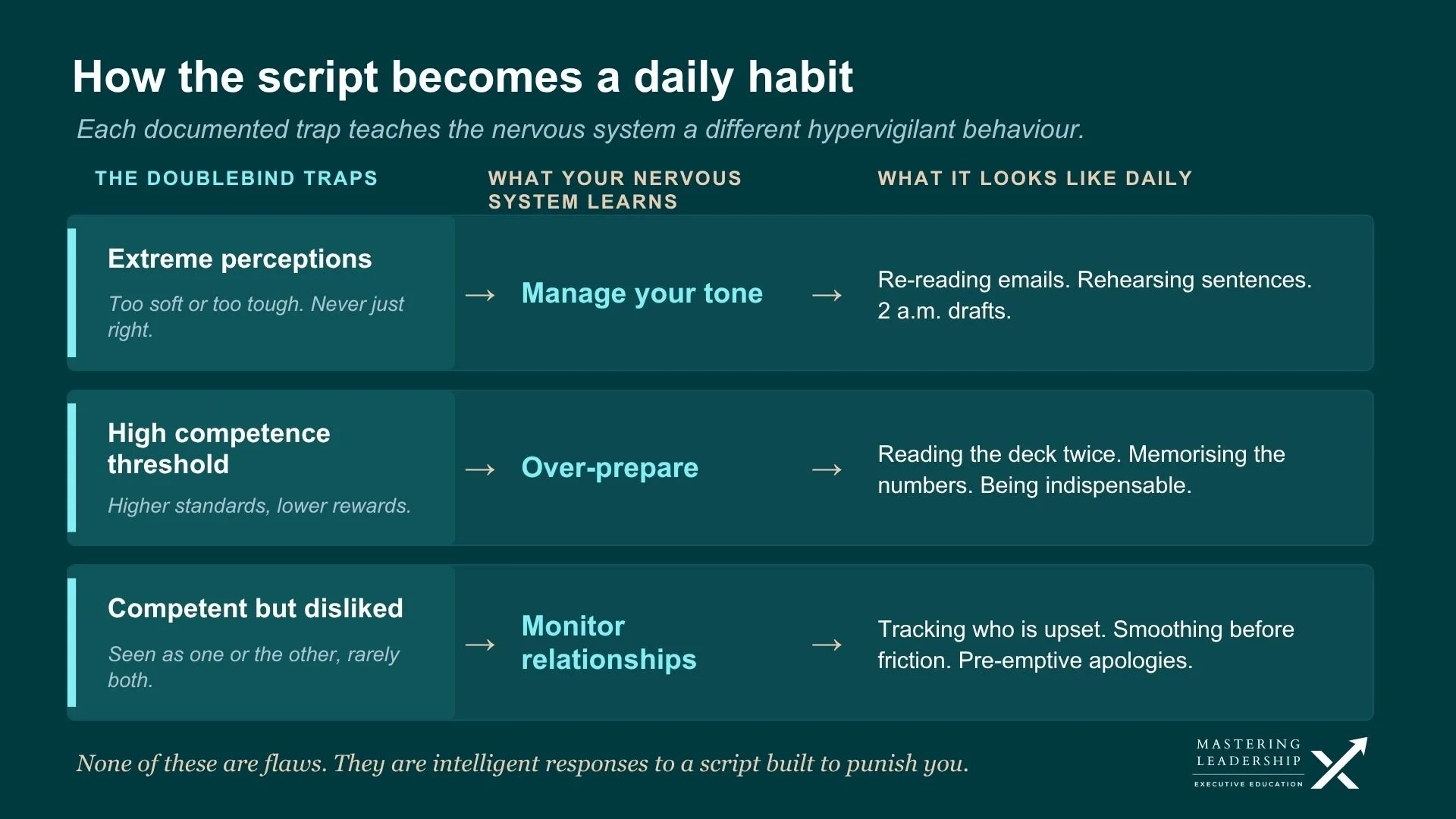
When women self-promote, negotiate assertively, or claim leadership, they are penalized in ways men are not (Rudman & Glick, 2001; Heilman & Okimoto, 2007). Catalyst's 2007 research on the double bind named the three specific shapes this takes: extreme perceptions (too soft or too tough, never just right), the high competence threshold (higher standards, lower rewards), and competent but disliked (you can be seen as one, rarely both).
Each of these traps generates a different hypervigilant behaviour.
Extreme perceptions teach you to manage your tone in every interaction. You soften the email, then you soften it again. You rehearse the sentence before you say it. You stay up at night drafting the response that will not get read the wrong way.
The high competence threshold teaches you to over-prepare. You read the deck twice. You memorise the numbers. You walk into the meeting with three more answers than anyone asked for. You become indispensable to the work, because being indispensable is what makes you uncuttable.
Competent but disliked teaches you to monitor relationships. You track who is upset with you, who you have not checked in on, who might think you are difficult. You smooth before there is a friction. You apologise pre-emptively for asks you have not made.
None of these are flaws. They are intelligent responses to a system that has been documented to punish women for the same behaviour that rewards the men beside them. The hypervigilance is the cost of trying to win a game whose rules were never written for you.
And here is the part that needs to be said out loud.
The system is exhausting because it was designed to be. There is no level of personal optimisation that makes it sustainable.
Three truths the senior women I work with keep arriving at
When I bring senior women together, three truths keep surfacing as the lessons they had to learn the hard way. They are not motivational. They are the math of leadership at the top, and once a woman names them out loud, the over-preparing has somewhere to stop.
You cannot be everything to everyone.
The senior leader. The lead at home. The daughter who shows up. The friend who remembers. The colleague who picks up the work no one else does. The mentor for the women coming up behind you. The wife who is also a partner. The host. The fixer. Pick. There is no version of leadership at the top that includes being all of those at full capacity. Trying to is what produces the bracing.
The senior women I work with name a practical strategy for this: delegate, and decline. You do not need to be everything to everyone, and that is okay. Saying no is not a retreat. It is a claim on what you choose to be present for.
You cannot be A+ in every role at the same time.
Some weeks you are an A+ parent and a C+ leader. Some weeks the inverse. Some weeks you are a B at everything because something hard is happening. When I name this out loud in a room of senior women, the room exhales. Because no one says it.
The fantasy of being excellent in all your roles simultaneously is the most expensive fantasy women carry. It is also the one we have been told the most often. The cost of believing it is not just exhaustion. It is the cumulative loss of clarity about which role actually requires your A+ right now, and which can hold a B for a season without anything collapsing.
You cannot be liked and a leader at the same time.
This is what the Catalyst research from 2007 documented. Twenty years later, the data has not moved. If you are claiming authority, you will be coded as cold. If you are warm, you will be coded as unserious. There is no third door.
The women who lead well do not waste energy trying to close this gap. They pick competent and let the rest sort itself out. Not because they do not care about being liked. Because they have done the math on what it costs to optimise for it, and the math does not work.
These three truths are not freeing in the abstract. They are freeing because they name the impossible shape of what you have been trying to do. You were not failing at being everything to everyone. You were attempting it.
What to do instead
The work is not to relax your standards. It is to stop trying to meet impossible ones.
Three moves help.
Name the system for what it is. The hypervigilance is rational given the structure. But you do not have to keep performing for it. Naming the system as the source of the cost is the first move toward not paying it personally. The women who do this report the same shift: the next time something goes sideways, they no longer reach first for what did I do wrong. They reach first for what is the system doing here.
Build the relationships that turn walls into doors. Yang et al.'s 2019 research on senior women's inner circles is the structural antidote to socially prescribed perfectionism. When you have a circle of senior women who actually carry your name, you stop needing to perform perfection for everyone in the room. The performance is for the people you have not yet recruited as allies. Recruit them. Two or three is enough.
Practise the no. You cannot do everything. You can only do what is yours to do. The first time you say no, your nervous system will spike. It will tell you that something bad is about to happen. Do it anyway. The second time is easier. By the tenth, the spike is gone. This is how the wiring updates.
These three moves are not techniques. They are the slow work of teaching your nervous system that the system you have been performing for no longer has authority over you.
What this looks like in coaching
I want to make this concrete, because the analytical case can sit in your head without ever landing in your body. Here is one version of how this work shows up in practice.
Anna is a client I worked with this past year. A senior vice president at a firm she had helped scale. She came to our first session having mapped her own coaching goals before we met: time management, supporting others while prioritising herself, setting boundaries and expressing concerns without anxiety. She had done the homework before the assignment.
On her 360 Leadership Trust Audit, her team rated her credibility at 4.46 out of 5. She rated her own credibility at 3.5. The team saw her as proven. She was still carrying herself as proving.
When I asked her what was getting in her way of the next move, she said burnout. Her exact words: "There are days I'm exhausted and not a full human."
She had been working harder. She had been adding hours. She had been over-preparing for meetings whose outcomes were already decided in her favour. Her behaviour and her body were both optimising for a threat that was no longer in the room.
The coaching work was not behavioural. It was perceptual. The shift she needed was internal before it could become external. Her nervous system needed to catch up to where her team already was.
What that looked like in our sessions: re-reading the 360 data out loud, slowly. Letting the numbers land. Pausing on the line they already see you as proven. Sitting with the discomfort of being seen as more than she was prepared to claim. Asking her what she would do tomorrow if she fully believed it.
Between sessions, we ran four specific practices.
The first-draft send. When Anna drafted an email, she sent it before she revised it more than once. Not for everything. For the low-stakes ones first. The goal was not faster email. The goal was teaching her nervous system that the catastrophe she had been bracing for did not actually arrive.
The POV-first move. In meetings where she usually compiled everyone else's positions before naming her own, she went first. One sentence. Her actual position. Before the room had spoken. The first three times were physically uncomfortable. The fourth was less so. By the end of the quarter, her team had started waiting for her to name the direction rather than compiling around her.
The body check. Before high-stakes meetings, she paused for ten seconds and named what her body was doing. The chest tightness. The jaw lock. The shoulders climbing toward her ears. She did not try to fix it. She named it. Naming a survival response interrupts it, even slightly. That interruption was the first crack in the wiring.
The one planned no. Each week, Anna declined one request that was not hers to hold. The first weeks she chose the safe ones. By the third month, she was declining things that mattered, where the discomfort was higher and the consequences were real. Her nervous system spiked each time. It also recovered faster each time.
These are not productivity hacks. They are the slow rewiring of a survival response. Each one was small enough not to trigger the full threat reaction, and consistent enough to teach her body that the threat was not in the room.
The behavioural changes followed once the internal map was updated. She stopped over-preparing for the meetings she was already qualified to lead. She started naming her point of view first, rather than compiling everyone else's afterward. She began to feel, in her own words, less braced.
The work is not finished. She still over-prepares for the meetings that matter most. She still catches herself bracing before the harder calls. But she catches herself. That is the signal her nervous system is updating, even if slowly. The script no longer runs on autopilot.
This is what the work of unlearning hypervigilance looks like. It is not a productivity hack. It is not a confidence exercise. It is the slow, deliberate practice of letting your nervous system match the room you are actually in.
What this means at the senior level
The perfectionism you are carrying is not a flaw. It is the receipt of a system that has been documented to punish women for the same behaviour that rewards men. Naming it hypervigilance rather than perfectionism is the first move. Stepping out of the performance is the second. Letting your nervous system catch up to a room that has already approved of you is the slow, third one.
The women who break through are not the ones who get perfect at running an impossible game. They are the ones who stop playing it.
The leadership that follows
Unlearning hypervigilance is not the same as lowering your standards. The research that surprised me most when I started doing this work is what it shows about the alternative.
Kristin Neff's work at the University of Texas has documented, across two decades and hundreds of studies, that self-compassion is associated with higher emotional resilience after setbacks, greater accountability after failure, lower stress reactivity, and stronger motivation to improve (Neff, 2003; Neff & Germer, 2018). The data tells the opposite of what most senior women fear. Letting go of self-criticism does not lower performance. It is what makes sustained performance possible.
The leadership layer is bigger than the individual one. Amy Edmondson's research on psychological safety has shown that teams led by leaders who can model imperfection — admit mistakes, acknowledge uncertainty, ask for help — consistently outperform teams led by leaders who cannot (Edmondson, 1999, 2018). The hypervigilance you are carrying does not just cost you. It costs the people you lead, by training them to do the same.
What sustainable leadership looks like, then, is not less effort. It is effort that is not braced against a phantom threat. It is decision-making that does not require eight rounds of softening. It is being a leader who can be tired and still credible, uncertain and still trusted, imperfect and still followed.
The wiring updates one decision at a time. The first no. The first email sent before it's been softened four times. The first meeting started with one answer instead of three. None of it feels safe in the moment. All of it is the work.
The leadership on the other side of that work is the kind senior women have been quietly carrying all along, without the cost of pretending it has to break them to count.
I hope you let yourself begin it.
MLX designs evidence-based leadership coaching and development programs for organizations that want to advance more women into senior leadership without burning them out. Our engagements begin with the Leadership Trust Audit, the 360 tool that surfaced Anna's data above, and continue through individual and team coaching grounded in the same research this piece draws from. If that is the kind of work you are trying to do, let's start a conversation.
References
Catalyst. (2007). The double-bind dilemma for women in leadership: Damned if you do, doomed if you don't. Catalyst Inc. https://www.catalyst.org/research/the-double-bind-dilemma-for-women-in-leadership-damned-if-you-do-doomed-if-you-dont/
Curran, T., & Hill, A. P. (2019). Perfectionism is increasing over time: A meta-analysis of birth cohort differences from 1989 to 2016. Psychological Bulletin, 145(4), 410-429. https://doi.org/10.1037/bul0000138
Edmondson, A. C. (1999). Psychological safety and learning behavior in work teams. Administrative Science Quarterly, 44(2), 350-383. https://doi.org/10.2307/2666999
Edmondson, A. C. (2018). The fearless organization: Creating psychological safety in the workplace for learning, innovation, and growth. Wiley.
Heilman, M. E., & Okimoto, T. G. (2007). Why are women penalized for success at male tasks? The implied communality deficit. Journal of Applied Psychology, 92(1), 81-92. https://doi.org/10.1037/0021-9010.92.1.81
Hewitt, P. L., & Flett, G. L. (1991). Perfectionism in the self and social contexts: Conceptualization, assessment, and association with psychopathology. Journal of Personality and Social Psychology, 60(3), 456-470. https://doi.org/10.1037/0022-3514.60.3.456
Neff, K. D. (2003). Self-compassion: An alternative conceptualization of a healthy attitude toward oneself. Self and Identity, 2(2), 85-101. https://doi.org/10.1080/15298860309032
Neff, K. D., & Germer, C. K. (2018). The mindful self-compassion workbook: A proven way to accept yourself, build inner strength, and thrive. Guilford Press.
Rudman, L. A., & Glick, P. (2001). Prescriptive gender stereotypes and backlash toward agentic women. Journal of Social Issues, 57(4), 743-762. https://doi.org/10.1111/0022-4537.00239
van der Kolk, B. A. (2014). The body keeps the score: Brain, mind, and body in the healing of trauma. Viking.
Yang, Y., Chawla, N. V., & Uzzi, B. (2019). A network's gender composition and communication pattern predict women's leadership success. Proceedings of the National Academy of Sciences, 116(6), 2033-2038. https://doi.org/10.1073/pnas.1721438116