The Invisible Playbook: Why Women Stall in Senior Leadership
MLX hosted its first event in May 2026 on the topic of women in senior leadership. We called it The Invisible Playbook: What Women Leaders Know That No One Talks About because the conversation we wanted to host is one that almost never happens out loud: how power actually moves for women, how to be strategic about your career, and the difference between being mentored and being sponsored.
I have a PhD in Organizational Behavior. I study trust and the relational dynamics that shape how leaders and organizations build productive working relationships. Most of my work is with senior leaders in sectors where the stakes are high, and the rules are unwritten.
And in every one of those rooms, I keep hearing the same conversation. It does not happen in the meeting. It happens in the hallway after. At lunch. In the bathroom. In the parking lot. It starts with "Can I tell you what really goes on here?" Women telling me they're not being promoted, even though they're qualified. Their careers got put on hold during their first child and unfrozen during their second. Women telling me their senior leadership is still holding meetings at strip clubs. Women telling me the joke in the room is that they're someone's girlfriend.
The reality is that women have been whispering the real rules to each other for generations. And the question underneath every one of those whispers is the same: is the next decade going to cost me what the last one did?
I built MLX to say those rules out loud, and more importantly, to move from whispering to strategic action. This piece is what The Invisible Playbook surfaced: what the data says, what the research confirms, and what the women who break through actually do.
The cliff is real
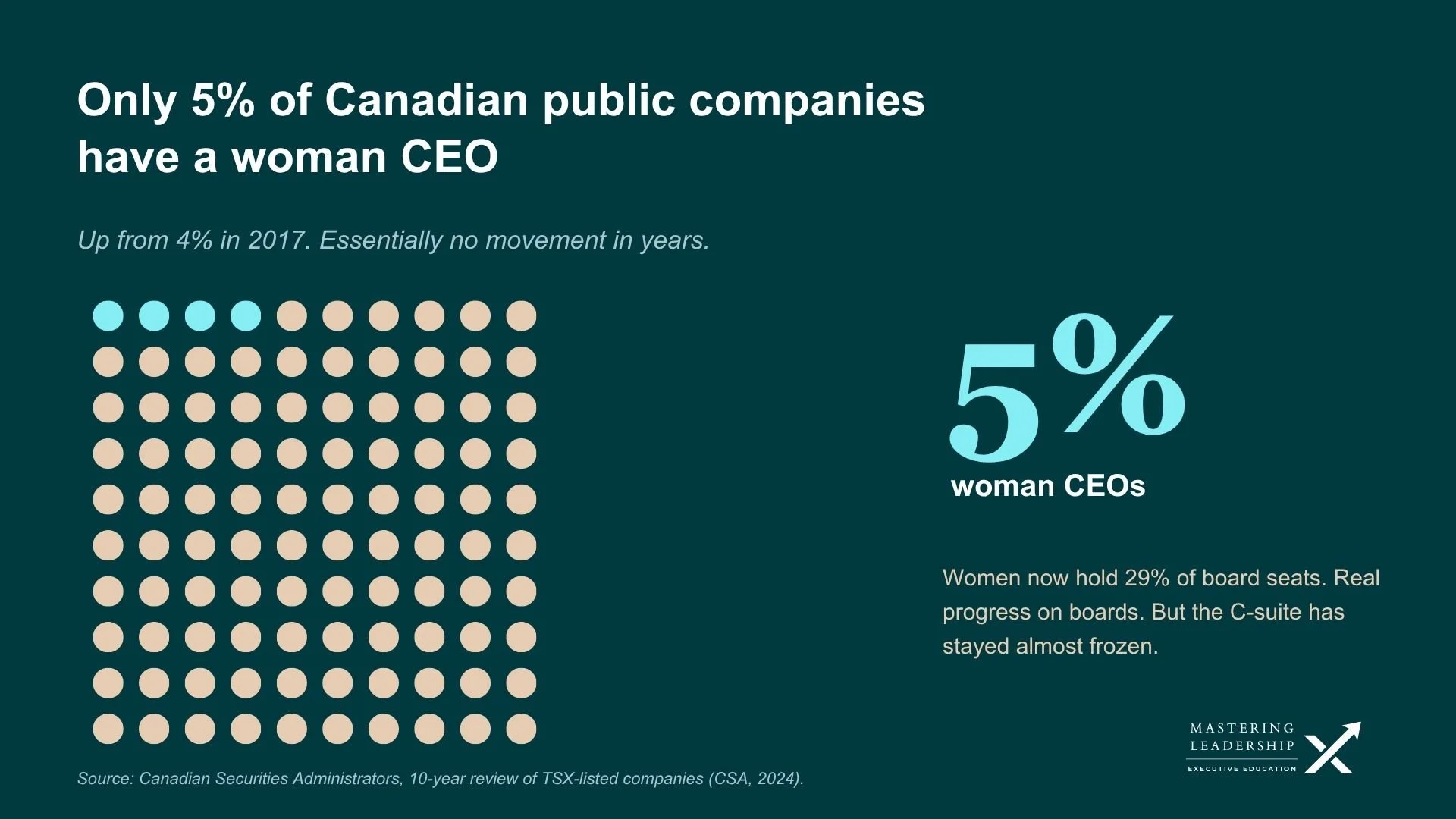
Let's start with what the data shows. The stats in Canada are clear. According to the Canadian Securities Administrators' 10-year review of TSX-listed companies, only 5% of Canadian public companies have a woman CEO. That number was 4% in 2017. Essentially, there has been no movement in seven years.
Women now hold 29% of board seats, which is real progress, but the C-suite has stayed almost frozen.
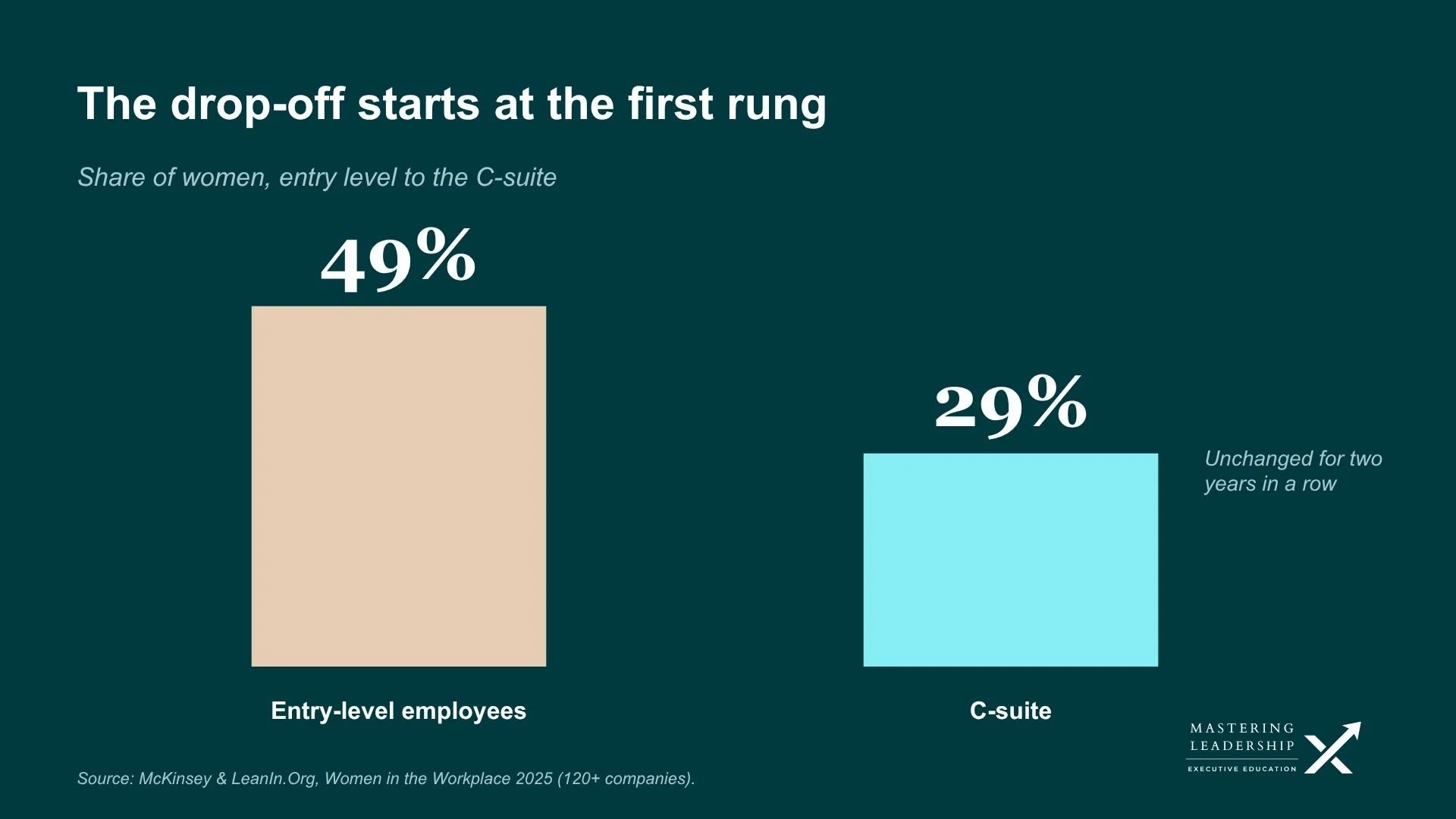
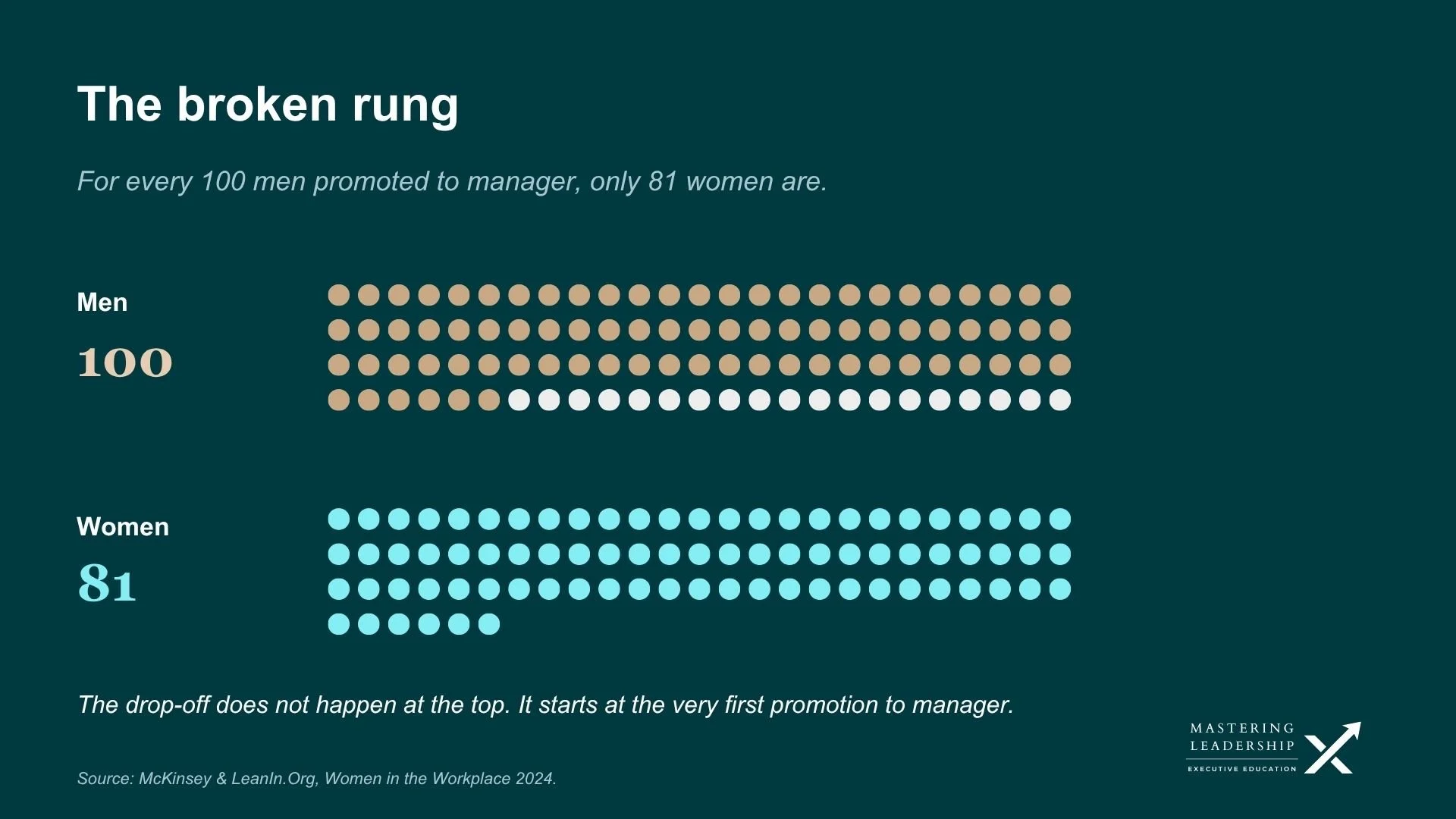
The picture at scale is the same. McKinsey's Women in the Workplace 2025 report, drawing on data from more than 120 companies, shows women make up 49% of entry-level employees and 29% of the C-suite. That C-suite number has been unchanged for two years in a row (McKinsey & LeanIn, 2025). And the broken rung, the very first promotion to manager, still has women being promoted at 81 for every 100 men.
The drop-off does not happen at the top. It starts at the first rung.
And this isn't only corporate. The same cliff shows up in academia. Women start undergrad at 51%. By the time women reach the rank of tenured full professor, that number drops to 32%. Same cliff. Different industry. The pattern is structural.
What Senior Leaders are thinking about
Beyond the data, I was curious what women leaders are thinking. In the registration survey for The Invisible Playbook, I asked one question of our attendees, all senior women across sectors: what leadership conversation do you keep having in your head but haven't had out loud yet?
Three patterns emerged.
A quarter wrote about being seen for what they actually bring, not what is on their resume. One wrote: "There are times I don't feel fully heard, even when I know the value of what I'm bringing." Another, simply: "What does the next level actually require?"
Another quarter wrote about clarity over politeness. About saying the harder, truer thing. One wrote: "We sometimes avoid hard conversations in the name of kindness, but clarity is kindness too." Another asked: "When do you challenge, when do you ignore, and when do you acquiesce?"
The largest cluster was about sustainability and the indispensable trap. One wrote: "How to be ambitious and committed to excellence without normalizing constant exhaustion." Another: "We still equate being indispensable with being effective."
Underneath all three answers, I saw the same concerns: Will I be heard? Will the next decade cost me the same as the last one?
That question is the gap between what these women already know and where the system keeps placing them.
The trail that ends
What these women are telling us is that the ambition is there, but the path is not. The data also shows the talent is there. So what is happening?
Picture a hiking trail that climbs steadily, with markers and milestones. And you climb it with the right gear and at the right pace. For the first decade, it works. You can see the woman ahead of you on the path. You can see what you need to do to keep moving. And then, somewhere past the tree line, the trail just ends. No sign. No reroute. Just a drop.
That is what senior women are walking into. They have done the work. They have hit the markers. They have earned the trust. And the path they were promised stops being a path.
The playbook they were given was clear: be good, work hard, support others, wait your turn. And it worked, for the first stretch. Then, at the senior level, it stops working. Not because they stop doing it. Because the rules of the game change at the top, and no one tells them.
Most respond by training harder. The logic is reasonable. If more effort got me here, more effort should get me there. So they double down. They take on the stretch assignment. They accept the project nobody wants. They become the indispensable one. They lead the working group, write the strategy deck, and pick up the work the senior men have stopped doing.
None of it moves them.
And here is what the numbers do not capture, but the women living it carry every day. The exhaustion. The slow erosion of the question, is this worth it? The conversations in the parking lot. The senior woman who quietly leaves. The other ones who stay but stop trying.
The temptation in that moment is to read the wall as your own failure. So you try harder. You jump through more of their hoops to prove you deserve more.
Here is what I want to say out loud.
Working hard and waiting to be recognized for it is, at its core, a submissive posture. It is waiting for permission to claim your power.
Where the playbook actually starts
The reality is that when women push, systems and cultures that were not built for us push back. The research calls this backlash. And the science of backlash is more brutal than the word suggests.
It works through a mechanism called prescriptive stereotyping. Descriptive stereotypes say what women ARE: warm, caring, communal. Prescriptive stereotypes say what women SHOULD BE. When a woman behaves in ways that violate the prescription, when she takes credit, claims authority, negotiates assertively, asks for the role, she is not just acting in an unexpected way. She is breaking a rule the system silently enforces. The penalty is automatic and rarely conscious. Lower likability ratings. Lower hireability scores. Less sponsorship. Less airtime in the meeting. Less benefit of the doubt the next time the room makes a call about her (Rudman & Glick, 2001; Heilman & Okimoto, 2007).
This is what women are experiencing when they push. Not a single big rejection, but a thousand small calibrations. None of it can be pointed at as proof. All of it adds up.
And here is what the science makes clear. The punishment is not for what she did. It is for who she is being while doing it.
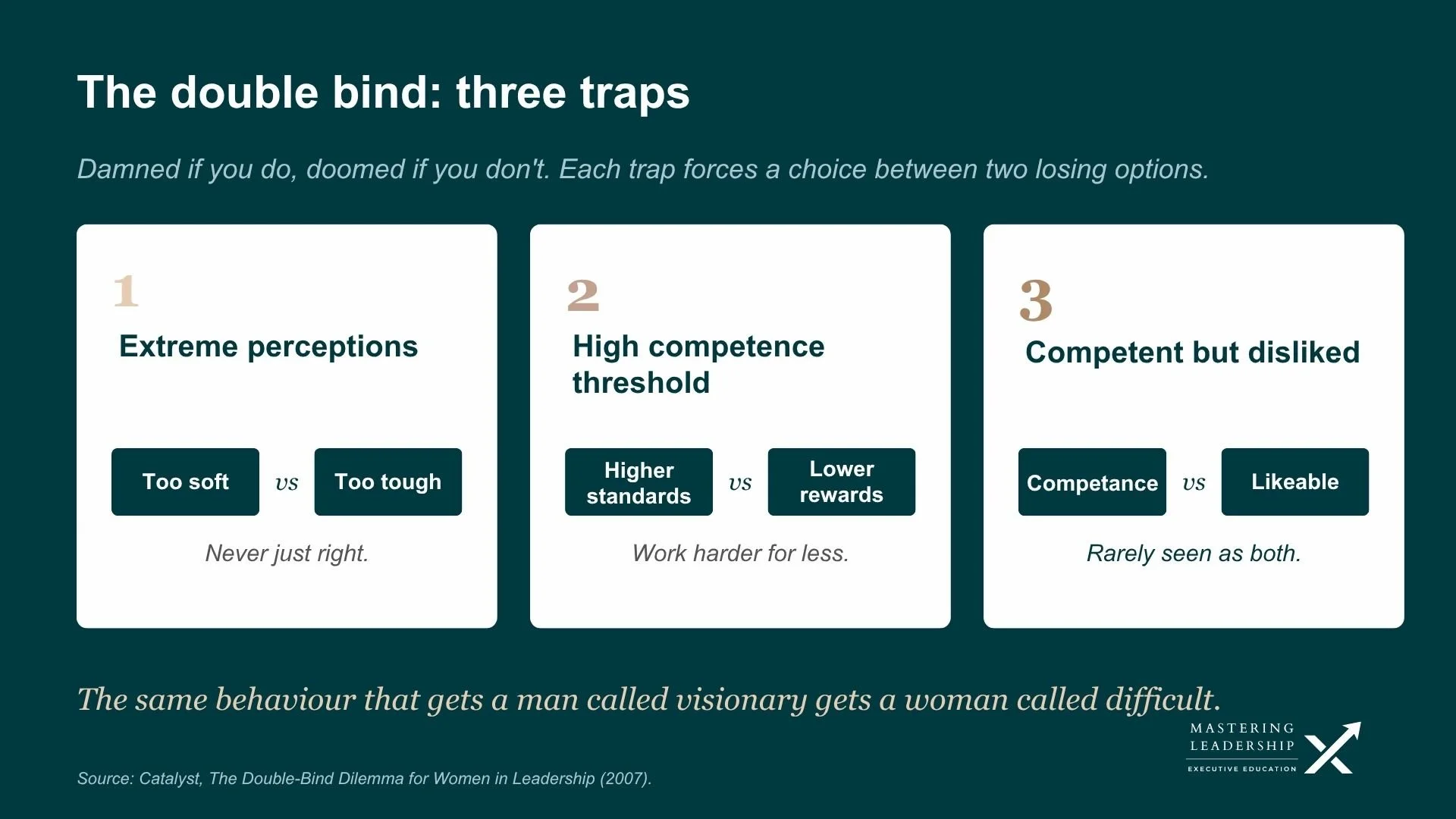
For women in leadership, this prescription takes three specific shapes. Catalyst's classic 2007 research on the double-bind dilemma named all three:
Extreme perceptions. Too soft or too tough. Never just right.
The high competence threshold. Higher standards, lower rewards.
Competent but disliked. You can be seen as competent, or you can be seen as likable. Rarely both.
The script doesn't just ask you to perform. It asks you to perform an impossible role, and then blames you when you cannot make it work.
The same behaviour that gets a man called visionary gets a woman called difficult.
Look at every entrepreneur, every CEO, every founder who has ever built something that mattered. They take risks. They go against the grain. They get told no. And they keep going. That is the behaviour the system rewards at the top. It is also the behaviour women are punished for on the way up.
The trap is that you cannot arrive without first breaking the script.
The script is what made the trail look like a path.
What I see across the senior women I work with is a consistent pattern. The women who break through are not the ones who refine the male script. They are the ones who stop running it. They step off the trail.
What they trade it for is something we have been taught not to trust. The relational. Listening. Empathy. Reading the room. Seeing talent before it announces itself. Networks built quietly, in the hallway, over coffee, with care.
The very things women have been taught are a weakness turn out to be the source of their power. What the system tries to train out of women is what builds them.
The real playbook
The research has been catching up to this for years. Herminia Ibarra's classic work at INSEAD documented something women have always known and rarely been credited for: we have always built rich informal networks (Ibarra, 1997). The coffee chats. The texts. The introductions. The quiet check-ins. For decades, this was dismissed as gossip rather than strategy.
More recent research shows that women with strong inner circles of other senior women are significantly more likely to land senior roles (Yang et al., 2019). Not because the relationships are nicer, but because that inner circle carries information, sponsorship, and warnings the formal networks do not. The networks women were taught were "just relationships" have always been the architecture of power.
At the core, relationships turn walls into doors.
But individual relational power is only half the playbook. The women who change the system don't just claim power. They give it away. The playbook is not just about claiming your own power. It is also about using it to open doors for the women behind you.
The first move is empowering yourself. Doing the hard, uncomfortable work of breaking the male script, trusting your own voice, and finding the rooms that are built for you.
At The Invisible Playbook, this is what Kim Roseborough-Darling named as her practical strategy: the Double D's, Delegate and Decline. Kim has built and sold businesses, walked into a partnership at Deloitte, and held every role a life asks of you while doing it. Her line for the room: you do not need to be everything to everyone, and that is okay. Saying no is not a retreat. It is a claim on what you choose to be present for.
And it is what Fatima Israel named when she described walking into rooms knowing she will be underestimated and using it as leverage. Fatima went from director to CMO without ever holding a VP title, by building relationships that turned into sponsorship and refusing to apologize for what makes her different. Her line that stayed with the room: power is in their underestimation. Own what makes you different. Use it as a filter to find the rooms that are right for you.
The second move is empowering other women. Real sponsorship, not mentoring. Putting your name behind theirs in rooms they are not in. Naming them for the role. Making the introduction. Sending the warning.
This is what Yasmin Pallan has built at Scotiabank Wealth Management: a structural sponsorship program that delivers numbers most firms only talk about. 100% retention. 85% career movement. 65% of those moves upward. Yasmin's panel insight on how the relational architecture actually works: learn to tell the difference between those who ask about your cup because they want to fill it, and those who ask because they want to take from it. Networks are not all the same. The Architect knows which is which.
These two moves are not the same thing. You can be excellent at one and absent on the other. Map them as axes, and you get four positions.
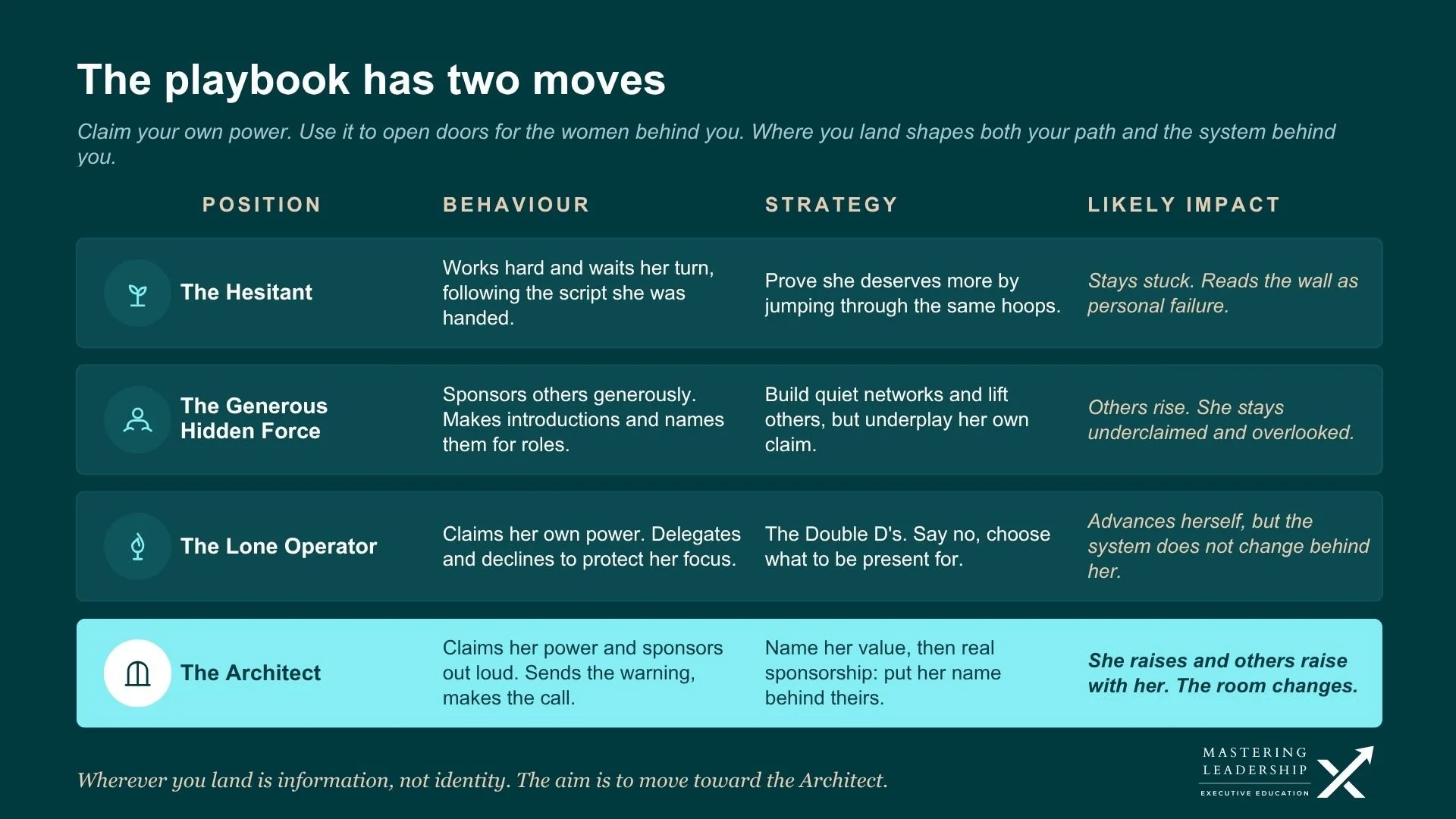
Each quadrant produces a different outcome. The Hesitant stays stuck. The Lone Operator advances herself but leaves the system unchanged behind her. The Generous Hidden Force lifts others while staying overlooked. The Architect does both, and the system shifts.
Wherever you land today is information, not identity. The aim is to move toward the Architect quadrant.
While the room was never built for you. No amount of trying harder is going to change that. The playbook you were given was not written for the lead role. The real playbook, the invisible playbook that will get you to where you want to go is not a secret being kept from you. It is the one you write for yourself, and for the women you bring with you.
Trust yourself to build what you need. Then turn around and build it for someone else. The rooms women are now building, like the one we built for The Invisible Playbook, are proof that the architecture works when it is both.
Name one woman in your life. Reach out to her this month. That is how rooms become networks. That is how networks become powerful.
I will keep building these rooms. I hope you will build them too.
Questions to sit with
Some questions to sit with honestly. Answer the version you would only say out loud to another woman, not the version you'd give in an interview.
On your relationship to power: When you think about claiming power for yourself, what is the first feeling that shows up? Hesitation. Discomfort. Apology. Name it, understand it, and then challenge it.
On your network: Map the five people you would call about your next career move. How many of them have the power to put you in the room where the decision is being made? If the answer is none, that is the gap to close.
On the difference between relationships and access: Are you building relationships, or are you building access? Connection and access are not the same thing. Relationships are about being known. Access is about who carries your name into rooms you cannot yet enter.
On getting access: Who already has access to the rooms you want to be in? Have you asked any of them to bring you in? If not, what would you say to them this month?
On sharing access: Whose name is on your lips when you are in a senior room, and they are not in? Name three women you have sponsored in the last year. If you cannot name three, who would be on that list by the end of next year?
On becoming an Architect: What would the Architect version of you look like in twelve months? Who would be in your network? Whose names would you be carrying? What would you have stopped waiting for?
MLX designs evidence-based leadership programs for organizations seeking to advance more women into senior leadership. If that is the work you are trying to do, let's start a conversation.
References
Canadian Securities Administrators. (2024). Report on the 10-year review of women on boards and in executive officer positions. CSA Staff Notice 58-318. https://www.securities-administrators.ca/
Catalyst. (2007). The double-bind dilemma for women in leadership: Damned if you do, doomed if you don't. Catalyst Inc. https://www.catalyst.org/research/the-double-bind-dilemma-for-women-in-leadership-damned-if-you-do-doomed-if-you-dont/
Heilman, M. E., & Okimoto, T. G. (2007). Why are women penalized for success at male tasks? The implied communality deficit. Journal of Applied Psychology, 92(1), 81-92. https://doi.org/10.1037/0021-9010.92.1.81
Ibarra, H. (1997). Paving an alternative route: Gender differences in managerial networks. Social Psychology Quarterly, 60(1), 91-102. https://doi.org/10.2307/2787014
McKinsey & Company, & LeanIn.Org. (2025). Women in the Workplace 2025. McKinsey & Company. https://www.mckinsey.com/featured-insights/diversity-and-inclusion/women-in-the-workplace
Rudman, L. A., & Glick, P. (2001). Prescriptive gender stereotypes and backlash toward agentic women. Journal of Social Issues, 57(4), 743-762. https://doi.org/10.1111/0022-4537.00239
Yang, Y., Chawla, N. V., & Uzzi, B. (2019). A network's gender composition and communication pattern predict women's leadership success. Proceedings of the National Academy of Sciences, 116(6), 2033-2038. https://doi.org/10.1073/pnas.1721438116