Proactive Leadership at Scale: From "Why Not" to "How Yes"
The fastest way to lose your best talent is to keep telling them what they can't do.
In an earlier piece, I wrote about proactive versus reactive leadership at the individual level. This one is about what happens when reactive leadership becomes the culture of an entire senior team. The pattern is far more durable than most CEOs realize.
In firms where the best people leave, the pattern shows up as turnover. In firms where they do not, it shows up as slowness, missed handoffs, and ideas that die in the layer between the floor and the leadership table. Same pattern. Different symptom.
This piece walks through what it takes to shift it. The research on why these cultures form and rarely reverse on their own. The reckoning senior leaders have to do before the work can begin. The five habits they have to confront once it does. And the one question that begins to change the room.
I want to tell you about a CEO I have been working with for the past year. He runs a large financial services firm. The numbers are good. The reputation is good. The talent on his bench is among the strongest in the industry.
And the culture is killing him.
Every initiative his business units propose is routed through three layers of approval. Each layer has its own version of "here's why this can't work..." Risk has a reason. Legal has a reason. Operations have a reason. By the time an idea lands back with the business unit head, what started as an opportunity is now a memo. By the time the memo gets approved, the opportunity has moved on.
He has the bench. He doesn't have the speed. And in the eighteen months before we started working together, three of his highest-potential business-unit leaders left for competitors. The exit interviews said the same thing in different words. "I had ideas. The system kept telling me no."
His best people are walking out the door, and the culture his senior team is producing is the reason why.
The fear-based culture he walked into
What he was inheriting wasn't just bureaucracy. The previous CEO had ruled from fear. He used unpredictability, public humiliation, and punishment as control mechanisms. By the time he left, the senior leadership team had learned the same lesson every team learns under that kind of leader. Keep your head down. Don't take risks. Say what you need to say to survive the meeting. Disengage from anything that doesn't have a clean path to survival.
That kind of learning is durable. Martin Seligman's foundational work documented what happens when people experience repeated punishment they cannot avoid or predict. They stop trying. They learn that effort and outcome are disconnected. That learning persists even after the conditions that produced it have changed (Seligman, 1972). The senior team had spent years under a leader who made engagement dangerous. By the time the new CEO arrived, the disengagement was so deep that most of the senior leaders no longer recognized it as such. It just felt like how things were.
The "why not" default wasn't only structural. It had become how people protected themselves.
What proactive leadership actually is
Before going further, it is worth being precise about what the CEO was trying to install. "Be proactive" is the most common thing senior leaders are told and the least useful instruction they receive. The phrase means nothing without naming the posture it is meant to replace.
Proactive leadership is not a personality trait. It is not optimism. It is not the absence of risk discipline. It is a specific operating posture in which the senior layer treats problems as system-level conditions to be designed for, rather than events to be managed when they arrive.
Three components hold it together.
The first is root cause rather than event-driven. A reactive leader investigates after the failure. A proactive leader designs the conditions that catch the failure earlier, or that make it less likely in the first place. The same incident produces two different responses and two different organizations a year later.
The second is system-level rather than person-level. A reactive leader, faced with a missed handoff between two units, addresses it as a performance issue with the people involved. A proactive leader, faced with the same handoff, asks what made the missed structure likely, and redesigns the structure. The performance conversation might still happen. It is no longer the whole intervention.
The third is strategic time rather than reactive time. A reactive leader's calendar is set by what arrives in the inbox. A proactive leader's calendar is set by the two or three structural moves the firm needs them to make this quarter. Everything else is delegated, declined, or designed out.
The default is reactive. Every individual reason for that is rational. The arriving problem is concrete, and the strategic move is abstract. The arriving problem has a named requester, and the strategic move does not. The arriving problem will be visible if it gets dropped, and the strategic move will be invisible if it gets delayed. Loss aversion does the rest. The senior leader who handles the inbox is rewarded by every signal the day produces. The senior leader who closes the inbox to think structurally has to wait months to know whether the bet was right.
The default tilts even harder in highly regulated, high-consequence environments. When the regulatory failure is the thing the firm cannot have, the senior layer overweights protection and underweights design. The cost is not visible as a single decision. It accumulates as slowness, missed handoffs, and ideas from the front line that die in the layer between the floor and the leadership table. The CEOs of those firms feel it as a drag they cannot point at, and the question their senior teams quietly ask back is the right one: How do we actually do this in a complex environment built for the opposite?
That question is the work.
The year nobody believed him
He came in with a clear vision. He saw the bureaucracy. He saw the three layers of approval. He saw the "why not" default that had quietly been draining speed from the firm for years. He named it out loud, repeatedly, in front of his leadership team. He told them he was going to change it.
At first, nobody believed him.
That part is worth sitting with. CEOs announce culture changes constantly. Most of those announcements don't survive the first quarter. The leadership team at this firm had been through enough of those cycles to know that the smart move was to nod, agree in public, and continue operating as before. They had seen the script before. They knew how it ended.
He kept saying it. Every leadership meeting. Every quarterly review. Every interaction where the answer to a business unit's pitch defaulted to "no." He named the pattern. He asked the room to think differently. He brought consequences when senior leaders blocked initiatives without offering a path forward. He didn't blink.
A year in, things had started to shift. Pockets of the organisation had started to feel the difference. Initiatives that would have been killed eighteen months earlier were getting designed. Business unit heads were bringing bigger ideas to the senior table. Mid-level talent that had been quietly looking elsewhere was starting to lean back in.
But not every part of the firm was experiencing it the same way. Some teams were being ripped apart by the transition. Senior leaders who had spent their careers being rewarded for raising objections suddenly found that behaviour was no longer landing the way it used to. They felt exposed. Their teams felt the strain. Morale in some pockets dropped. Not everyone was happy.
That was the texture of the firm when he brought us in.
The mandate came through HR. The CEO needed his top-down messaging reinforced where it actually had to land, in the room with his senior team. We were brought in to lead an L&D reset, classroom-based, designed for the VP cohort across Canada and the United States. The brief was direct. Challenge the existing culture out loud. Get every senior leader in the room to look at their own role inside it. Give the team the language and structure to do what the CEO had been pushing for a year on his own.
The hardest moment in the work
When we walked into the first sessions, the resistance was visible.
People wanted to believe him. They had been told the firm would operate differently. They had even seen pockets of it start to work. But the bodies in the room had spent years protecting themselves under the previous CEO, and the new instruction had not yet reached the part of them that decides how to behave when an idea hits the table. They wanted the new firm. They were still operating in the old one.
The early conversations were about pushing and fighting back. Senior leaders who had been carrying the weight of the old system felt as though they were being asked, in front of their peers, to give up the very thing that had made them successful. Some were tired. Some were angry. Some were quietly checking out, considering whether this was the firm they wanted to be at for the next chapter of their careers.
The desire to disengage was real. I want to name that directly. Cultural change at the senior level isn't only hard for the people resisting it. It is also hard for the people who have already made the shift personally and are looking around wondering whether anyone else is going to catch up.
The hardest moment in the work came when the senior leaders had to look at something honestly.
Their disengagement had been a choice.
Not a fully conscious one. But a choice they had made over years, in small accumulating decisions, to protect themselves from a leader who had made it dangerous to do otherwise. The previous CEO produced the conditions. The senior leaders produced the response. That response had then become the culture.
Here is what they had to face. At the senior level, you are not a victim of the culture. You are the culture. Every meeting where you raised an objection without offering a path forward, you produced the culture. Every initiative you blocked because you were tired or burned or politically exposed, you produced the culture. Every time you defaulted to "why not" to protect yourself, you produced the culture.
The "How Yes" work could not begin until the senior leaders had named this out loud. That they had a hand in building the culture they were now being asked to dismantle. That their disengagement was a choice, even if it had once been a wise one. That they were active culture makers, not passive recipients.
That naming was the precondition. After that, the room changed.
The fear started to drop. Leaders stopped feeling scared to push back. They stopped performing alignment. They started having real conversations about what was working and what wasn't.
The five habits they had built into the culture
Underneath the agency reframe were five specific reckonings the senior team had to work through before the "How Yes" shift could actually take hold.
Firefighting as the senior layer's default mode. The senior team had no strategic time. Every day was inbox, escalation, calibration call, exception review. There was no space to think structurally because the structural work never had a slot in the calendar. This was not a time-management problem. It was a leadership-design problem. The senior leaders had let themselves become the firm's escalation layer, and as long as they stayed there, nothing else they wanted to change was going to move. There is no room to engineer good failure when you are running between fires. There is no room to delegate when you are the one already in the work. There is no room to be on the front line when your day is set by the next escalation. There is no room to question the process when the process is the only thing keeping the day from collapsing. The "How Yes" work could not start until the senior leaders made the harder decision to step out of the operational pull, hold the line on calendar time for design work, and accept that the inbox would suffer in the short term so that the firm could move differently in the long term.
Failure as a personal flaw rather than a process issue. The senior team had spent years in a culture where failure had been punished as character. They had learned to avoid it at all costs. They had also learned to avoid the smaller failures that produce learning, the ones that compound into capability over time. The "How Yes" work required them to relearn what failure was for. Not as a thing to survive. As a thing to engineer. Visible enough that the team could learn from it. Contained enough that it didn't destroy what mattered. Until the senior leaders made peace with that, they were always going to default to the answer that prevented small failures and produced the larger one of stagnation.
The delegation excuse. For years, the senior team had complained that their direct reports didn't have the capacity to take on more. The complaint was true at the surface. The teams below them had not grown into the capability the senior leaders said they wanted. But the senior leaders had to look at why. They had not delegated. They had not given their teams the stretch assignments. They had not built the space in which their direct reports could grow into who the firm needed them to be. The capacity gap they kept naming was a gap they had helped produce by holding everything close. The leaders had to own that. The team below them was not going to develop into the talent they said the firm needed unless the senior leaders gave them the space to grow into it.
The front-line relationship. The previous CEO's fear-based regime had created a senior layer that managed up and ignored down. The senior leaders had stopped knowing what their front-line teams actually saw, knew, or needed. Their information about the firm came filtered through three layers of people protecting themselves. The "How Yes" shift required them to return to the front line, build real relationships, listen to what was actually happening, and treat that information as more reliable than what the political filter produced. Most of them had not had a real conversation with a front-line employee in two years. That changed.
Going along because it was easier. For years, every senior leader had been going along with the bureaucracy because it was easier than challenging it. The approval chain was painful but predictable. The default "no" was lazy but safe. Nobody had been questioning whether the process they were operating within was still producing the outcome it was originally designed for. The senior leaders had stopped asking that question years ago. Their silence had been part of what kept the bureaucracy alive. The "How Yes" work required them to start asking it again, out loud, in rooms where the answer might mean dismantling something they had been quietly maintaining for years.
These five reckonings were the work underneath the work. The "How Yes" question is easy to say. Living inside the firm in a way that makes it real requires the senior leaders to look honestly at what they had been doing to keep the old culture intact. That self-reflection was hard. It was also the point.
The two harder questions
After those reckonings, the senior leaders weren't finished. They were now sitting with two questions that were even harder than the agency work that came before.
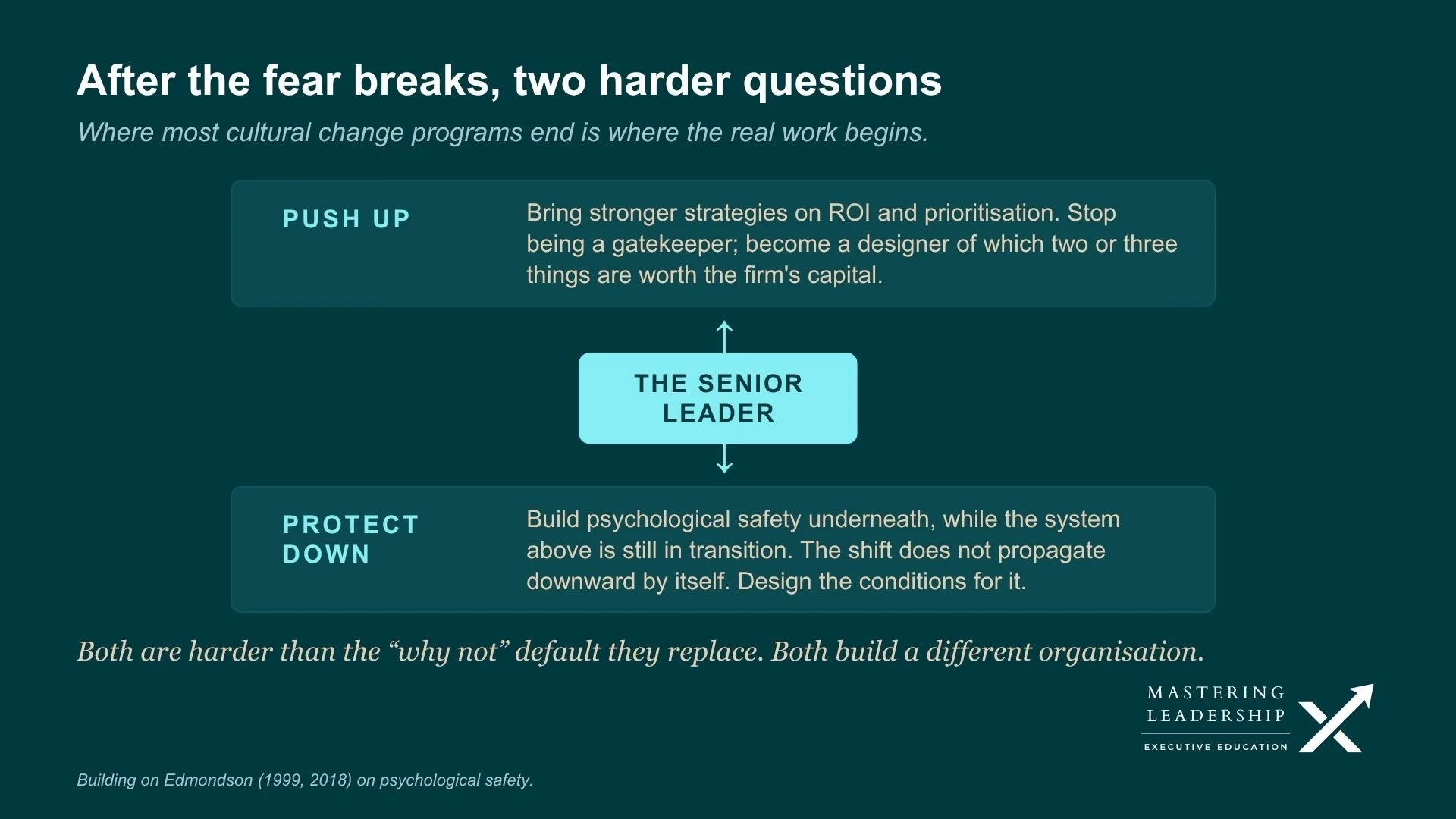
The first was about the layer beneath them. How do I protect my team and create psychological safety underneath them, while the system above is still in transition? The shift the CEO is driving doesn't propagate downward on its own. Senior leaders have to design the conditions in which their direct reports can take risks, surface mistakes, and bring ideas without bracing for the old version of the response.
The second was about the layer above them. How do I push up with stronger strategies on ROI and prioritisation? When the senior leader stops being a gatekeeper and starts being a designer, the relationship with executive leadership changes. The conversations are no longer about whether to approve. They are about which two or three things, of the many possible, are worth the firm's capital this year.
Both questions are harder than the "why not" default they replaced. They also produce a different organisation.
Why these cultures almost never reverse on their own
This pattern isn't character. It's incentive layered on top of learned fear.
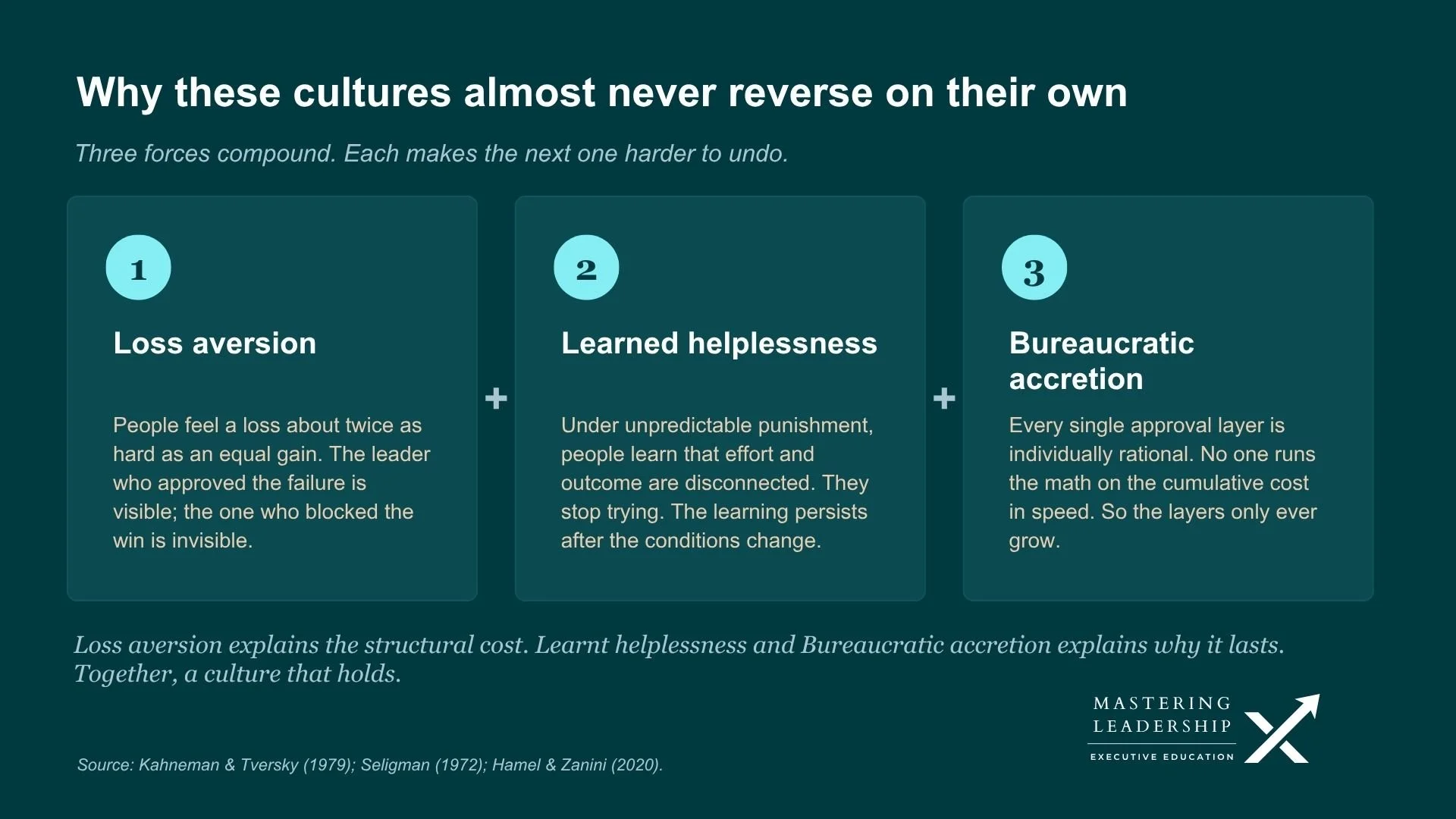
The behavioural economics research on loss aversion is decades old. Kahneman and Tversky documented that people feel losses roughly twice as much as they feel equivalent gains (Kahneman & Tversky, 1979). In organisations, that asymmetry becomes structural. The senior leader who approved the failed initiative is visible. The senior leader who blocked the successful one is invisible.
Now add a previous CEO who punished visible failure unpredictably. The asymmetry isn't just structural anymore. It is wired into the nervous system of the senior team. The safer career move is to be the person who raised the objection. Not the person who took the risk.
Gary Hamel has written about the structural side of this for years. Bureaucracy doesn't grow because anyone wants more of it. It grows because every individual reason for adding a layer of approval is rational, and no one ever runs the math on what it has cost in cumulative speed (Hamel & Zanini, 2020). What Hamel describes is the structural cost. What Seligman describes is what makes the structural cost durable. Together they explain why these cultures, once they form, almost never reverse on their own.
The CEO of the firm I am working with is doing what almost never happens. He is reversing it. Slowly. Consistently. Without blinking.
What "How Yes" actually looks like
A "How Yes" culture isn't a culture without risk management. It isn't a culture where the senior team rolls over for every business-unit pitch. It's a culture where the default sequence is reversed.
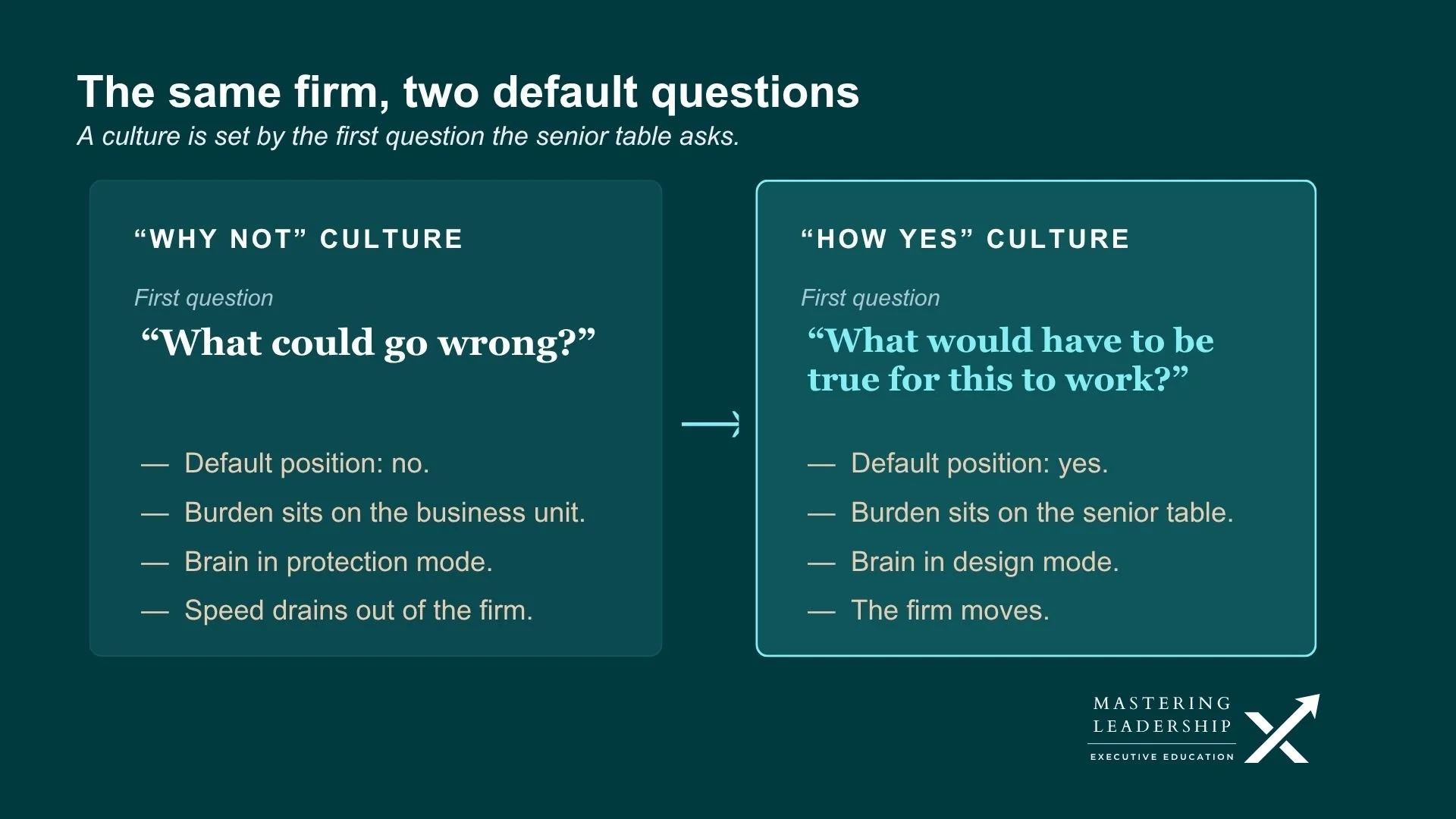
In a "Why not" culture, the first question is "What could go wrong?" The default position is no, and the burden is on the business unit to overcome it.
In a "How Yes" culture, the first question is "What would have to be true for this to work?" The default position is yes, and the burden is on the senior team to surface the structural constraints and design around them.
That is a different conversation. It is also a different organisation.
Amy Edmondson's research on psychological safety has documented for two decades what happens when this shift takes hold (Edmondson, 1999, 2018). Teams move faster because they aren't relitigating their right to act. Failures get surfaced earlier because nobody is hiding them. Successes compound because the muscle of trying things gets exercised, not atrophied.
The CEO I am working with doesn't need different people. He needs his senior team to ask a different first question.
The one question that changes the framework
Here is what we gave the company.
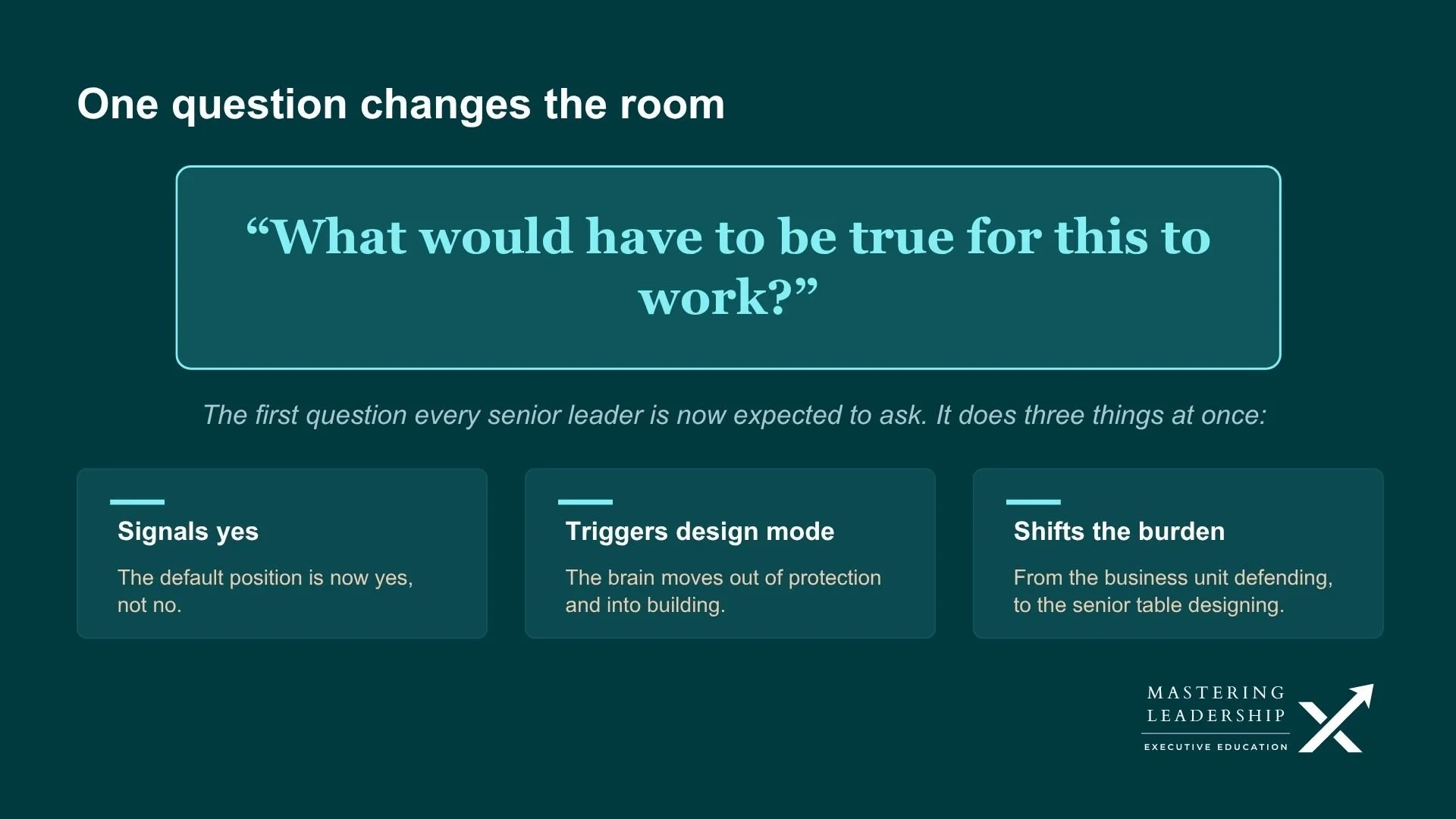
When a business unit brings an initiative to the senior table, the first question every senior leader at the table is now expected to ask is: "What would have to be true for this to work?"
Not "What's the risk?" Not "What could go wrong?" Not "Have you cleared this with risk and legal?"
"What would have to be true for this to work?"
That sentence does three things at once. It signals the default position is yes. It puts the senior leader's brain into design mode, not protection mode. It shifts the burden of the conversation from the business unit defending the idea to the senior table designing the conditions under which the idea succeeds.
It is also a sentence that protects against bad ideas. If the answer is "We'd have to violate our regulatory framework," the conversation is over fast. If the answer is "We'd need a different way to track exposure in real time," you now have a project, not a rejection.
The shift is plain to anyone running a senior team in a regulated environment. When the person on the floor brings an idea, the senior layer's job is to take it and drive it, or to name precisely what would have to be true for it to work. Not to dismiss it.
Where "why not" cultures actually live
Junior people don't produce "Why not" cultures. Senior people do.
Junior people show up full of ideas and short on permission. They learn quickly to bring ideas only when they think the senior person in the room will say yes. The "Why not" default lives at the senior layer, and it cascades down.
The fastest way to lose your best talent is to keep telling them what they can't do. In firms where the talent does not leave, the cost shows up instead as slowness, missed handoffs, and front-line ideas that never reach the leadership table. Different symptom, same bill.
The CEO I am working with knew this when he came in. His bench was strong but his culture was reactive, and the talent walked out before he had a chance to change it.
His bench was strong. His culture was reactive. The talent left.
One question worth sitting with
If you are a CEO or a senior leader reading this, here is the question worth sitting with.
When was the last time you watched one of your senior leaders say yes to an ambitious business-unit pitch in the first conversation?
If you can't remember, your culture is "Why not?" And the best people on your bench already know it. If your people don't leave, your bench is paying the same cost in a different currency.
The next move is yours.
MLX is the firm I built to do this work with CEOs and senior teams.
The Leadership Trust Audit maps where the trust, agency, and engagement gaps actually live across your senior layer. It tells you which leaders have made the shift, which are still operating from the old playbook, and where the cultural transition is at its hardest. The work that follows targets that pattern, not the one the org chart implies.
Individual and team coaching is where senior leaders do the harder reckonings: failure as learning, the delegation of work, the front-line relationships, the questioning of processes they had been quietly maintaining for years. The shift from "why not" to "how yes" doesn't happen by command. It happens through the work each senior leader does on their own posture, and on their own team.
Structural design is what makes the change durable. We help install the processes, the calibration prompts, and the metrics that keep the new culture self-sustaining once the CEO is no longer in every meeting reinforcing it.
If you're a CEO trying to move your senior team from "why not" to "how yes," or a senior leader trying to do that work with stronger strategy and a team you can actually grow into, let's start a conversation. The first call is thirty minutes to map where your team sits and what the next move would look like.
References
Edmondson, A. C. (1999). Psychological safety and learning behavior in work teams. Administrative Science Quarterly, 44(2), 350-383. https://doi.org/10.2307/2666999
Edmondson, A. C. (2018). The fearless organization: Creating psychological safety in the workplace for learning, innovation, and growth. Wiley.
Hamel, G., & Zanini, M. (2020). Humanocracy: Creating organizations as amazing as the people inside them. Harvard Business Review Press.
Kahneman, D., & Tversky, A. (1979). Prospect theory: An analysis of decision under risk. Econometrica, 47(2), 263-292. https://doi.org/10.2307/1914185
Seligman, M. E. P. (1972). Learned helplessness. Annual Review of Medicine, 23(1), 407-412. https://doi.org/10.1146/annurev.me.23.020172.002203