Trust at Scale: The Invisible Playbook for Architects
Most leadership development for women is built on a blueprint that doesn't work. That's a strong claim. The data will back it up.
In 2017, 4% of Canadian public companies had a woman CEO. Seven years later, the number is 5%. One percentage point of movement across seven years (CSA, 2024). Over those same seven years, an industry of women's leadership programs ran. Mentorship initiatives. Inclusion training. Pipeline panels. Sponsorship pilots. The programs ran. The numbers didn't move.
If you're a CHRO or an L&D leader, you paid for those programs. If you're a senior woman, you've been inside them, or watched the women in your network end up in them. Either way, you already know what I'm about to say. The blueprint we've been working from is wrong.
This piece is about the right one.
It's the third in a series. The Invisible Playbook named the system that produces the cliff senior women keep hitting. Why Senior Women Cannot Stop Performing named what running that system does to a woman's nervous system over a decade. This one is about what comes next. What the women who actually make it to the C-suite track while they do it. What their organisations build behind them. And what an Architect, the rarest of the four positions I named in the first piece, is actually constructing when she stops performing and starts designing.
Three things come up across the rest of this piece. First, the structural design that produces real sponsorship instead of performative mentorship. Second, the personal architecture of strategy, visibility, and trust capital that gets a senior woman legible to the people who decide. Third, the measurement infrastructure that proves either of those is working, before another seven years pass with no movement.
I'll give you scripts too. Things you can actually say. Things you can ask for. Most of this work doesn't fail at the strategy level. It fails because no one ever told you the words to use when the moment arrived.
Here's where we start.
Why mentorship was the wrong blueprint
Mentorship is the most-measured intervention in women's leadership development. It's also the one that produces the highest satisfaction scores and the smallest movement in advancement.
That should worry you.
Look at how organisations measure their mentorship programs. The dashboard is the same everywhere. Number of pairs formed. Hours logged. Attendee satisfaction. Scope of conversations. Those are real numbers, but they're the wrong ones. They measure whether the program is running. They don't tell you whether anything is changing.
Here's what would. Promotion rate of mentees relative to a matched comparison group. Retention rate of mentees post-program. Pay parity within the mentee cohort. Movement into roles with profit and loss responsibility. Those are the metrics of advancement. And those are the metrics that almost never move when mentorship is the intervention.
The research is clear. Mentorship offers advice. Sponsorship spends political capital. Mentorship is necessary but not sufficient. Sponsorship correlates with a 22 to 30 percent advancement premium over mentorship alone (Hewlett & Sherbin, 2010; Hewlett, 2013). Ibarra, Carter, and Silva said the same thing in different words. Men still get more promotions than women in the same organisations, with the same performance ratings, supported by the same number of mentors. The difference is whether someone with power is actively advocating for the promotion in rooms where the decision is being made (Ibarra, Carter, & Silva, 2010).
So here's the question. If you're running a mentorship program and your senior women aren't moving into senior roles at materially higher rates than the comparison group, you're not running an advancement program. You're running a vanity program. The difference is what you're tracking.
Here's a script. When the L&D conversation in your organisation is about adding another mentorship cohort, the question to put on the table is: "What outcome would tell us at two years out that this program is working? And what are we willing to redesign if those numbers don't move?" If no one in the room can answer, you know the budget you're approving is for compliance.
Followership is the rung that breaks first
Sponsorship is the right lever. It doesn't work in a vacuum.
Before a senior leader sponsors someone, they have to recognise her as ready. That recognition is built through followership. And women's followership gets read differently than men's.
The research on followership has been around for decades. Robert Kelley named the active follower in HBR in 1988 as someone who thinks critically, takes initiative, supports the mission, and challenges upward when the mission requires it (Kelley, 1988). Barbara Kellerman and others extended this. The followership-to-leadership transition is where most people get tested, and where most get stuck (Kellerman, 2008; Uhl-Bien et al., 2014).
It's also where senior leaders form the impressions that later become sponsorship decisions. When a junior or mid-career professional challenges the strategy, surfaces the bad news, takes initiative without being asked, supports peers in ways that strengthen the unit, that's what senior leaders point to when they say "she's ready for more."
Here's the part that rarely makes it into corporate leadership development conversations.
The same followership behaviour is coded differently when a woman does it.
The research on implicit followership theories has shown that when men engage in exemplary followership, the behaviour reads as leadership readiness (Sy, 2010; Carsten et al., 2010). When women do the same, it reads as conscientiousness, team-player-ness, or reliability. The challenge that marks a man as ready to lead can mark a woman as difficult. The initiative that gets a man on the partner track can get a woman labelled as overstepping.
By the time the conversation in the senior room is about who to sponsor, a lot of the women who have been doing exemplary followership work have already been priced out of the consideration set. The readiness signal never registered for them.
McKinsey's "broken rung" sits exactly here. The director-to-VP transition, where the largest pipeline loss happens, is where the followership recognition transition lives. The metric doesn't move because the recognition never happens.
What an Architect builds at this layer isn't coaching for women on how to be followed. It's calibration prompts that target followership signals explicitly. It's sponsorship pairing that starts at the followership layer, before the recognition gap has done its damage. It's mid-career development aimed at the broken rung specifically, not at the cusp of senior promotion.
Here's a script for the senior woman reading this. If you want your followership work to register, name it as forward signal, not effort. "I led the team through that pivot because I think we're going to need to do it again at scale next year. Here's what I learned that I'd carry forward." That is followership coded as leadership readiness. "I worked really hard on that project" is followership coded as conscientiousness. The work is the same. The framing decides which version makes it into the room.
What sponsorship actually is
Once the recognition layer is functioning, sponsorship can do its work. Here's what differentiates a real sponsor from a mentor who has been given the wrong label.
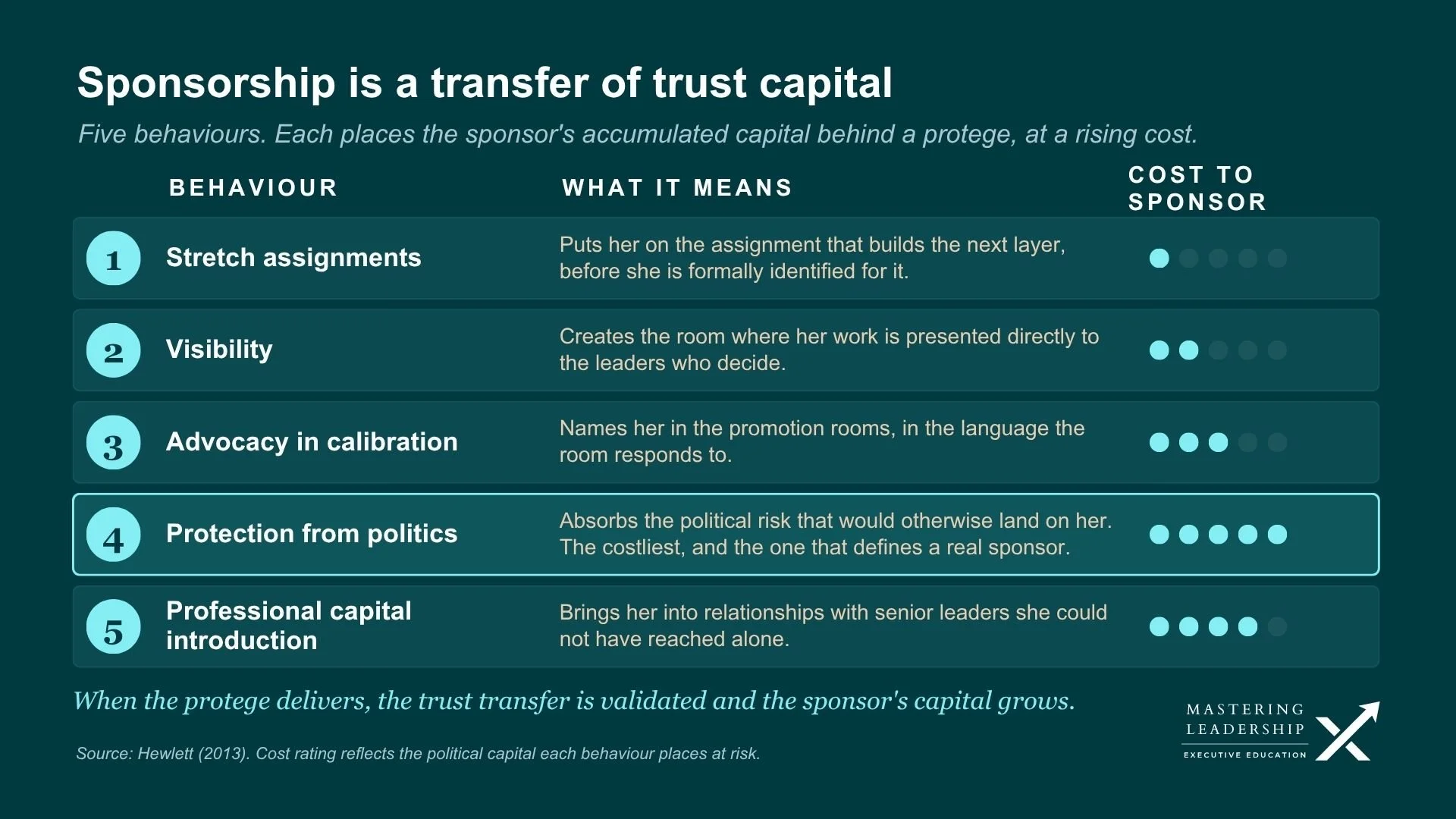
Hewlett's research mapped five sponsorship behaviours (Hewlett, 2013).
Stretch assignments. The sponsor puts the protégée on the assignment that develops the next layer of her capability, before she has been formally identified for it.
Visibility. The sponsor makes the protégée's work visible to the senior leaders who decide. Not by talking about her. By creating the room where her work is presented directly.
Advocacy in calibration. The sponsor names the protégée in the rooms where promotion decisions are made and argues for her in the language the room responds to.
Protection from politics. The sponsor absorbs or deflects the political risk that would otherwise land on the protégée. This is the costliest behaviour for the sponsor, and the one that most differentiates real sponsorship from advice.
Professional capital introduction. The sponsor brings the protégée into relationships with senior leaders the protégée couldn't have reached on her own.
What unites the five is the same underlying move. The sponsor extends trust to the protégée at scale. He or she is placing accumulated trust capital, the reputation built over years of delivery and judgement, behind the protégée in rooms she's not in.
That's the frame most sponsorship writing misses. Sponsorship isn't a service. It's a transfer of trust capital from someone who has accumulated it to someone the system hasn't yet caught up to.
When the protégée delivers, the trust transfer gets validated. The sponsor's capital grows. The system updates its read. When the protégée doesn't deliver, the sponsor's capital shrinks. That's why most senior leaders mentor but don't sponsor. Mentorship costs them an hour. Sponsorship puts their accumulated capital at risk.
An Architect knows this. She decides whose name she's willing to put her capital behind. She does it deliberately, not reactively. She also tracks it. Not how many people she mentors. How many people she has sponsored, what positions they've moved into, and what the trust transfer has produced over time.
Here's a script. If you're a senior woman trying to convert a mentor into a sponsor, the words are: "What I'm asking for is different from advice. I'd like you to put my name forward when the [role] conversation comes up. Here's what you'd be backing. And here's the upside for the firm if you do." That's what asking for sponsorship sounds like. Anything softer is asking for more mentorship.
Strategy, visibility, and the trust capital that holds it all up
The structural side of this piece is about what organisations build for the women coming behind. The personal side is about what the senior woman herself builds to become the person who can be sponsored, named, chosen for the room.
Three things sit at this layer. Strategic thinking. Framed visibility. Accumulated trust capital. The third is the currency that lets the first two compound.
What true strategy actually looks like
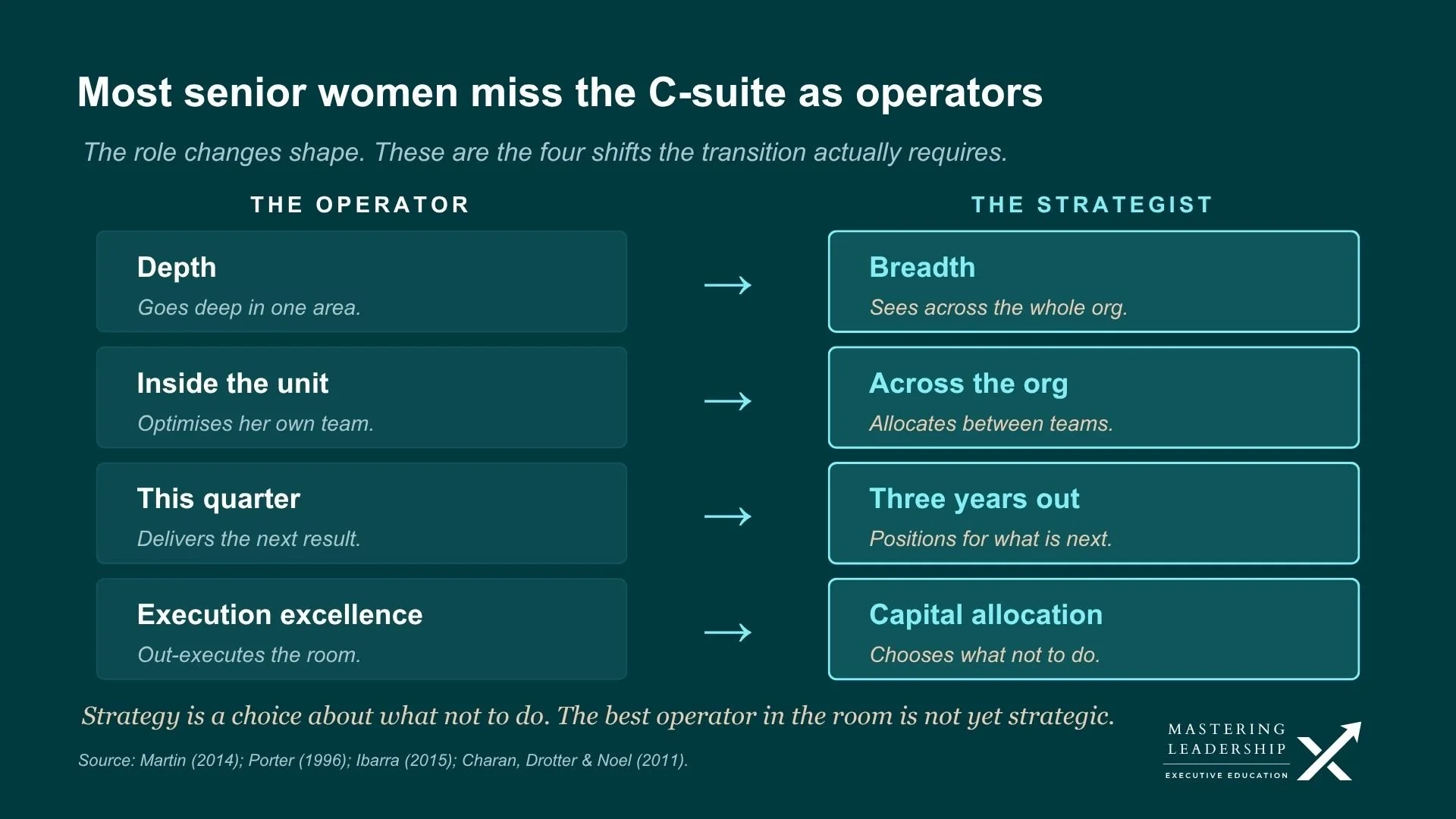
Most senior women miss the C-suite not because they aren't capable. They miss it because they're still operating like operators when the role they want requires strategists. Those are different jobs.
Roger Martin's work on strategy named the distinction. Strategy is a choice about what not to do (Martin, 2014). Michael Porter said it the same way decades earlier. Strategy is about positioning, not operational excellence (Porter, 1996). The senior leader who out-executes everyone in the room is not yet strategic. The strategic leader is the one who has decided which problems are worth solving and which aren't.
Herminia Ibarra documented the specific shifts required to make this transition. The leader who has succeeded at one level often fails at the next because the role has changed shape, and the muscles that produced the earlier success aren't the ones the next role requires (Ibarra, 2015). Charan, Drotter, and Noel mapped the same transition across the leadership pipeline. Going from senior leader to enterprise leader requires a different way of seeing the firm, not a more intense version of what got you the previous promotion (Charan, Drotter, & Noel, 2011).
The specific shifts: from depth to breadth, from inside the unit to across the org, from this quarter to three years, from execution excellence to capital allocation.
Most senior women miss the transition because they were promoted for execution. The system rewarded them for being the best operator in the room. When the next promotion requires them to stop operating and start strategising, no one tells them. The same hypervigilance the second piece in this series named keeps them executing when they should be choosing.
Here's what an Architect tracks at this layer. The percentage of her week spent on portfolio decisions versus operational ones. Meetings where she sets the agenda versus responds to it. Decisions that span the firm versus her unit. Nobody hands her this dashboard. She keeps it herself. She looks honestly at whether her week looked like the week of a strategist or like the week of the best operator in the room.
Here's a script. When a request comes in that would have you operating instead of choosing, the line is: "Walk me through how this connects to the [strategic priority] we set last quarter. If we can't draw that line, I'm not the right person to take this on." That's a strategic decision said out loud. The first three times you say it, your nervous system will spike. By the tenth time, it won't.
Framing wins to the people who matter
The visibility piece is harder than it sounds because of the documented double bind. Women get penalised for self-promotion in ways men don't (Rudman & Glick, 2001). Bowles, Babcock, and Lai documented the social cost of self-advocacy that women face and men don't (Bowles, Babcock, & Lai, 2007). The standard prescription, lean in and self-promote, has a real cost that the prescription doesn't name.
The structural workaround is what Bowles called communal self-promotion (Bowles, 2012). The win gets framed as evidence of what the team and the strategy can do, not as a personal achievement. The frame protects against the backlash without giving up the visibility.
Specific moves. Lead with the business outcome, not the activity. Quantify in the language the C-suite actually uses: revenue, margin, risk, pipeline, retention. Connect the outcome to a stated organisational priority. Position the win as forward signal: what the team can be trusted to do next.
Tinsley and Ely's research on what actually moves perceptions named the same pattern. Most people get the dynamics wrong. The fix is not to tell women to be more aggressive. It's to design the framing so the work becomes legible without triggering the cost (Tinsley & Ely, 2018).
What the Architect tracks here is the language people use to describe her work back to her. Whose summary of her work is reaching the people who decide. Whether her forward signal, what she can be trusted to do next, is in those summaries.
Scripts for this one. When you walk a senior leader through a recent win, the structure is: "The team delivered [outcome] against [organisational priority]. The piece I want to flag for you is what it tells us about what's possible next. With [resource or backing], here's the version of that we could land in the next [horizon]." That is communal self-promotion in the language the C-suite trades in.
Trust capital as the actual currency
This is where the piece earns its title.
The C-suite isn't a meritocracy. It's a trust market. Strategy and visibility get you into the consideration set. Trust capital is what makes you a credible bet under pressure.
The foundational model of organisational trust is Mayer, Davis, and Schoorman's, and it names three dimensions: ability, benevolence, integrity. Those dimensions matter because they're what determine whether someone gets granted authority in a system that runs on judgement under uncertainty (Mayer, Davis, & Schoorman, 1995).
The Leadership Trust Audit framework I developed in my own research distinguishes three trust dimensions that map onto how senior leaders actually evaluate one another for advancement. Character. Credibility. Connection.
Character is whether you mean what you say. Whether you keep the small commitments. Whether you tell the truth when it's costly.
Credibility is whether you can deliver. Whether your past calls have been right. Whether your judgement holds under pressure.
Connection is whether they want to work with you. Whether you're the person they would choose to have in the room when the decision is hard.
The C-suite ascent requires all three. Character without credibility gets you trusted but not relied on. Credibility without character gets you used. Both without connection gets you respected but not chosen. The role goes to the person they want in the room with them.
An Architect builds her trust capital deliberately. On character, she keeps the small commitments, returns the email, names the bad news early, doesn't perform certainty she doesn't have. On credibility, she frames her wins so they compound, quantifies the impact, makes her track record legible. On connection, she builds the inner circle. Yang et al.'s 2019 research showed that women with strong inner circles of other senior women are significantly more likely to land senior roles (Yang et al., 2019). Two or three senior women who actually carry her name into rooms she isn't in.
Strategy is what gets you to the C-suite. Visibility is what makes the strategy legible. Trust is what compounds the two into capital that doesn't erode under pressure.
Without trust, strategy reads as ambition and visibility reads as self-promotion. With trust, both read as readiness.
Here's a script for building the connection dimension specifically. Once a quarter, the senior woman you most want carrying your name gets a message that says: "I want to keep our trust strong. I'd love a coffee where I update you on what I'm working on, hear what's on your mind, and figure out where I can be useful to you." That message does three things at once. It names the relationship as trust-based. It puts you in a posture of usefulness. And it creates the regular cadence that turns acquaintance into someone who will say your name out loud.
What the working blueprint actually tracks
The personal architecture matters. It doesn't scale on its own. The Architect's harder work is building the organisational structure that produces what individual sponsorship and trust capital produce, but at scale, for many women at once.
The research and the field experience converge on a small set of design principles. The sponsorship programs that move the senior pipeline share the same architecture, even when they're run in completely different industries.
The metric architecture comes first. The structural program that produces movement is the one that decides, before the program begins, what it will track at two years out, and is willing to redesign the program if those numbers don't move. Most programs get designed against the curriculum first and the metrics afterward. The working programs invert that order.
Three tracking layers, not one. Protégée development, measured against capability milestones, not satisfaction. Sponsor behaviour, measured against the five-behaviour framework, not hours logged. Calibration outcomes, measured against the actual promotion and movement of the protégées over the two years following the program. Programs that track only the first layer report engagement. Programs that track all three report advancement.
Sustained duration. Most working programs run nine months to a year. The transition from advice-mode to advocacy-mode requires sustained pairing. Shorter programs don't produce sponsor behaviour change at the depth required to move the metric.
A built-in advocacy phase. The design choice that most distinguishes producing programs from performing ones is a structured period where the sponsor's role shifts from development to active advocacy in rooms the protégée isn't in. Most programs don't have this phase. The programs that do produce movement at materially higher rates than the ones that don't.
The numbers that working programs produce against matched comparison groups: high retention, measurable career movement, upward trajectory over the two years after the program ends. Those are the metrics that move when the design is right. They're also the metrics that don't move when the design is wrong.
That's the difference between a sponsorship program that performs sponsorship and one that produces it. The performing programs report attendance. The producing programs report advancement.
If you're designing a sponsorship program in your organisation right now, the test of whether it will work isn't whether the curriculum feels strong or whether the matches feel good. The test is whether you have decided, before the program starts, what metrics you'll track at two years out, and whether you are willing to redesign the program if those metrics don't move.
The building codes: bias interrupters in the systems you already have
Sponsorship at the program layer is part of the answer. The other part is the design of the systems that produce day-to-day decisions about who gets hired, promoted, and assigned the work that becomes the next promotion.
Iris Bohnet's work at Harvard, in What Works: Gender Equality by Design, made the case that bias-reduction effort focused on changing minds is slow and unreliable. The data on unconscious bias training has been clear for years. It doesn't durably change behaviour. The interventions that do change behaviour are the ones that change the systems that produce the decisions, not the minds of the people making the decisions (Bohnet, 2016).
Joan Williams' work at UC Hastings extended this into specific bias interrupters that organisations can install in their existing processes (Williams & Multhaup, 2018).
The interventions that have measurable impact:
Structured interviewing. Standardised criteria and standardised questions applied to every candidate. The research base is decades deep.
Calibration meetings with explicit gender review. When performance reviews are calibrated in a meeting where the explicit question is "have we reviewed the same behaviour the same way regardless of who exhibited it?", the gap in performance ratings narrows.
Promotion process redesign. When the criteria for the next role are written down before the candidates are evaluated, the gap in promotion rates narrows. When the criteria are inferred from candidate evaluations after the fact, the gap stays.
Anti-interruption protocols in senior meetings. The data on interruption patterns in mixed-gender meetings is clear. Women are interrupted more often, and when they speak, their ideas are more often attributed to others. Explicit protocols change this measurably.
Performance review language audits. Reviews of senior women contain different language patterns than reviews of senior men with the same performance. The language is reliably softer, more focused on style than substance, more likely to emphasise communality over competence. Auditing the language and feeding it back to reviewers changes the patterns.
Each of these is cheap, repeatable, and measurable. Most organisations don't use them because they don't know they exist, or because the L&D conversation has been dominated by training programs that produce satisfaction but not movement.
What an Architect builds at this layer is to install these interventions in the systems that already exist, and to track their impact. Not to redesign the culture. To redesign the decisions.
This is the work that compounds. Sponsorship moves the women in the program. Bias interrupters change the system the program is operating in. The two together produce the kind of movement that doesn't require another seven years of running the same programs and watching the numbers refuse to move.
What this costs the Architect
I want to name the cost directly, because if I don't, the piece is dishonest.
Doing this work is more work. There's no version of this where the senior woman who decides to become an Architect is doing less than she was before. She's doing different work, with a different return on her time, but more work.
Here's the risk for the senior woman reading this. The pattern I named in the second piece. The helper-default. The habit of taking on every gap, smoothing every friction, becoming indispensable to every system she touches. If the unlearning work she did to step out of the helper-default ended with her stepping into a more sophisticated version of it, the unlearning didn't finish.
There's a distinction worth holding onto. Helper-default is reactive. The Architect's structural work is chosen. Helper-default is unbounded. The Architect's work is contained in specific commitments, with specific metrics, on a specific time horizon. Helper-default is the work she does forever. Architecture is the work she does once.
The energy economics matter. A senior woman who has built a sponsorship program with the right metric architecture has done a year of intentional work that will move many women's careers for the next decade. A senior woman who has been carrying the helper-default for the same period has done a year of unbounded work that has moved no one's career and exhausted her own.
That's why an Architect tracks her own time the same way she tracks the structural metrics. Where is her capital going. What is it producing. What is the return on the structural investment versus the return on the ad hoc helping.
There will be days when she doesn't want to do this work. The work continues to operate on those days because the structures she built don't require her presence to keep running. That is the whole point of building them.
What it costs the organisation that ignores this
The case for inaction has run out.
The senior woman attrition numbers across industries are clear. McKinsey and LeanIn's Women in the Workplace 2025 report documented that women, especially women of colour, continue to leave senior roles at higher rates than men in matched comparison groups (McKinsey & LeanIn, 2025).
The replacement cost of a senior leader is in the range of 150 to 200 percent of annual salary, depending on the role and industry. That is the direct cost. It doesn't include the lost productivity during the transition, the institutional knowledge that walks out, or the disruption to the teams the departing leader was leading.
The cascade effect compounds the cost. When a senior woman leaves an organisation, the mid-career women in that organisation reconsider their own trajectories. The research has documented that the visible departure of senior women produces a measurable spike in mid-career women's intent to leave. The pipeline doesn't just lose the senior woman. It loses the women she was making the case to.
The reputational cost is the slowest and the most expensive. Junior women evaluating where to build their careers read the senior layer of an organisation before they accept the offer. When the senior layer is thin or visibly attriting, the best candidates self-select out before the recruiter ever knows they were considering.
McKinsey's Diversity Wins research has made the business case repeatedly. Organisations with more diverse senior leadership outperform organisations without it on profitability, innovation, and resilience under stress (McKinsey, 2020).
The case isn't that this is the right thing to do. The case is that it's the most expensive thing organisations are still doing.
If you're a CHRO reading this, the question is whether the cost of inaction has crossed the threshold where the design work becomes a board-level priority, or whether it's still being filed under L&D programming with a six-figure budget and no metric expectation.
What I see, ten years from now
The seven years from 2017 to 2024 produced a one-point movement in the senior leadership number. The next seven years will be different.
Not because the system will fix itself. It has had two decades to fix itself, and it hasn't. The next seven years will be different because the women who got past the cliff are starting to turn around and rebuild the rung underneath them. Because more CHROs are willing to track the metrics that actually move careers. Because the design work to move the number is sitting in this piece, available to any leader who wants to do it.
Two questions worth sitting with.
The first is for the senior woman. What is one structural move you can make this quarter that wasn't on your calendar before? Not another mentorship hour. A specific bias interrupter you can install. A specific protégée whose name you can put in a specific room. A specific commitment that will outlast your presence in the building.
The second is for the CHRO. What is one program in your portfolio that is reporting attendance instead of advancement? And what are you willing to redesign about it in the next ninety days?
The next number isn't written. We're writing it now.
This series has named three layers of work. The Invisible Playbook named the system that produces the cliff. Why Senior Women Cannot Stop Performing named the cost of running that system for too long. This piece named what the Architect builds when she stops performing and starts designing.
MLX is the firm I built to do all three layers with you. Our engagements work each one in sequence, and we track every layer against the metrics that move.
The Leadership Trust Audit is our proprietary diagnostic that maps Character, Credibility, and Connection across your leadership team. It identifies where the recognition gap is widening, where the followership-to-leadership transition is breaking down, and where the trust capital is thin. It produces a dashboard of your trust architecture before any redesign begins, so the work that follows targets the gap that actually exists, not the one the L&D budget assumes.
Individual and team coaching is the personal layer. It is where the senior women on your bench unlearn what the system has cost them, deliberately build their trust capital, and become legible to the people who decide. We measure the work against the trust dimensions and against career movement, not against satisfaction.
Structural design and program build is the system layer. We design sponsorship programs based on metrics that correlate with advancement, not those that correlate with attendance. We install bias interrupters in the systems that already exist. We build the calibration prompts that surface followership readiness before the recognition gap does its damage. And we track every layer of the work against the metrics that prove the system is moving.
If your organisation has been running women's leadership programs and the senior numbers have not moved, the gap is almost never the curriculum. It is the metric architecture and the system underneath. That is what MLX is built to redesign.
For CHROs, L&D leaders, and senior women ready to design for movement rather than for programming, let's start a conversation. The first call is thirty minutes to map where your organisation sits on the three layers, and what the next structural move would look like.
References
Bohnet, I. (2016). What works: Gender equality by design. Harvard University Press.
Bowles, H. R. (2012). Claiming authority: How women explain their ascent to top business leadership positions. Research in Organizational Behavior, 32, 189-212. https://doi.org/10.1016/j.riob.2012.10.005
Bowles, H. R., Babcock, L., & Lai, L. (2007). Social incentives for gender differences in the propensity to initiate negotiations: Sometimes it does hurt to ask. Organizational Behavior and Human Decision Processes, 103(1), 84-103. https://doi.org/10.1016/j.obhdp.2006.09.001
Canadian Securities Administrators. (2024). Report on the 10-year review of women on boards and in executive officer positions. CSA Staff Notice 58-318. https://www.securities-administrators.ca/
Carsten, M. K., Uhl-Bien, M., West, B. J., Patera, J. L., & McGregor, R. (2010). Exploring social constructions of followership: A qualitative study. The Leadership Quarterly, 21(3), 543-562. https://doi.org/10.1016/j.leaqua.2010.03.015
Charan, R., Drotter, S., & Noel, J. (2011). The leadership pipeline: How to build the leadership powered company (2nd ed.). Jossey-Bass.
Hewlett, S. A. (2013). Forget a mentor, find a sponsor: The new way to fast-track your career. Harvard Business Review Press.
Hewlett, S. A., & Sherbin, L. (2010). The sponsor effect: Breaking through the last glass ceiling. Harvard Business Review Research Report.
Ibarra, H. (2015). Act like a leader, think like a leader. Harvard Business Review Press.
Ibarra, H., Carter, N. M., & Silva, C. (2010). Why men still get more promotions than women. Harvard Business Review, 88(9), 80-85.
Kellerman, B. (2008). Followership: How followers are creating change and changing leaders. Harvard Business School Press.
Kelley, R. E. (1988). In praise of followers. Harvard Business Review, 66(6), 142-148.
Martin, R. L. (2014). The big lie of strategic planning. Harvard Business Review, 92(1/2), 78-84.
Mayer, R. C., Davis, J. H., & Schoorman, F. D. (1995). An integrative model of organizational trust. Academy of Management Review, 20(3), 709-734. https://doi.org/10.5465/amr.1995.9508080335
McKinsey & Company. (2020). Diversity wins: How inclusion matters. McKinsey & Company.
McKinsey & Company, & LeanIn.Org. (2025). Women in the Workplace 2025. McKinsey & Company. https://www.mckinsey.com/featured-insights/diversity-and-inclusion/women-in-the-workplace
Porter, M. E. (1996). What is strategy? Harvard Business Review, 74(6), 61-78.
Rudman, L. A., & Glick, P. (2001). Prescriptive gender stereotypes and backlash toward agentic women. Journal of Social Issues, 57(4), 743-762. https://doi.org/10.1111/0022-4537.00239
Sy, T. (2010). What do you think of followers? Examining the content, structure, and consequences of implicit followership theories. Organizational Behavior and Human Decision Processes, 113(2), 73-84. https://doi.org/10.1016/j.obhdp.2010.06.001
Tinsley, C. H., & Ely, R. J. (2018). What most people get wrong about men and women. Harvard Business Review, 96(3), 114-121.
Uhl-Bien, M., Riggio, R. E., Lowe, K. B., & Maslyn, J. M. (2014). Followership theory: A review and research agenda. The Leadership Quarterly, 25(1), 83-104. https://doi.org/10.1016/j.leaqua.2013.11.007
Williams, J. C., & Multhaup, M. (2018). For women and minorities to get ahead, managers must assign work fairly. Harvard Business Review.
Yang, Y., Chawla, N. V., & Uzzi, B. (2019). A network's gender composition and communication pattern predict women's leadership success. Proceedings of the National Academy of Sciences, 116(6), 2033-2038. https://doi.org/10.1073/pnas.1721438116