Scaling Leadership Impact: Strategies, Stories, and Lessons from the Best
Leadership is not about doing it all; it's about enabling others to succeed and amplifying your team's collective impact. As John Maxwell famously said, "If you want to do a few small things right, do them yourself. If you want to do great things and make a big impact, learn to delegate."
Scaling as a leader requires prioritization, delegation, and an unwavering focus on what truly matters. But here's something most leadership advice glosses over: none of these strategies work without trust.
Delegation without trust is just offloading. Prioritization without trust creates confusion, not clarity. And developing leaders in a low-trust culture? You're just training people to play it safe.
In this first part of a two-part series, we'll explore the practical strategies for scaling leadership impact (delegation, prioritization, and talent multiplication) and show how trust is the invisible thread running through all of them. In Part 2: The Trust Multiplier, we'll go deeper into the science of trust and give you a self-diagnostic to identify exactly where your leadership is bottlenecked.
The Power of Delegation: A Leadership Superpower
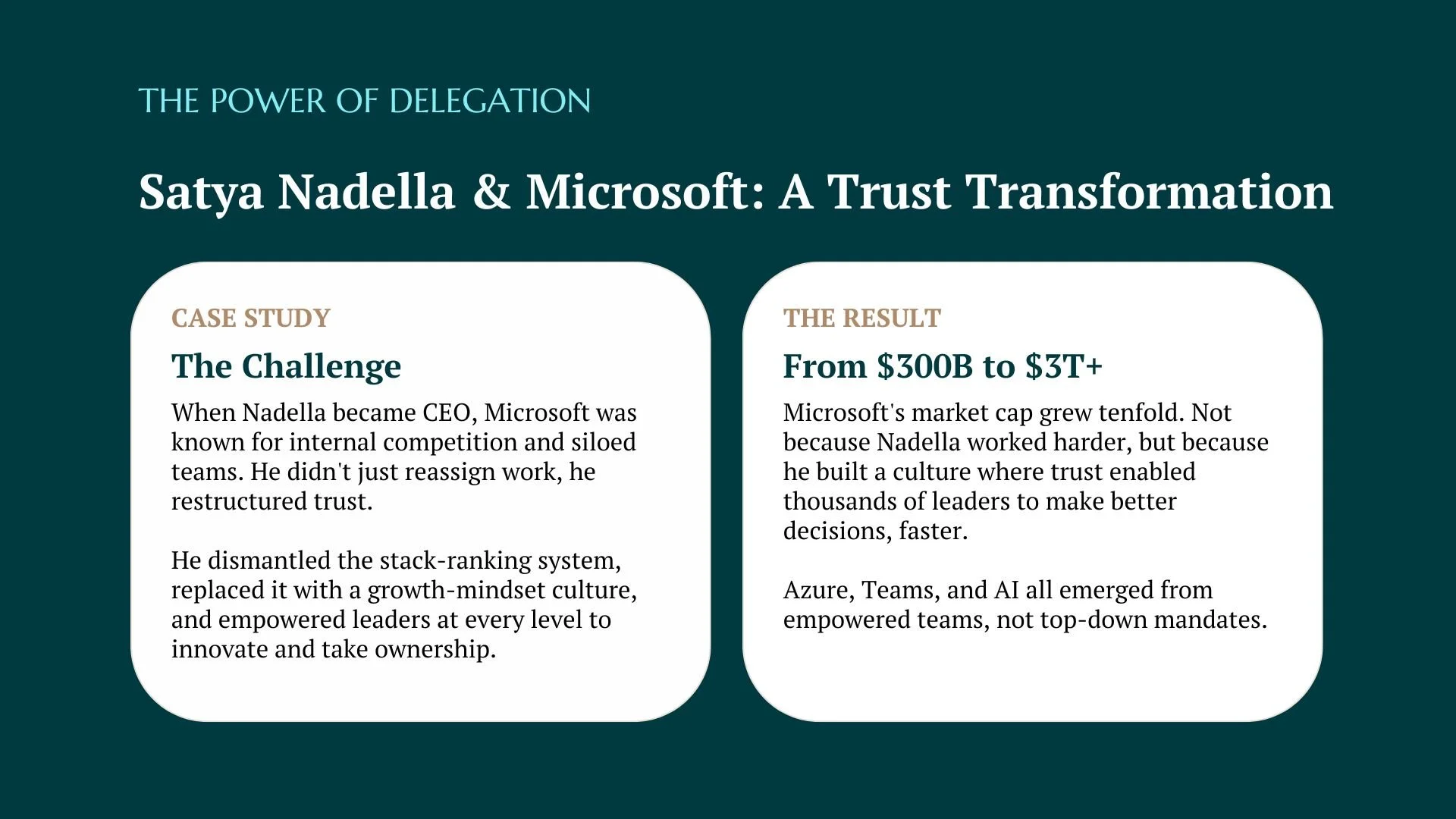
One of the most significant shifts leaders must make is recognizing that they can’t do everything themselves. Delegation is not a sign of weakness; it’s a sign of trust and strategic thinking. Consider the example of Satya Nadella, CEO of Microsoft, who transformed the company by fostering a culture of empowerment. Nadella’s focus on trust and autonomy enabled leaders at every level to innovate and take ownership, driving groundbreaking advancements such as Microsoft Azure’s expansion.
Three Keys to Effective Delegation
Identify what doesn't require your unique expertise.
Ask yourself honestly: "Can someone else do this as well or better than me?" For most of your calendar, the answer is yes. The work that truly requires you is narrower than you think. It’s strategic direction, key relationships, and cultural tone-setting.
Empower with resources and authority.
Half-delegation, handing off the task but keeping the decision rights, actually erodes trust. It signals that you don't trust your team's judgment. Give people real authority alongside the responsibility. This creates a culture of accountability and ownership.
Provide clarity, then step back.
When delegating, clearly define expectations, timelines, and desired outcomes. Then get out of the way. The goal is agreed-upon outcomes with freedom of method, not surveillance with a deadline attached.
The Trust Thread
Delegation is fundamentally a trust practice. You're extending trust before it's been fully earned and creating conditions that validate it. Every successful delegation builds trust. Every micromanaged handoff destroys it. The question isn't "Can I trust them?", it's "Am I creating the conditions for trust to grow?"
Prioritization: Focusing on What Truly Drives Value
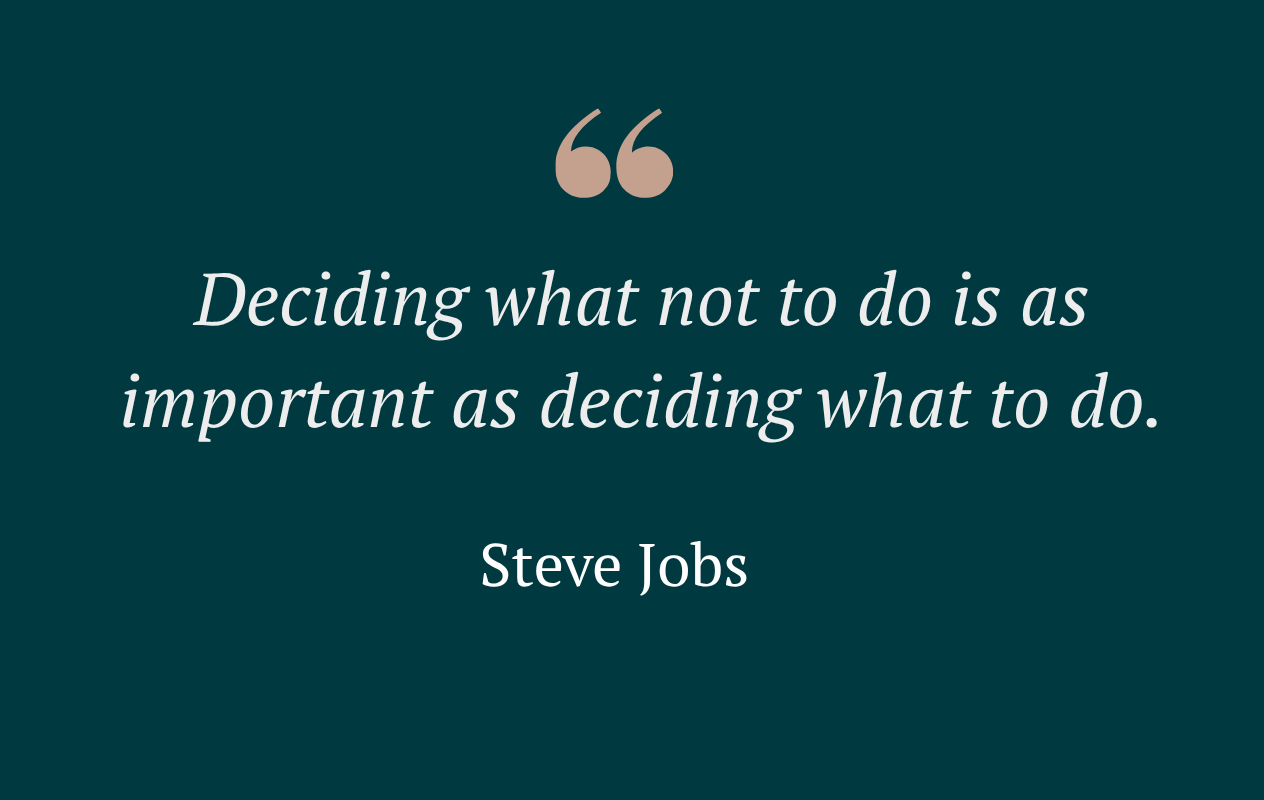
"Deciding what not to do is as important as deciding what to do."
Steve Jobs
When Jobs returned to Apple, he cut the product line from 350 to 10. That wasn't just efficiency; it was a trust signal to the entire organization: We believe in our people enough to focus them on fewer things and expect excellence. The result was innovation and market dominance that transformed an industry.
For executives, prioritization isn't about personal productivity tools. It's about organizational focus, thereby creating clarity that cascades through every level.
Three Strategies for Executive Prioritization
The Strategic Value Filter
For every initiative on your plate, ask: Does this directly advance our top 2–3 strategic priorities? If not, it's a candidate for elimination or delegation, regardless of how interesting or urgent it feels. This takes discipline, but it's the single most impactful time reclaimer for senior leaders.
The Trust-Based Time Audit
Review your calendar weekly with this lens: Am I spending time on things that only I can do, or am I holding onto tasks because I haven't built the trust systems to let go? Leaders who do this honestly often find that 40 to 60% of their time is spent on work others could own, if the trust were there.
The "What Would Break?" Test
Before saying yes to anything, ask: If I don't do this, what actually breaks? Often, the honest answer is "nothing", which means the task is a candidate for delegation or elimination entirely.
The Trust Thread
Prioritization failures are often trust failures in disguise. When you hold onto work "because it's faster if I do it myself," what you're really saying is: I haven't invested in the trust infrastructure that would let me let go. Every task you keep is a trust debt you're accumulating, and it compounds.
Building Future Leaders: Multiplying Your Impact
The ultimate test of scalable leadership isn't what happens when you're in the room, it's what happens when you're not. To truly scale, you need to invest in developing others into leaders, not just high-performing individual contributors.
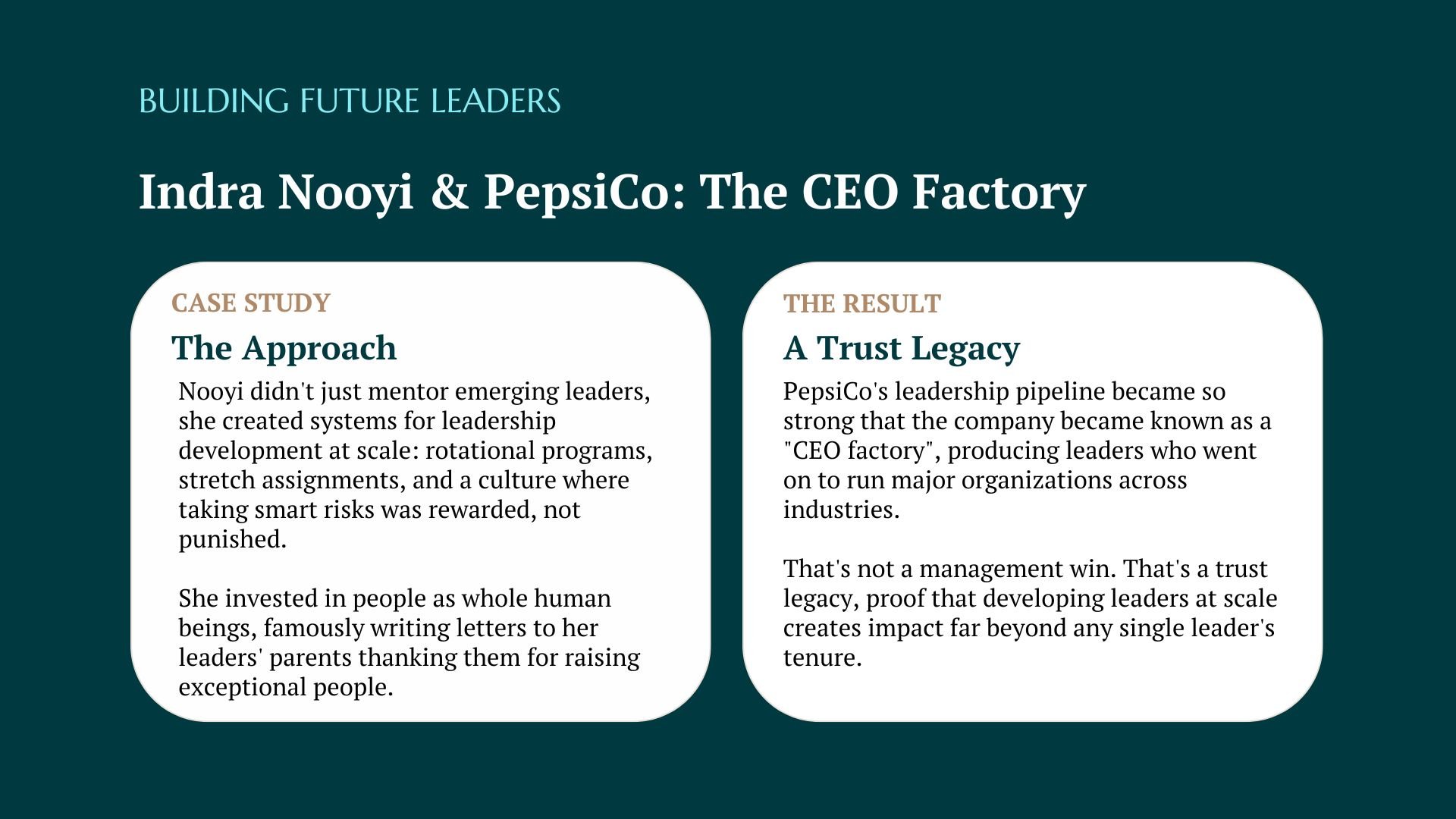
Four Steps to Develop Future Leaders
Spot potential and stretch it.
Identify team members with leadership potential and assign them stretch assignments that push beyond their current roles. The key: pair stretch with support, not sink-or-swim. People grow fastest when they feel both challenged and backed.
Mentor through frameworks, not answers.
Share your decision-making frameworks, not just your conclusions. The goal isn't to create leaders who think like you, \ it's to develop leaders who can think for themselves with the same rigor. That requires trust: trusting them to reach conclusions different from yours.
Build a feedback culture.
Foster an environment where constructive feedback flows in all directions, not just top-down. Leaders who actively seek feedback from their teams model the vulnerability that makes trust possible. When people feel safe speaking honestly, the entire organization becomes smarter.
Recognize and reward leadership behaviors.
Celebrate not just results but the behaviours that drive them: transparent communication, cross-functional collaboration, owning mistakes, and developing others. What you celebrate, you reinforce, and it becomes organizational DNA.
The Trust Thread
You can't develop leaders in a low-trust environment. People won't take risks, admit gaps, or push boundaries if they don't trust that failure is treated as learning, not career damage. The first thing you're developing is their trust in you and the organization, and then their skills.
Aligning Tasks with Strengths
Delegation becomes exponentially more effective when tasks are aligned with individual strengths. As Sheryl Sandberg emphasized in Lean In, recognizing and deploying unique talents is key to unlocking potential.
This isn't just intuition; Gallup's research shows that strengths-based management approaches can increase team engagement by up to 73%. But here's the nuance most people miss: strengths-based delegation only works when people trust that you see them clearly and care about their growth, not just their output.
How to Align Tasks with Strengths
Have real conversations. Conduct regular one-on-ones focused not just on status updates, but on understanding each team member's skills, aspirations, and what energizes them. These conversations build connection, one of the core pillars of trust.
Use assessments as a starting point, not an endpoint. Tools like the Leadership Trust Audit, CliftonStrengths, or DISC can surface useful patterns, but they're conversation starters, not labels. The insight comes from discussing results together.
Match assignments to strengths intentionally. When people work in their strengths, they need less oversight. Trust becomes self-reinforcing: they deliver better work, you micromanage less, they feel more empowered, and the cycle continues.
Tracking and Measuring Leadership Impact
Scaling your leadership isn't just about doing more; it's about making a bigger, measurable impact. Leaders like Jeff Bezos understood this: Amazon's long-term dominance was built on obsessively tracking customer satisfaction and innovation metrics, not on Bezos personally approving every decision.
What gets measured gets managed. For leaders serious about scaling, track these three categories:
Team Health: Engagement surveys, pulse checks, psychological safety scores. Are people bringing their best? Do they feel trusted?
Delegation Quality: Success rate and efficiency of delegated work. Decision velocity: How fast do decisions get made when you're not involved?
Leadership Pipeline: Internal promotion rates, succession readiness. How many people could step into expanded roles within 12 months?
Notice that all three categories ultimately measure trust. High engagement means people trust the environment. Fast delegation means you trust your team. A strong pipeline means you've built trust at scale.
Overcoming Common Barriers to Scaling
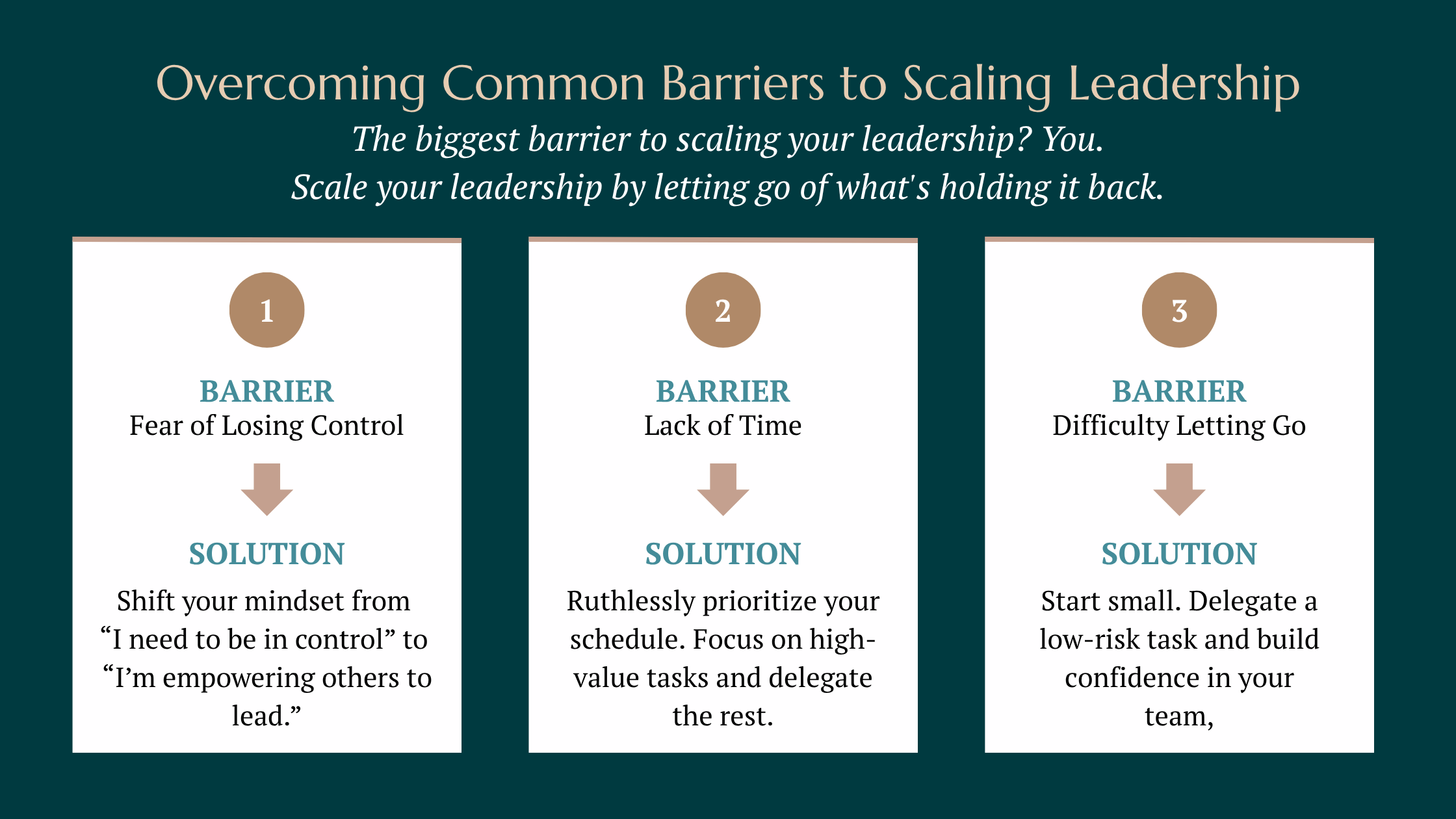
Every leader encounters resistance to scaling, often from within themselves. These barriers sound reasonable ("It's faster if I do it," "They're not ready"), but they're almost always trust gaps wearing practical disguises.
The Thread That Ties It All Together
If you've noticed a pattern in this article, that's intentional. Every strategy we've explored, from delegation, prioritization, talent development, strengths alignment, to measuring impact, depends on the same underlying capability: trust.
Delegation without trust is micromanagement with extra steps. Prioritization without trust creates anxiety, not focus. Leadership development without trust produces cautious operators, not bold leaders.
As Mark Cuban puts it, "Value is measured in the total upside of a business relationship, not by how much you squeezed out in any one deal." The same is true for leadership: your impact isn't measured by what you personally deliver, but by the collective capacity you build through trust.
The strategies in this article will get you started. But to truly scale, you need to understand why trust works at a deeper level, the science behind it, how to diagnose where it's breaking down, and how to build it systematically across your organization.
That's exactly what Part 2 is for.
Continue to Part 2
The Trust Multiplier: How the Best Leaders
Scale Impact Without Burning Out
Go deeper into the science of trust, including the Trust Equation (Credibility × Character × Connection), the neuroscience behind high-performing teams, enterprise-level scaling strategies, and a self-diagnostic to identify exactly where your leadership is bottlenecked.